
Emerging Technologies II: Robotics, Virtual & Augmented Reality – SS1 Digital Technologies Lesson Note (Third Term)
Download this term · ₦1,000Lesson note at a glance
- Subject
- Digital Technologies
- Class
- SS1
- Term
- Third Term
- Topic
- Emerging Technologies II: Robotics, Virtual & Augmented Reality
- Order
- Topic 8 of 8 this term
- Reading time
- 4 min
Robotics, virtual reality (VR) and augmented reality (AR) are emerging technologies. Robotics deals with the design, construction and operation of robots, which are machines that carry out complex actions automatically. VR is a computer-generated environment that makes the user feel inside a world that looks real. AR overlays digital information onto the real world through a camera.
Subject: Digital Technologies
Class: SS1
Behavioural objectives
By the end of the lesson, students should be able to:
- define robotics and name the three things a machine usually needs to be a robot;
- give examples of where robots are used;
- define virtual reality (VR) and explain how a VR headset works;
- define augmented reality (AR) and give common examples;
- state the main difference between VR and AR;
- discuss the effects of these technologies on jobs, cost and health.
What is robotics?
When we hear “robot”, we often think of movie characters like Terminator or R2-D2. In real life, a robot is simply a machine designed to carry out a complex series of actions automatically.
Definition: Robotics is the branch of technology that deals with the design, construction and operation of robots.
What makes a machine a robot?
To be a robot, a machine usually needs three things:
- Sensors: To “see” or “feel” its surroundings (like a camera or touch sensor).
- A brain (processor): To decide what to do based on what the sensors find.
- Actuators: The “muscles” that allow it to move (like motors, wheels or arms).
Where do we use robots?
Robots are well suited to jobs that are dull, dirty or dangerous for humans.
- In factories: Robots can weld car parts together 24 hours a day without getting tired, and with very few mistakes.
- In medicine: Surgeons use tiny robotic arms to perform very delicate operations that human hands might be too shaky for.
- In space: We send robots (like the Mars Rovers) to other planets because it is too dangerous and far for humans to travel right now.
- At home: You might have seen “Roomba” vacuum cleaners that move around a room on their own to suck up dust.
What is virtual reality (VR)?
Virtual reality, sometimes called “the digital dive”, lets you walk on the moon or swim with sharks without leaving your classroom.
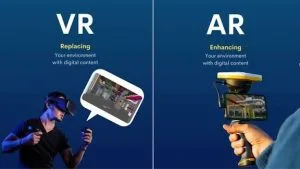
Definition: VR is a computer-generated environment with scenes and objects that appear to be real, making the user feel they are immersed in their surroundings.
How does VR work?
You wear a special VR headset (like an Oculus or Google Cardboard) that covers your eyes. The headset tracks your head movement. If you turn your head to the left, the digital world turns left too. Your brain is “tricked” into thinking you are actually inside that world.
Uses of VR
- Gaming: Playing a game where you are “inside” the action.
- Training: Pilots use VR “flight simulators” to practise flying planes before they touch a real one.
- Tourism: Visiting a museum in Paris while sitting in Lagos.
What is augmented reality (AR)?
People often confuse VR and AR, but they are different. VR replaces your world, while augmented reality (AR) adds to it. AR is sometimes called “the digital layer”.
Definition: AR is a technology that “overlays” digital information (like images, text or 3D models) onto the real world using a camera, usually on a smartphone.
Common examples of AR
- Snapchat and Instagram filters: The app sees your real face through the camera and “adds” digital dog ears or glasses to it.
- Google Maps: You can hold up your phone, and it will draw “arrows” on the actual street in front of you to show you where to walk.
- Education: You could point your phone at a page in your Biology textbook, and a 3D heart appears on your screen, beating in time.
How do these technologies affect people?
These technologies are changing the “future of work”.
- Robotics helps us do heavy and precise work.
- VR helps us experience things that are too far or too dangerous.
- AR helps us see more information about the world around us.
Important questions to think about
- Jobs: Will robots take away our jobs? They take away tasks, and humans have to learn how to fix and program the robots.
- Cost: Currently, VR headsets are expensive. As the technology grows, they will become cheaper and more available to schools.
- Health: Spending too much time in VR can cause “motion sickness” or eye strain. It is important to use these tools in moderation.
Evaluation
- Brainstorm: If your school had a robot, what is one “boring” task you would give it to do every day?
- Identify: Is a “drone” a type of robot? Why or why not?
- Compare: What is the main difference between wearing a VR headset and looking at an AR filter on your phone?
- Discussion: How could a doctor in Nigeria use augmented reality to learn how to perform a new surgery?
Assignment
- Name the three things a machine usually needs to be a robot and state what each one does.
- Give two uses of VR and two examples of AR.
- State one possible problem of using VR for too long.
This term's Digital Technologies topics
SS1 Third Term · 8 topics
- Word Processing Application
- Spreadsheets Application I
- Spreadsheets Application II
- Presentation Software
- Database Introduction
- Practical Database Management
- Emerging Technologies: Artificial Intelligence (AI) & IOT
- Emerging Technologies II: Robotics, Virtual & Augmented Reality
Get Digital Technologies as PDF and Word
Every week of SS1 Digital Technologies, Third Term, formatted and ready to print. Ad-free, and the copy lock comes off.
Get this term Card, bank transfer, USSD or OPay
Third Term Digital Technologies Lesson Notes for Other Topics

Practical Project II
Read the full lesson note.

Practical Project I
Read the full lesson note.
Past Questions Drills
Read the full lesson note.
Comprehensive Revision of SS1, 2 and 3
Read the full lesson note.

Mobile Application Development II
Read the full lesson note.

Cloud Computing II
Read the full lesson note.

Blockchain Technology
Read the full lesson note.

Cybersecurity III
Read the full lesson note.

Digital Entrepreneurship
Read the full lesson note.

Cyber Laws and Digital Rights
Read the full lesson note.

Project Work
Read the full lesson note.
Mobile Application Development I
Read the full lesson note.

Spreadsheets Application I
Read the full lesson note.
Spreadsheets Application II
Read the full lesson note.

Presentation Software
Read the full lesson note.
Lesson Notes for Other Classes

Basic 1 Lesson Note
The complete lesson note to guide your studies.

Basic 2 Lesson Note
The complete lesson note to guide your studies.

Basic 3 Lesson Note
The complete lesson note to guide your studies.

Basic 4 Lesson Note
The complete lesson note to guide your studies.

Basic 5 Lesson Note
The complete lesson note to guide your studies.

Basic 6 Lesson Note
The complete lesson note to guide your studies.
