
Computer Hardware – SS1 Digital Technologies Lesson Note (First Term)
Download Lesson NoteLesson note at a glance
- Subject
- Digital Technologies
- Class
- SS1
- Term
- First Term
- Topic
- Computer Hardware
- Order
- Topic 4 of 8 this term
- Reading time
- 3 min
Subject: Digital Technologies
Class: SS1
Introduction to Hardware
Imagine a human body. You have a brain (to think), hands (to pick things up), and a voice (to speak). A computer is similar. Hardware refers to all the physical parts of a computer that you can see and touch.
If the software (like WhatsApp or a game) is the “soul” of the computer, the hardware is the “body.”
The Two Big Groups of Hardware:
- System Unit: This is the main “box” or case. It houses the brain of the computer (the CPU). Even on a laptop, the part under the keyboard is the system unit.
- Peripheral Devices: These are the “extra” parts connected to the system unit. Think of them like your arms and legs—they help the computer interact with the outside world.
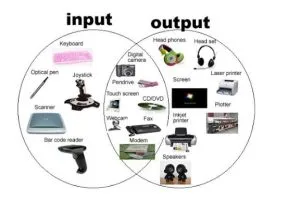
Input Devices (The “Senses”)
An Input Device is any piece of hardware that sends information into the computer. It’s how you tell the computer what to do. Without input devices, a computer would just sit there and do nothing.
- Keyboard: For typing text and commands.
- Mouse: For pointing and clicking.
- Scanner: For turning a physical paper photo into a digital file.
- Microphone: For putting sound/voice into the computer.
- Webcam: For capturing video.
Teacher’s Tip: Just remember: Input = Put In. You are putting data inside the machine.
Output Devices (The “Voice”)
Once the computer has processed your data, it needs to show you the result. An Output Device takes information from the computer and gives it to you in a way you can understand.
- Monitor (Screen): Shows you what you are doing in real-time.
- Printer: Gives you a “hard copy” (physical paper) of your digital work.
- Speakers/Headphones: How the computer gives you sound.
- Projector: Used to show the computer screen on a large wall for many people to see.
Storage Devices (The “Memory”)
A computer needs a place to keep your files so they don’t disappear when you turn the power off. We call this Storage.
- Internal Storage (The Hard Drive)
This is inside the computer. It holds your operating system (like Windows) and all your main apps.
- 2. External/Removable Storage
These are parts you can take with you from one computer to another:
- Flash Drives (USB Sticks): Small, portable, and very common.
- External Hard Drives: For saving huge amounts of data, like 1,000 movies.
- Memory Cards (SD Cards): The tiny chips you put in your phone or camera.
- Optical Discs: CDs and DVDs (though these are becoming less common).
System vs. Peripheral Devices
This is where students sometimes get confused, but it’s actually very simple!
The System Unit (The Core)
The system unit is the “engine room.” Inside it, you find the Motherboard, the CPU (Central Processing Unit), and the RAM (Memory). These parts are essential. If you remove the CPU, the computer isn’t a computer anymore—it’s just a metal box.
Peripheral Devices (The Extras)
A peripheral is anything that is “on the outside.” You can unplug a peripheral (like a printer or a mouse) and the computer will still technically work.
- Input Peripherals: Mouse, Keyboard.
- Output Peripherals: Printer, Monitor.
- Storage Peripherals: External Hard Drive.
Check for Understanding
- Look around your computer lab. List three hardware parts you can see.
- What is the main difference between a keyboard and a monitor? (Hint: Think Input vs. Output).
- Why do we need a Hard Drive if we already have RAM?
- Is a USB Flash Drive a “System” device or a “Peripheral” device? Why?
This term's Digital Technologies topics
SS1 First Term · 8 topics
First Term Digital Technologies Lesson Notes for Other Topics
Data Protection and Backup System
Read the full lesson note.
Internet of Things (IoT) Application
Read the full lesson note.
Cloud and Virtualization
Read the full lesson note.
Networking II
Read the full lesson note.
Software Development Lifecycle
Read the full lesson note.
Advanced Programming II
Read the full lesson note.
Advanced Programming I
Read the full lesson note.
Web Design II
Read the full lesson note.

Web Publishing and Hosting
Read the full lesson note.

Advanced Word Processing Tools
Read the full lesson note.

Advanced Spreadsheet I
Read the full lesson note.
Advanced Spreadsheet II
Read the full lesson note.

Advanced Presentation Tools
Read the full lesson note.
Web Design I
Read the full lesson note.
History and Evolution of Digital Technologies
Read the full lesson note.
Lesson Notes for Other Classes

Basic 1 Lesson Note
The complete lesson note to guide your studies.

Basic 2 Lesson Note
The complete lesson note to guide your studies.

Basic 3 Lesson Note
The complete lesson note to guide your studies.

Basic 4 Lesson Note
The complete lesson note to guide your studies.

Basic 5 Lesson Note
The complete lesson note to guide your studies.
Basic 6 Lesson Note
The complete lesson note to guide your studies.

