
Nigerian Traditional Art – JSS3 Cultural & Creative Arts Lesson Note (First Term)
Download this term · ₦1,000Lesson note at a glance
- Subject
- Cultural & Creative Arts
- Class
- JSS3
- Term
- First Term
- Topic
- Nigerian Traditional Art
- Order
- Topic 1 of 5 this term
- Reading time
- 7 min
Nigerian traditional art is the sculpture, metalwork and carving made by Nigerian peoples over many centuries, often for kings, shrines and community life.
Behavioural objectives
- Name the main centres of Nigerian traditional art and say where each is found.
- State the materials used at Igbo-Ukwu, Ife, Benin, Owo, Esie and Nupe.
- Describe at least two famous objects from Igbo-Ukwu, Ife and Benin.
- Describe the Ikom monoliths of Cross River State.
- List the steps of lost-wax bronze casting.
What are the main centres of Nigerian traditional art?
There are eight main centres in this topic: Igbo-Ukwu, Ife, Benin, Nupe (Tsoede), Owo, Esie, Ibibio and Ikom.
- Igbo-Ukwu: bronze art from the south-east, among the earliest in the region.
- Ife: naturalistic bronze, stone and terracotta sculpture from the south-west.
- Benin: cast bronze and carved ivory made for the Oba’s court.
- Nupe (Tsoede): abstract art, carved stools and metalwork from the Niger area.
- Owo: ivory carving and sculpture linked to both Ife and Benin.
- Esie: a town in Kwara State with the first museum in Nigeria.
- Ibibio: art of the people of Akwa Ibom in the south-east.
- Ikom: carved stone monoliths in Cross River State.
What is Igbo-Ukwu art?
Igbo-Ukwu art is the bronze and other metal art found at three archaeological sites in south-eastern Nigeria.
What are the three Igbo-Ukwu sites?
- Igbo Isaiah: a shrine, found in 1938 by Isaiah Anozie while digging beside his home.
- Igbo Richard: a burial chamber, where a corpse dressed in regalia was found.
- Igbo Jonah: a cache, which means a storage area for objects.
- Thurstan Shaw, an archaeologist, excavated the sites in 1959 at the request of the Nigerian government.
- The sites are linked with the Nri-Igbo.
What are the features of Igbo-Ukwu art?
- Materials: bronze, copper, iron, terracotta, beads and ivory.
- Date: about the ninth to tenth century, centuries before the Ife bronzes.
- Technique: skilled bronze casting.
- Trade: some objects show long-distance trade.
What are the famous Igbo-Ukwu objects?
- Pendant: a human head with scarification marks, one of the few human figures at Igbo-Ukwu.
- Triton shell: a shell decorated with flies, crickets, frogs and snakes.
- Bronze bowl: its shape follows a large round gourd, with raised loops in bands.
- Roped vessel: a water vessel on a stand covered with ropework, one of the finest Igbo-Ukwu bronzes.
- Others: a small staff, a ram’s head, a manilla and a crescent-shaped vessel.

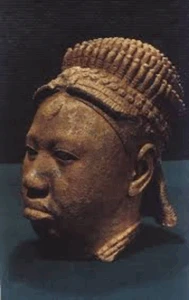
What is Ife art?
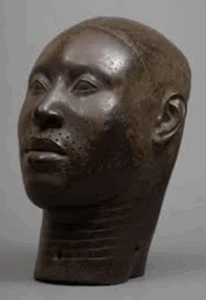
Ife art is the naturalistic bronze, stone and terracotta sculpture made in Ile-Ife in south-western Nigeria.
What are the features of Ife art?
- Materials: terracotta, bronze (copper alloy) and stone.
- Date: about 1000 to 1500 A.D., at its best between 1200 and 1400 A.D.
- Style: idealised naturalism, which means lifelike but perfected faces.
- Forms: full-length figures and busts, sometimes heavily beaded.
- Patrons: made mainly for the ruling class.
- Large heads: kings and gods have large heads because the head was believed to hold Ase, a person’s inner power.
Who was Obalufon II?
- He was an early king of Ife, said to have invented bronze casting.
- He is honoured in a life-size copper mask.
- He is regarded as the Yoruba patron of brass casting, weaving and regalia.
Why did Ife art decline?
- Political and economic power shifted to the nearby kingdom of Benin.
- Ife was also famous for glass beads, which were traded across West Africa.
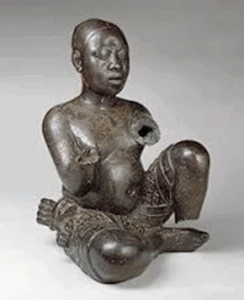

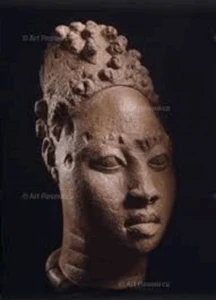
What is Ife stone carving?
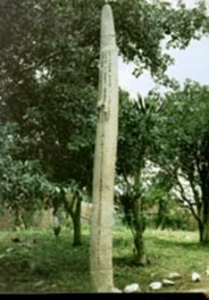
Ife stone carving is sculpture cut from stone, such as the Idena figure and the Staff of Oranmiyan.
- Idena (gatekeeper): has iron nails in its hairstyle and an elaborately tied sash.
- Staff of Oranmiyan: about 18 feet high, studded with spiral-headed nails.
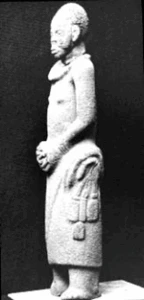
What are Ife terracottas?
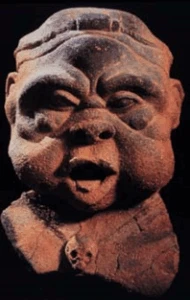
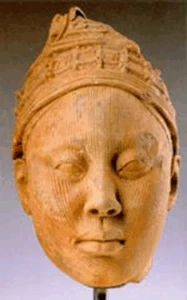
Ife terracottas are sculptures made from baked clay, dated about 1000 to 1300 A.D.
- Child of Obatala: a figure linked to Obatala, the creation divinity.
- Ritual specialist: shown by the bead on the forehead and the skull pendant.
- Possible queen: has a beaded headdress, facial striations and elaborate headgear.
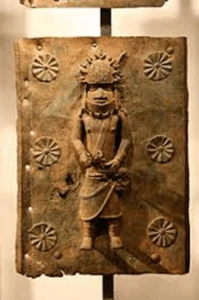
What is Benin art?
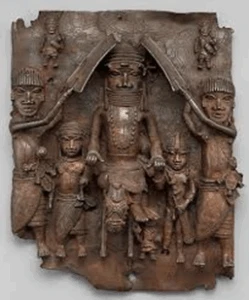
Benin art is the art of the Kingdom of Benin (Edo Empire), which lasted from 1440 to 1897 in present-day South-South Nigeria.
- Materials: cast bronze and carved ivory.
- Patron: the Oba of Benin, a divine ruler.
- Purpose: ceremonial objects for the court.
- Western view: the works are admired as art.
- Benin view: the works are historical records, memory aids and ritual objects.

What is Nupe (Tsoede) art?
Nupe art is the art of the Nupe people, who live mainly in Niger State and parts of Kwara State.
Who are the Nupe?
- The Yoruba call the Nupe “Tapa”.
- They trace their origin to Tsoede, who left the court of Idah and set up towns along the Niger in the 15th century.
- Trade and contact with the Yoruba of Igbomina and Oyo mixed their cultures.
- Their ruler is called the Etsu Nupe, not Emir.
What are the features of Nupe art and culture?
- Style: their art is often abstract.
- Stools: wooden stools with patterns carved on the surface.
- Tribal marks: facial scars show family, prestige and protection, though the custom is fading.
- Jewellery: worn as adornment.
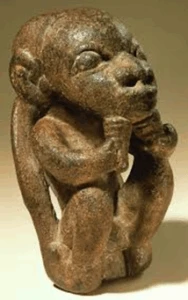
- Tsoede bronzes: bronze figures found at Tada and Jebba are linked to Tsoede.

What is Owo art?
Owo art is the sculpture and ivory carving of Owo, a city in Ondo State.
- Owo was the capital of a Yoruba city-state between 1400 and 1600 A.D.
- Oral tradition says Owo began in Ile-Ife, and its art shows strong Ife links.
- Owo stayed largely independent of Benin but sometimes paid tribute.
- Courtly culture passed in both directions between Owo and Benin.
- Benin’s rulers used more ivory insignia in the 17th and 18th centuries, imported Owo art and hired Owo artisans.
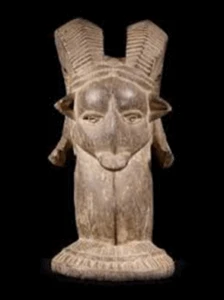
What is Esie art?
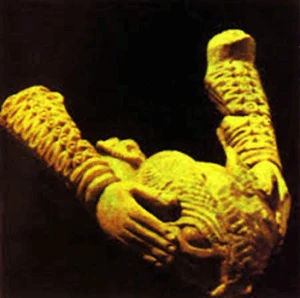
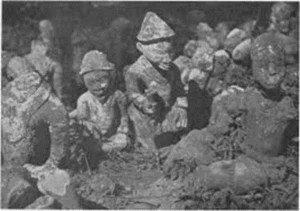
Esie is a town in Kwara State, known for its museum and its ancient stone figures.
- The Esie Museum was the first museum established in Nigeria.
- The town’s Yoruba-speaking people belong to the Igbomina group.
- The museum displays the stone figures of Esie.

Who are the Ibibio?
The Ibibio are a people of south-eastern Nigeria, found mainly in Akwa Ibom State.
- They are related to the Anaang, Efik, Ekid, Oron and Ibeno peoples.
- These groups share names, culture and traditions, and speak related Ibibio-Efik languages.
- Akwa Ibom State was created from Cross River State on 23 September 1987.
- Ibibio art includes carved wooden masks used in masquerades.
What are the Ikom monoliths?
The Ikom monoliths (Akwanshi) are carved stones standing in circles in about thirty communities in Ikom, Cross River State.
What are the features of the monoliths?
- Makers: the Ejagham people.
- Height: about one to two metres.
- Shape: each stone has the form of a human torso.
- Stone: mostly basalt, a few sandstone and shelly limestone.
- Carvings: geometric patterns and symbols, eyes, mouth, ringed head, beard, navel, hands and facial marks.
- Uniqueness: no two stones have the same design.
- Setting: some stand at village meeting places, others in forest outside the village.
How are the monoliths protected?
- The National Commission for Museums and Monuments declared them an ancient monument on 19 March 1963.
- Rain, sun, erosion, vandalism and theft threaten them.
- They were put on the 2008 World Monuments Watch list.
- They are on the UNESCO World Heritage Tentative List.
What do scholars say about the carvings?
- Some scholars say the symbols are a coded system known to the artists.
- Some say the geometric designs show knowledge of measurement and mathematics.
- Some compare the stone circles to Stonehenge in the United Kingdom.
How were bronze objects cast?
Lost-wax casting is the method of making a metal object by melting wax out of a clay mould and filling the space with molten metal.
- Make a model of the object in wax.
- Cover the model with clay to form a mould.
- Heat the mould so the wax melts and runs out.
- Pour molten bronze or brass into the empty mould.
- Let the metal cool and harden.
- Break the clay mould to free the object.
- Clean and polish the finished piece.
How do the main art centres compare?
| Centre | Region | Main materials | Notable feature |
|---|---|---|---|
| Igbo-Ukwu | South-east | Bronze, copper, iron, beads | Roped vessel and triton shell |
| Ife | South-west | Terracotta, bronze, stone | Idealised naturalism |
| Benin | South-South | Bronze, ivory | Court art for the Oba |
| Nupe | Middle Belt | Wood, metal | Abstract art and carved stools |
| Owo | South-west (Ondo) | Ivory, terracotta | Links with Ife and Benin |
| Ikom | South-east (Cross River) | Basalt, sandstone | Carved stone circles |
Evaluation
- Name the three Igbo-Ukwu sites and say what each was used for.
- List four features of Ife art.
- Why were kings and gods in Ife art shown with large heads?
- For whom was Benin art mainly made, and from which materials?
- Describe the Ikom monoliths in four points.
Assignment
Choose one art centre from this note. Write five points on its location, materials, date, famous objects and uses, and draw one object from it.
This term's Cultural & Creative Arts topics
JSS3 First Term · 5 topics
- Nigerian Traditional Art
- Contemporary Nigerian Art and Artists
- Motif
- Display Techniques
- Lettering
Get Cultural & Creative Arts (CCA) as PDF and Word
Every week of JSS3 Cultural & Creative Arts (CCA), First Term, formatted and ready to print. Ad-free, and the copy lock comes off.
Get this term Card, bank transfer, USSD or OPay
JSS3 Cultural & Creative Arts (CCA) Lesson Notes for Other Topics
Contemporary Nigerian Art And Artists
Read the full lesson note.

Motif
Read the full lesson note.
Display Techniques
Read the full lesson note.
Lettering
Read the full lesson note.

Package Designs
Read the full lesson note.
Package Designs II
Read the full lesson note.
Marketing Of Artwork
Read the full lesson note.

Funding For Art Business
Read the full lesson note.

Introduction To Embroidery
Read the full lesson note.
Knitting
Read the full lesson note.
Making Of Crochets
Read the full lesson note.
Batik Work
Read the full lesson note.

Uses And Impact of Music
Read the full lesson note.

Drama And The Development Of Rural Communities
Read the full lesson note.

Opportunities For Career Dramatists
Read the full lesson note.
Lesson Notes for Other Classes

JSS1 Lesson Note
The complete lesson note to guide your studies.

JSS2 Lesson Note
The complete lesson note to guide your studies.
