
Meaning and Definition of Values – Basic 5 Civic Education Lesson Note (Third Term)
Download Lesson NoteLesson note at a glance
- Subject
- Civic Education
- Class
- Basic 5
- Term
- Third Term
- Topic
- Meaning and Definition of Values
- Order
- Topic 2 of 6 this term
- Reading time
- 3 min
Behavioural Objectives:
- Students should understand the meaning and importance of values.
- Students should be able to identify and differentiate between types of values. • Students should appreciate the role of values in shaping behaviour and society.
Key Vocabulary Words:
- Values
- Meaning
- Definition
- Types
- Personal
- Social
- Cultural
- Ethical
- Spiritual
Learning Resources and Materials:
- Lagos State Scheme of Work for Civic Education
- Textbooks recommended by the Lagos State Ministry of Education
- Whiteboard and markers
- Chart paper and markers
- Student notebooks
Building Background/Connection to Prior Knowledge:
- Review the concept of citizenship and the importance of good behaviour.
- Connect to previous lessons by discussing the influence of values on individual actions.
Embedded Core Skills: • Critical thinking • Communication • Collaboration
Content:
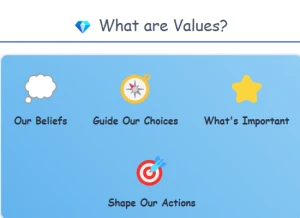
Meaning and Definition of Values: • Meaning: Values are beliefs or principles that guide how we behave and make decisions. • Definition: Values are the things we consider important in life, such as honesty, kindness, and respect.
Types of Values:
- Personal Values: These are beliefs and principles that individuals hold dear to themselves. Examples include honesty, integrity, and loyalty.
- Social Values: These are shared beliefs within a society or community, such as fairness, justice, and equality.
- Cultural Values: These are beliefs and traditions passed down through generations within a culture, like respect for elders or celebration of certain holidays.
- Ethical Values: These are principles that govern ethical behavior, such as honesty, integrity, and responsibility.
- Spiritual Values: These are beliefs related to spirituality or religion, such as compassion, forgiveness, and love.
Discussing Types of Values:
- Personal Values: These are the values that each person holds dear to themselves. For example, if someone values honesty, they will always tell the truth, even if it is difficult.
- Social Values: These are beliefs that are important to society as a whole. For instance, in our community, we value kindness, so we help each other and treat others with respect.
- Cultural Values: These are traditions and customs that are important to our culture. For example, in some certain families, we gather with family and friends to celebrate and show gratitude.
- Ethical Values: These are principles that help us distinguish right from wrong. For instance, if someone finds a lost wallet containing $1,000, their ethical values of honesty and integrity.
- Spiritual Values: These are beliefs related to our spiritual or religious beliefs. For example, if someone follows the teachings of their religion, they may value compassion and forgiveness towards others.
Evaluation:
- Values are beliefs or principles that guide how we _____ and make decisions. a) Behave b) Study c) Eat d) Sleep
- Personal values are beliefs that individuals hold dear to _____. a) The government b) Themselves c) Their friends
- Social values are shared beliefs within a _____ or community. a) School b) Society c) Library d) Playground
- Cultural values are traditions passed down through generations within a _____. a) Family b) TV show c) Movie d) City
- Ethical values help us distinguish _____ from wrong. a) Left b) Right c) Up d) Down
- Spiritual values are beliefs related to spirituality or _____. a) Friendship b) Religion c) Video games d) Sports
- Values are important because they guide us in making _____ decisions. a) Easy b) Difficult c) Fun d) Boring
- Personal values are beliefs that are important to each _____. a) Dog b) Person c) Teacher d) Neighbour
- Social values are shared beliefs within a _____. a) Class b) Community c) Playground d) TV show
- Cultural values are passed down through generations within a _____. a) Family b) Store c) Park d) School
- Ethical values help us distinguish _____ from wrong. a) Good b) Bad c) Sleepy d) Funny
- Spiritual values are beliefs related to spirituality or _____. a) Religion b) Science c) Video games d) School
- Values are important because they guide us in making _____ decisions. a) Hard b) Easy c) Delicious d) Boring
- Personal values are beliefs that are important to each _____. a) Person b) Teacher c) Dog d) Neighbour
- Social values are shared beliefs within a _____. a) Community b) Classroom c) Library d) Movie theater
This term's Civic Education topics
Basic 5 Third Term · 6 topics
Third Term Civic Education Lesson Notes for Other Topics
Respect
Read the full lesson note.

Ways of Showing Respect
Read the full lesson note.
People to Respect
Read the full lesson note.
People to Respect (Authorities)
Read the full lesson note.

Places to Respect
Read the full lesson note.

Places to Respect II
Read the full lesson note.
Things to Respect in the Society
Read the full lesson note.
Things to Respect in the Society II
Read the full lesson note.
Solution to Disunity Cont'd
Read the full lesson note.

Building a United Nigeria - Comprehensive Review
Read the full lesson note.

Concept of National Unity and Evidence of Loyalty
Read the full lesson note.
Characteristics of National Unity
Read the full lesson note.

Factors that Promote National Unity
Read the full lesson note.

Factors that Promote National Unity - Part II
Read the full lesson note.

Factors that Hinder National Unity - Part I
Read the full lesson note.
Lesson Notes for Other Classes

Basic 1 Lesson Note
The complete lesson note to guide your studies.

Basic 2 Lesson Note
The complete lesson note to guide your studies.

Basic 3 Lesson Note
The complete lesson note to guide your studies.

Basic 4 Lesson Note
The complete lesson note to guide your studies.

Basic 6 Lesson Note
The complete lesson note to guide your studies.

JSS1 Lesson Note
The complete lesson note to guide your studies.

