
International Organisation: United Nations – SS3 Government Lesson Note (First Term)
Download this term · ₦1,000Lesson note at a glance
- Subject
- Government
- Class
- SS3
- Term
- First Term
- Topic
- International Organisation: United Nations
- Order
- Topic 6 of 8 this term
- Reading time
- 7 min
The United Nations Organisation (U.N.O.) works through six organs: the General Assembly, the Security Council, the Secretariat, the Trusteeship Council, the International Court of Justice and the Economic and Social Council. Each organ has its own membership and functions. Together they deal with world peace and security, administration, justice, and economic and social matters.
Behavioural objectives
By the end of the lesson, students should be able to:
- name the six organs of the U.N.O.;
- describe the membership of the General Assembly, the Security Council, the Trusteeship Council, the International Court of Justice and the Economic and Social Council;
- state the functions of each organ;
- explain the role of the Secretary General and the Secretariat;
- list the past Secretaries General of the U.N.O.
What are the organs of the U.N.O.?
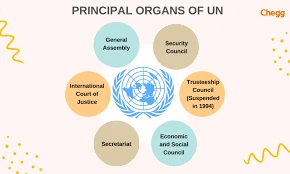
The following are the organs of the U.N.O.:
- The General Assembly.
- The Security Council.
- The Secretariat.
- The Trusteeship Council.
- The International Court of Justice.
- The Economic and Social Council.
What is the General Assembly?
The General Assembly is the central organ of the U.N.O. Its membership includes all member countries of the U.N.O. Each state is entitled to five representatives (a delegation). The Assembly meets once a year in a regular session.
The General Assembly has the power to deliberate on any matter that falls within the jurisdiction of the organisation’s interest. On important matters, decisions are made by a two-thirds vote of the members present and voting. Decisions on ordinary matters are reached by a simple majority. The chairmanship of the Assembly is held for one year and rotated among member-states.
Functions of the General Assembly
- Deliberative function: It provides a forum for the discussion of world peace and security and makes recommendations for the resolution of conflicts.
- Approval of annual budget: It discusses and approves the annual budget of the organisation.
- Voting: The General Assembly has the power to vote on issues of international importance.
- Admission: It admits new members into the organisation.
- Election: The body elects non-permanent members into the Security Council and judges of the International Court of Justice.
- Settlement of disputes: It settles disputes by peaceful means and works to remove the causes of war and the threat of war.
- Annual report: The General Assembly considers annual reports by the Secretary General, for example the state of the world address.
- It jealously guards the realisation of fundamental human rights and freedom for all people.
What is the Security Council?
The Security Council has fifteen members. The membership was enlarged from eleven to fifteen in 1965. Out of the fifteen members, five are permanent members: the United States of America, Russia, China, France and Britain. They also wield veto power.
There are ten non-permanent members of the Security Council. They are elected by the General Assembly for a two-year term. The Security Council is the most powerful organ of the U.N.O and is charged with the primary responsibility of maintaining international peace and security.
Functions of the Security Council
- Peace and security: The major function of the Security Council is to maintain peace and security in the world.
- It makes recommendations to the General Assembly for the appointment of the Secretary General.
- It makes annual and special reports to the General Assembly.
- It recommends the admission of new member states.
- It investigates any matter that can lead to war and works for peaceful resolutions.
- It recommends the suspension and expulsion of erring member-states to the General Assembly for consideration.
- A veto by any of the permanent members nullifies a decision.
- The organ elects the judges of the World Court in collaboration with the General Assembly.
What is the Secretariat?
The Secretariat is the administrative unit of the U.N.O. It is headed by the Secretary General, who is responsible for the supervision and coordination of the activities of all the organs. The Secretary General is elected by the General Assembly on the recommendation of the Security Council for a five-year term. He can be re-elected.
Past Secretaries General of the U.N.O.
- Mr. Trygve Lie (Norway)
- Mr. Dag Hammarskjöld of Sweden (1953 to 1961)
- U. Thant of Burma (1961 to 1972)
- Kurt Waldheim of Austria (1972 to 1982)
- Pérez de Cuéllar of Peru (1982 to 1992)
- Boutros Boutros Ghali of Egypt (1993 to 1998)
- Dr. Kofi Annan of Ghana (1998 to 2006)
- Mr. Ban Ki Moon of Korea, the incumbent Secretary General when this note was written
Functions of the Secretariat
- The Secretariat handles all U.N.O. correspondence.
- It gives the annual report of the U.N.O. to the General Assembly.
- It performs administrative functions as the administrative headquarters of the organisation.
- It makes available all the materials needed for all meetings of the organisation.
- It serves as the information centre of the organisation.
- It carries out the recruitment of U.N. staff.
What is the Trusteeship Council?
The council comprises member states who administer trust territories, permanent members of the Security Council and other members determined and elected by the General Assembly. It oversees the administration of non-self-governing territories under member countries. Its relevance has diminished with the independence of virtually all countries.
Functions of the Trusteeship Council
- It is responsible for the supervision of territories placed under the international trusteeship system.
- The council helps to promote the economic, social, political and educational development of the people of these territories.
- The council receives and considers progress reports submitted by member countries.
- It encourages the territories to work towards self-government.
- The council pays periodic official visits to the trust territories to assess the progress being made there.
- The council accepts and considers petitions from the trusteeship areas.
What is the International Court of Justice?
The International Court of Justice is the judicial organ of the U.N.O. It is also known as the World Court. Its headquarters is at The Hague, Netherlands. It has 15 judges, elected by the General Assembly and the Security Council for a period of nine years. Members of the court can be re-elected at the end of their term of office, and their appointment is on a full-time basis.
Functions of the International Court of Justice
- This organ is the main judicial organ of the U.N.O.
- The court settles disputes among member-countries of the U.N.O. brought before it.
- It gives legal advice to the U.N.O. and the specialised agencies.
- The court interprets international conventions and agreements.
- The decisions of the court are binding on member-states in disputes.
What is the Economic and Social Council?
The council is made up of 54 members, who are elected by the General Assembly for a period of three years. Retiring members are eligible for immediate re-election. This council is mainly responsible for all economic and social activities of the U.N.O. Issues are settled by a simple majority vote.
Functions of the Economic and Social Council
- The council is responsible for the economic and social activities of the U.N.O.
- It prepares reports on the activities of all U.N.O. agencies.
- It organises international conferences to examine the economic and social development problems of the world.
- It makes recommendations for the promotion of fundamental human rights.
- It gives information and assistance to the Security Council.
- It coordinates the activities of specialised agencies, for example the Food and Agriculture Organization.
Evaluation
Questions on the General Assembly and the Security Council
- Mention 4 functions of the General Assembly of the U.N.O.
- State 4 functions of the Security Council of the U.N.O.
Questions on the Trusteeship Council and the International Court of Justice
- List 3 functions of the Trusteeship Council.
- Highlight 3 functions of the International Court of Justice.
General evaluation and revision questions
- Explain the meaning of nationalism.
- What are the factors that contributed to the growth of nationalist movements in West Africa?
- Explain the effect of the Second World War on nationalists in West Africa.
- Why did nationalist leaders in West Africa criticise colonial rule?
Assignment
Reading assignment
- Comprehensive Government by Anyaele J.U. pgs. 222-224
- Essential Government by C.C. Dibie pgs. 225-259
Weekend assignment
- The Secretary General of the U.N.O. is appointed for a period of _____ (a) three years (b) five years (c) seven years
- The official language of the Commonwealth is (a) English (b) French (c) Spanish
- The Security Council of the U.N.O. has _____ permanent members (a) 6 (b) 7 (c) 5
- The current U.N.O. Secretary General is _____ (a) Ban Ki Moon (b) Kofi Annan (c) Tony Blair
- The headquarters of the International Court of Justice is located in _____ (a) Britain (b) U.S.A. (c) Netherlands
Theory
- Highlight 5 functions of the Secretariat of the U.N.O.
- State 4 functions of the International Court of Justice.
This term's Government topics
SS3 First Term · 8 topics
Get Government as PDF and Word
Every week of SS3 Government, First Term, formatted and ready to print. Ad-free, and the copy lock comes off.
Get this term Card, bank transfer, USSD or OPay
SS3 Government Lesson Notes for Other Topics
Military In Nigeria
Read the full lesson note.
Conflict Resolution And Management
Read the full lesson note.
Peace Education
Read the full lesson note.
The Interdependence Of Nations And Globalisation
Read the full lesson note.
Nigeria’s Foreign Policy
Read the full lesson note.
International Organisation II - African Union
Read the full lesson note.

International Organisation III - Commonwealth of Nations:
Read the full lesson note.

International Organization - ECOWAS
Read the full lesson note.
Organization of Petroleum Exporting Countries (OPEC)
Read the full lesson note.
Millennium Development Goals (MDG) & New Economic Partnership for Economic Development(NEPAD)
Read the full lesson note.
E- Government and Leadership and Followship.
Read the full lesson note.
Lesson Notes for Other Classes

SS1 Lesson Note
The complete lesson note to guide your studies.

SS2 Lesson Note
The complete lesson note to guide your studies.
