
Purchase of Business Account – SS3 Financial Accounting Lesson Note (First Term)
Lesson note at a glance
- Class
- SS3
- Subject
- Financial Accounting
- Term
- First Term
- Reading time
- 6 min
Purchase of a business is the takeover by a company of the assets and liabilities of an existing business, in return for an agreed purchase consideration.
Behavioural objectives
By the end of the lesson, students should be able to:
- Define purchase consideration, vendor, goodwill and capital reserve.
- Revalue the assets and liabilities of a business taken over.
- Calculate the purchase consideration from the terms of payment.
- Prepare journal entries and ledger accounts for the purchase of a business.
- Prepare the balance sheet of the company after the takeover.
Instructional techniques
- Identification
- Explanation
- Questions and answers
- Demonstration
- Videos from source
Instructional materials
- Videos
- Loudspeaker
- Textbook
- Pictures
What are the key terms in the purchase of a business?
There are eight key terms: vendor, purchaser, purchase consideration, business purchase account, net assets, goodwill, capital reserve and debenture.
- Vendor: the owner of the business that is being sold, such as John Brothers.
- Purchaser: the company that buys the business, such as B.K. Limited.
- Purchase consideration: the total amount the company agrees to pay the vendor for the business.
- Business purchase account: a temporary account in the company’s books that collects the assets, liabilities and consideration of the takeover.
- Net assets: the agreed value of the assets taken over minus the liabilities taken over.
- Goodwill: the extra amount paid above the value of the net assets, for the reputation and customers of the business.
- Capital reserve: the gain that arises when the net assets taken over are worth more than the consideration paid.
- Debenture: a loan to the company that earns fixed interest, for example a 10% debenture.
How is the purchase consideration paid?
The purchase consideration is paid in four ways: shares, debentures, cash or a mixture of these.
| Method | What the company gives the vendor |
|---|---|
| Shares | Equity shares, which may be issued at par or at a premium. |
| Debentures | Debentures, which may be issued at par, at a discount or at a premium. |
| Cash | Money paid through the bank. |
| Mixed | A combination of shares, debentures and cash. |
What are the steps in recording a purchase of a business?
There are seven steps, from listing the assets taken over to preparing the new balance sheet.
- List the assets and liabilities that the company takes over.
- Revalue each asset and liability to the agreed figure.
- Find the purchase consideration from the terms of payment.
- Compare the net assets taken over with the consideration.
- Record goodwill if the consideration is higher, or capital reserve if it is lower.
- Journalise the takeover, then post to the ledger accounts.
- Prepare the new balance sheet of the company.
How are goodwill and capital reserve found?
Goodwill or capital reserve is found by comparing the net assets taken over with the purchase consideration.
- Net assets: total agreed value of assets taken over minus liabilities taken over.
- Goodwill: purchase consideration minus net assets, when the consideration is higher.
- Capital reserve: net assets minus purchase consideration, when the net assets are higher.
- Given goodwill: in some questions the goodwill is stated, as in the B.K. Limited example.
Simple illustration
| Item | Case A | Case B |
|---|---|---|
| Net assets taken over | ₦100,000 | ₦100,000 |
| Purchase consideration | ₦120,000 | ₦90,000 |
| Result | Goodwill of ₦20,000 | Capital reserve of ₦10,000 |
What is the difference between goodwill and capital reserve?
Goodwill is the amount paid above the net assets. Capital reserve is the amount by which the net assets exceed the price paid.
| Point | Goodwill | Capital reserve |
|---|---|---|
| When it arises | Consideration is higher than net assets | Net assets are higher than consideration |
| Journal entry | Debited with the assets | Credited with the liabilities |
| Balance sheet | Shown as an asset | Shown under capital and reserves |
What are the journal entries?
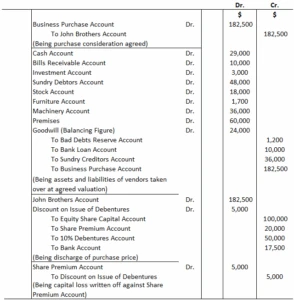
Three journal entries record a purchase of a business: the consideration, the assets and liabilities, and the payment.
Entry 1: purchase consideration agreed
- Debit: Business purchase account.
- Credit: Vendor’s account, with the purchase consideration.
Entry 2: assets and liabilities taken over
- Debit: each asset at its agreed value, and goodwill if any.
- Credit: each liability taken over.
- Credit: Business purchase account, with the balance.
- Capital reserve: credit it instead of goodwill when net assets exceed the consideration.
Entry 3: payment to the vendor
- Debit: Vendor’s account, with the full consideration.
- Debit: Discount on debentures, if the debentures are issued at a discount.
- Credit: Share capital at nominal value, and Share premium for any premium.
- Credit: Debentures at nominal value.
- Credit: Bank, with the cash paid.
How is the purchase of a business account prepared?
The account is prepared by revaluing the assets, finding the consideration and journalising the takeover, as the B.K. Limited example shows.
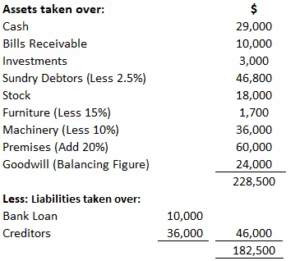
Worked example: B.K. Limited
- Company: B.K. Limited, registered with a capital of $1,000,000 in equity shares of $10 each.
- Action: it acquired the business of John Brothers.
- Balance sheet: the firm’s balance sheet at the date of acquisition is given in the question.
Revaluation and terms
- Machinery and furniture to be depreciated at 10% and 15% respectively.
- Premises to be appreciated by 20%.
- Make provision for bad debts on debtors at 2.5%.
- Goodwill of the firm valued at $24,000.
- Purchase consideration to be discharged as follows:
- Allotment of 10,000 equity shares of $10 each at $12 each.
- Allotment of 500 10% debentures of $100 each at a discount of $10 each.
- Balance in cash.
- Required: show journal entries in the books of the company and prepare the balance sheet.
How each revaluation is worked
| Item | Adjustment | Working |
|---|---|---|
| Machinery | Depreciate by 10% | Book value × 90% |
| Furniture | Depreciate by 15% | Book value × 85% |
| Premises | Appreciate by 20% | Book value × 120% |
| Debtors | Provision of 2.5% | Debtors × 97.5% |
How the payment in shares and debentures is valued
| Item | Working | Amount |
|---|---|---|
| Equity shares at $12 | 10,000 × $12 | $120,000 |
| Share capital (nominal) | 10,000 × $10 | $100,000 |
| Share premium | 10,000 × $2 | $20,000 |
| Debentures at issue price | 500 × $90 | $45,000 |
| Debentures (nominal) | 500 × $100 | $50,000 |
| Discount on debentures | 500 × $10 | $5,000 |
| Cash | Balance of the consideration | Total consideration minus $165,000 |
Solution: calculation of purchase consideration
Journal entries in the books of B.K. Limited
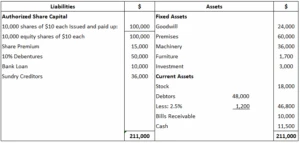
Balance sheet of B.K. Limited
- Heading: Balance sheet of B.K. Limited as on ……..
What should students remember?
- Agreed values: record assets at the revalued figures, not the old book values.
- Debenture discount: it is a debit entry and is shown in the balance sheet until it is written off.
- Share premium: it is credited, and it is part of the consideration paid in shares.
- Business purchase account: it must balance and close to nothing after the entries.
- Excluded items: any asset not taken over, such as cash in some questions, is left out of the entries.
Evaluation
- Define purchase consideration.
- State four ways in which a company may pay the purchase consideration.
- Explain when a company records goodwill and when it records a capital reserve.
- Write the journal entry that records the agreed purchase consideration.
- A company issues 2,000 shares of $10 each at $12 to a vendor. Find the share capital and the share premium.
Assignment
Andrew Young agreed to take over the business of Ayo. He takes over the assets and liabilities except the cash balance. The balance sheet of Ayo as of 31st December 1976 is given.
Terms of the takeover
- The purchase consideration is to be ₦150,000.
- Assets to be revalued as follows: fixtures ₦60,000, motor van ₦25,000, debtors ₦13,500 and stock ₦15,000.
- The purchase price was paid on 6 January 1977.
Prepare
- Journal entries in respect of the acquisition.
- Ledger entries.
- Balance sheet.
This term's Financial Accounting topics
SS3 First Term · 11 topics
SS3 Financial Accounting Lesson Notes for Other Topics

Nigeria Financial System
Read the full lesson note.

Capital Market I
Read the full lesson note.

Capital Market II
Read the full lesson note.

Loan Capital
Read the full lesson note.

Securities And Exchange Commissions (SEC)
Read the full lesson note.

Nigerian Stock Exchange
Read the full lesson note.
Acquisition/Purchase Of Business
Read the full lesson note.

Public Sector Accounting
Read the full lesson note.
Preparation Of Public Sector Accounting
Read the full lesson note.

Hadith 23, 25, & 26 of Imam Nawawi
Read the full lesson note.

Preparation Of Personal Cost Budget
Read the full lesson note.

Branch Account
Read the full lesson note.
Joint Venture Account
Read the full lesson note.
Consignment Account
Read the full lesson note.

Hire Purchase Account
Read the full lesson note.
Lesson Notes for Other Classes

SS1 Lesson Note
The complete lesson note to guide your studies.

SS2 Lesson Note
The complete lesson note to guide your studies.
