
Loan Capital – SS3 Financial Accounting Lesson Note (First Term)
Lesson note at a glance
- Class
- SS3
- Subject
- Financial Accounting
- Term
- First Term
- Reading time
- 5 min
Loan capital is money a company borrows for a long period from outside lenders, repaid with fixed interest, and it is mostly raised by issuing debentures.
Behavioural objectives
By the end of the lesson, students should be able to:
- Define loan capital and debentures.
- List the types of debentures.
- State the issue prices of debentures and calculate a premium or discount.
- List the relevant ledger accounts.
- State the differences between shares and debentures.
- Show the ledger entries for a debenture issue.
Instructional techniques
- Identification
- Explanation
- Questions and answers
- Demonstration
- Videos from source
Instructional materials
- Videos
- Loudspeaker
- Textbook
- Pictures
What is a debenture?
A debenture is a medium to long-term debt that a company uses to borrow money.
- Bond: it is issued under the company’s seal, acknowledging a loan.
- Fixed interest: it bears a fixed rate of interest, for example 5%.
- Liability: it is a long-term liability of the company.
- Issue price: it can be issued at par, at a premium or at a discount.
What are the features of debentures?
The features of debentures describe how a debenture holder differs from a shareholder.
- Creditor: a debenture holder is a lender to the company, not an owner.
- Fixed interest: interest is paid at a fixed rate, whether the company makes a profit or not.
- Interest calculation: interest is a percentage of the nominal value. For example, 5% on ₦10,000 = ₦10,000 × 5/100 = ₦500 a year.
- No voting right: holders do not vote at the general meeting.
- Charge on profit: interest is an expense paid before any dividend.
- Security: some debentures are backed by the company’s assets.
What are the types of debentures?
There are ten types of debentures, grouped under four headings: redemption (tenure), convertibility, security and transferability (registration).
| Basis | Types |
|---|---|
| Redemption (tenure) | Redeemable, irredeemable (perpetual) |
| Convertibility | Convertible, non-convertible |
| Security | Secured (first mortgage, second mortgage), unsecured |
| Transferability (registration) | Registered, bearer |
1. Redemption (tenure)
- Redeemable debentures: these are repayable at a specified future date.
- Irredeemable debentures: these are also known as perpetual debentures. They do not carry any date of redemption.
2. Convertibility
- Convertible debentures: the holders have the option of converting their holdings into equity shares.
- Non-convertible debentures: these have no option of being converted into shares or equity.
3. Security
- Secured or mortgage debentures: these are secured by a charge on some asset or set of assets of the company.
- First mortgage debentures: these have the first claim on the asset pledged as security.
- Second mortgage debentures: these have a claim on the same asset, but only after the first mortgage holders.
- Unsecured debentures: these are also known as simple or naked debentures. They carry no charge on the assets of the company.
4. Transferability (registration)
- Registered debentures: the name, address and other holding details of the holder are recorded with the issuing company.
- Transfer of registered debentures: the holder must inform the issuing company so that it can update its records.
- Unregistered or bearer debentures: these can be transferred by mere delivery to the new holder. They are not recorded in the register of the company.
What are the issue prices of debentures?
A debenture may be issued at par, at a premium or at a discount.
- Nominal value: the face value printed on the debenture, for example ₦100.
- Par: issue price equals the nominal value.
- Premium: issue price is above the nominal value.
- Discount: issue price is below the nominal value.
| Issue price | Meaning | Example |
|---|---|---|
| At par | The debentures are issued at the nominal value. | ₦100 debentures are issued at ₦100. |
| At a premium | The issue price is above the nominal value. The premium is the excess of the issue price over the nominal value. | Debentures of ₦100 are issued at ₦120. Premium = ₦120 minus ₦100 = ₦20. |
| At a discount | The issue price is below the nominal value. | Debentures of ₦100 are issued at ₦90. Discount = ₦100 minus ₦90 = ₦10. |
What is the difference between shares and debentures?
A share is a unit of ownership in a company, while a debenture is a unit of loan to the company.
| Point | Shares | Debentures |
|---|---|---|
| Holder | Owner of the company | Creditor of the company |
| Return | Dividend, paid from profit | Interest at a fixed rate |
| Payment when no profit | No dividend is paid | Interest must still be paid |
| Voting | Ordinary shareholders vote | No voting right |
| Repayment | Not repaid during the life of the company | Repaid on the redemption date, unless irredeemable |
| Security | No charge on assets | May be secured on assets |
| Classed as | Share capital | Loan capital (long-term liability) |
Which ledger accounts are used for debentures?
Six main ledger accounts are used when a company issues debentures.
- Cash Book/Bank Account: debited when money is received.
- Debenture Application and Allotment Account: records money received on application and allotment.
- Debenture First and Final Call Account: records the money called after allotment.
- % Debenture Account: for example 5% Debenture Account, credited with the nominal value issued.
- Discount Account: debited with the discount when debentures are issued below nominal value.
- Premium Account: credited with the premium when debentures are issued above nominal value.
How are the entries for a debenture issue recorded?
Each issue is recorded by following the cash received and the nominal value issued.
- Debit the Bank Account each time money is received.
- Credit the Application and Allotment Account and the Call Account with the sums due.
- Credit the % Debenture Account with the full nominal value issued.
- Credit the Premium Account with any premium.
- Debit the Discount Account with any discount.
Worked example: ledger entries for a debenture issue
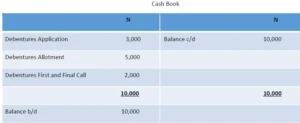
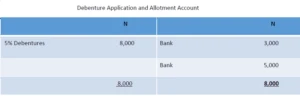
Mibal Limited issued 10,000 5% debentures of ₦1.00 each, payable as follows:
- 30k on application
- 50k on allotment
- 20k on first and final call
All the debentures were applied for and allotted.
Required: Show the necessary ledger entries.
Solution
Workings:
- Application: 0.30 × 10,000 = ₦3,000
- Allotment: 0.50 × 10,000 = ₦5,000
- First and final call: 0.20 × 10,000 = ₦2,000
- Total received: ₦3,000 + ₦5,000 + ₦2,000 = ₦10,000, which equals the nominal value issued.


Evaluation
- What is a debenture?
- Mention four types of debentures.
- State three differences between shares and debentures.
- List four ledger accounts used in the issue of debentures.
- Jones Plc issued 15,000 8% debentures of ₦1.00 at ₦1.20 each, payable as follows:
- 40k on application
- 60k on allotment (including premium)
- 20k on the first and final call
Required: Show the necessary ledger and journal entries.
Assignment
Define a debenture. Then explain the difference between debentures issued at a premium and debentures issued at a discount, giving one example of each.
This term's Financial Accounting topics
SS3 First Term · 11 topics
SS3 Financial Accounting Lesson Notes for Other Topics
Nigeria Financial System
Read the full lesson note.

Capital Market I
Read the full lesson note.

Capital Market II
Read the full lesson note.

Securities And Exchange Commissions (SEC)
Read the full lesson note.

Nigerian Stock Exchange
Read the full lesson note.
Acquisition/Purchase Of Business
Read the full lesson note.
Purchase Of Business Account
Read the full lesson note.

Public Sector Accounting
Read the full lesson note.
Preparation Of Public Sector Accounting
Read the full lesson note.

Hadith 23, 25, & 26 of Imam Nawawi
Read the full lesson note.

Preparation Of Personal Cost Budget
Read the full lesson note.

Branch Account
Read the full lesson note.
Joint Venture Account
Read the full lesson note.
Consignment Account
Read the full lesson note.
Hire Purchase Account
Read the full lesson note.
Lesson Notes for Other Classes

SS1 Lesson Note
The complete lesson note to guide your studies.

SS2 Lesson Note
The complete lesson note to guide your studies.
