
Branch Account – SS3 Financial Accounting Lesson Note (Second Term)
Lesson note at a glance
- Class
- SS3
- Subject
- Financial Accounting
- Term
- Second Term
- Reading time
- 9 min
A branch is a part of an organisation that operates with some degree of independence, usually in a different place from the head office.
Behavioural objectives
By the end of the lesson, students should be able to:
- Differentiate between departmental and branch accounts.
- Mention and explain the types of branch.
- State the importance of branch accounts.
- List and explain the pricing methods a head office uses to charge goods to branches.
- State the features of a foreign branch.
Instructional techniques
- Identification
- Explanation
- Questions and answers
- Demonstration
- Videos from source
Instructional materials
- Videos
- Loudspeaker
- Textbook
- Pictures
What is a branch?
A branch is a part of a business or non-business organisation that operates with some degree of independence.
- Location: a business may have its head office in one city and branches in other parts of the country.
- Reason for a branch: a branch is created where a section of the business is physically separate from the main section.
- Relationship: when activities take place away from the main place of operation, a relationship arises between the branch and the head office.
- Small branch: a retail shop run by one person, selling only goods sent by the head office.
- Large branch: a foreign branch thousands of kilometres away that buys materials, manufactures and distributes in its area, with little control from the head office.
What is a branch account?
Branch accounts are the records of dealings between the head office and its branches.
- The method used depends on the transactions between the head office and the branch.
- It also depends on whether the head office or the branch keeps the records.
What is the difference between a department and a branch?
A department is a section of a business that handles one line of goods or service, usually under the same roof as the main business.
A branch is a part of the business in a separate location, with some independence from the head office.
| Point | Department | Branch |
|---|---|---|
| Location | Usually in the same premises as the main business | Usually in a different place from the head office |
| Basis of division | Type of goods or service sold | Place where the business is carried on |
| Independence | Little or none | Some degree of independence |
| Records | Kept by the main business | Kept by the head office or by the branch |
| Example | Shoe section and clothing section in one store | A shop in Kano owned by a business headquartered in Lagos |
Why are branch accounts important?
Branch accounts show how well each branch is doing and how much it owes the head office.
- Profit or loss: they show the profit or loss of each branch separately.
- Control: they help the head office check goods, cash and stock held by branch managers.
- Detecting losses: shortages and misuse of goods or cash can be traced to a branch.
- Indebtedness: they show what each branch owes the head office at any time.
- Decisions: they help management decide whether to expand, support or close a branch.
- Final accounts: they supply the figures needed for the profit and loss account of the whole business.
What are the types of branch?
There are three types of branch for accounting purposes: branches whose records the head office keeps, branches that keep separate records, and foreign branches.
- Branches whose accounts are kept by the head office: the whole of the accounting records are kept at the head office.
- Branches that keep separate accounting records: the branch keeps its own books and reports to the head office.
- Foreign branches: branches in other countries, which keep separate records in foreign currency.
How does the head office account for a branch when it keeps the accounts?
The head office keeps all the records when the branch is treated as a sales department.
- The head office does all the buying and the branch only sells.
- The branch receives all its goods from the head office.
- The branch manager must account for these goods.
- Goods are charged to the branch at selling price, and the branch must produce cash or stock to cover their value.
Branch managers are kept under check through reports sent to the head office at regular intervals. The reports give details of:
- Goods received and goods returned to the head office.
- Cash sales and credit sales.
- Cash received from debtors.
- Stock, expenses and debtors.
What are the pricing methods?
There are three pricing methods a head office can use to charge goods to branches: cost price, cost plus a percentage, and selling price.
| Method | Goods are charged at | Best used when |
|---|---|---|
| Cost price | Cost to the head office | Goods are perishable or selling prices fluctuate |
| Cost plus a percentage | Cost plus a fixed percentage (loading) | The head office wants the branch gross profit and stock control |
| Selling price | The price at which the branch sells | The head office wants close checks on branch staff |
What is the cost price method?
The cost price method charges goods sent to the branch at cost price.
- When used: where goods are perishable or selling prices are hard to fix because of fluctuations.
- Stock: opening and closing stocks are also taken at cost price.
- Disadvantage: it lacks the check on the trading activities of the branch which the selling price method gives.
What is the cost plus a percentage method?
The cost plus a percentage method charges goods to the branch at cost plus a fixed percentage.
- It is often regarded as the most effective method of charging goods to a branch.
- The head office keeps accounts which show the gross profit or loss of the branch.
- The amount added to cost is called the loading.
- If cost plus the percentage equals the selling price, the head office also has stock control.
- Goods received by the branch must then equal sales, plus returns to the head office, plus branch closing stock.
The head office keeps these accounts:
- Branch stock account.
- Goods sent to the branch account.
- Branch stock adjustment account.
Two methods are used to record the entries:
- Branch stock adjustment method.
- Memorandum or double-column method.
What is the branch stock adjustment method?
The branch stock adjustment method separates the cost of goods from the loading by using extra accounts.
- Branch stock account: records goods sent to the branch by the head office at the invoice price.
- Branch stock adjustment account: records the loading added to the cost of goods sent. It is used to find the actual gross profit of the branch.
- Goods sent to the branch account: records the goods at their cost price.
- Debtors account: records the transactions of the branch debtors.
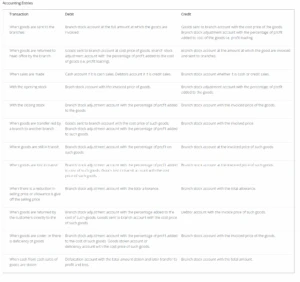
Worked example of loading
- Goods cost the head office ₦8,000.
- The head office adds 25% on cost, which is ₦2,000.
- The invoice price to the branch is ₦10,000.
- Branch stock account is debited with ₦10,000.
- Goods sent to the branch account is credited with ₦8,000 (cost).
- Branch stock adjustment account is credited with ₦2,000 (loading).
What are the steps under the adjustment method?
- Debit branch stock account and credit goods sent to the branch and branch stock adjustment accounts when goods are sent.
- Credit branch stock account with sales and returns from the branch.
- Reverse the cost and loading for goods returned by the branch.
- Take closing stock of the branch at invoice price.
- Close the goods sent to the branch account by transferring its balance to the head office purchases account.
- Transfer the balance on the adjustment account to the profit and loss account.
The transfer in step 5 relieves the head office trading account of the need to charge for these goods. They are already accounted for in the branch stock and adjustment accounts.
What is the selling price method?
The selling price method charges goods to the branch at the actual prices at which the branch will sell them.
- Most proprietary goods are charged to branches this way.
- The aim is to check branch managers and staff, so that all goods sent are fully accounted for.
- At balancing time, the balance on the branch stock account is the closing stock of the branch at selling price.
The head office keeps these accounts for the branch:
- Branch stock account: shows goods at selling price.
- Goods sent to branch account: shows goods sent to the branch.
- Total debtors account: shows amounts owed by branch customers.
- Expenses account: shows the expenses of the branch.
How are branches that keep separate account records handled?
A branch keeps separate accounting records when it is more convenient to prepare complete accounts at the branch.
The reasons are:
- The branch is located far from the headquarters.
- The nature of the branch activities calls for it.
- The size of the branch makes it economical to prepare the accounts there.
The link between the branch and the head office is shown through two accounts:
- Head office current account (head office account): kept in the branch books.
- Branch current account (branch account): kept in the head office books.
Key points on how these accounts work:
- Debtor and creditor: the head office and the branch stand as debtor and creditor.
- Balances: the branch account in the head office books has a debit balance, and the head office account in the branch books has a matching credit balance.
- Indebtedness: at any time, the branch account shows what the branch owes the head office.
- Use: the current accounts record transactions that supply resources to the branch and withdrawals of resources from it.
- Profit: branch profit does not belong to the branch. It is credited to the head office current account, and a loss is debited.
- Final entry: the head office debits the branch current account and credits the profit and loss account.
What are foreign branches?
A foreign branch is a branch in another country that carries out part of the trading or manufacturing of the business.
- Separate accounting records are kept at such a branch, as described above.
The features of a foreign branch are:
- Two columns: the branch account in the head office books has one column in foreign currency and one in local currency (Naira).
- Memoranda: the foreign currency entries are memoranda, needed to reconcile with the head office account.
- Returns to head office: the branch sends its trading and profit and loss account, its balance sheet and a detailed copy of the head office account.
- Conversion: branch assets, liabilities and revenue items are converted at the applicable rate between the branch country and the head office country.
Evaluation
- Differentiate between a branch and a department.
- Mention and explain the types of branch.
- State the importance of branch accounts.
- Goods costing ₦12,000 are sent to a branch at cost plus 25%. Calculate the invoice price and the loading.
Classwork: Students answer the evaluation questions in their notebooks.
Assignment
Answer all parts in your notebook:
- List the three pricing methods a head office can use to charge goods to its branches.
- State the disadvantage of the cost price method.
- List the features of a foreign branch.
This term's Financial Accounting topics
SS3 Second Term · 6 topics
SS3 Financial Accounting Lesson Notes for Other Topics

Preparation Of Personal Cost Budget
Read the full lesson note.
Joint Venture Account
Read the full lesson note.
Consignment Account
Read the full lesson note.
Hire Purchase Account
Read the full lesson note.

Contract Account
Read the full lesson note.
Nigeria Financial System
Read the full lesson note.

Capital Market I
Read the full lesson note.

Capital Market II
Read the full lesson note.

Loan Capital
Read the full lesson note.

Securities And Exchange Commissions (SEC)
Read the full lesson note.

Nigerian Stock Exchange
Read the full lesson note.
Acquisition/Purchase Of Business
Read the full lesson note.
Purchase Of Business Account
Read the full lesson note.

Public Sector Accounting
Read the full lesson note.
Preparation Of Public Sector Accounting
Read the full lesson note.
Lesson Notes for Other Classes

SS1 Lesson Note
The complete lesson note to guide your studies.

SS2 Lesson Note
The complete lesson note to guide your studies.
