
Introduction to Computer Networking – SS3 Data Processing Lesson Note (First Term)
Download this term · ₦1,000Lesson note at a glance
- Subject
- Data Processing
- Class
- SS3
- Term
- First Term
- Topic
- Introduction to Computer Networking
- Order
- Topic 1 of 9 this term
- Reading time
- 5 min
Computer networking is the practice of linking two or more computing devices together to share data, using computer hardware and software.
Behavioural objectives
By the end of the lesson, students should be able to:
- Define networking, network design, network protocols and network topology.
- Name the two basic network design forms and state how they differ.
- Name and describe the common network topologies.
- Give examples of network protocols and state what they do.
- Explain the meaning of Internet, intranet and extranet.
What is computer networking?
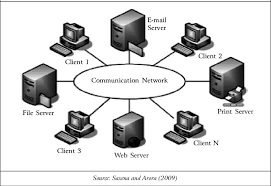
Networking is the practice of linking two or more computing devices together to share data.
- Hardware: the physical parts, such as computers, cables, switches, routers and network cards.
- Software: the programs that control the network, such as the operating system and network protocols.
Why do we use computer networks?
- Sharing data: users send and receive files and messages.
- Sharing resources: many computers can use one printer or one storage device.
- Communication: users send email and hold online meetings.
- Internet access: one connection can serve many devices, as in a school or home network.
What is network design?
Network design is the way a network is organised, and the two basic forms are client/server and peer-to-peer.
What is a client/server network?
- Meaning: a network with centralised server computers that store email, Web pages, files and applications.
- Client: a computer that asks the server for a service or file.
- Example: a school network where all students log in to one central server.
What is a peer-to-peer network?
- Meaning: a network in which every computer has equal status and can share files directly with the others.
- Example: a small home or office network with no central server.
What is the difference between client/server and peer-to-peer?
| Feature | Client/server | Peer-to-peer |
|---|---|---|
| Central server | Yes | No |
| Status of computers | Server and clients have different roles | All computers are equal |
| Best size | Medium to large networks | Small networks |
| Storage of files | Mainly on the server | On each computer |
What is network topology?
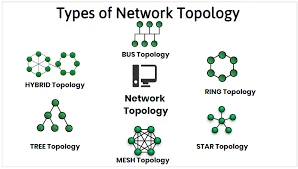
A network topology is the layout or structure of a network from the point of view of data flow.
There are five common topologies: bus, star, ring, mesh and tree.
What are the types of network topology?
- Bus: all devices connect to one main cable.
- Star: every device connects to a central hub or switch.
- Ring: each device connects to two neighbours, forming a closed loop.
- Mesh: each device connects to many or all of the other devices.
- Tree: several star networks are joined to a main cable, in layers.
What are the strengths and weaknesses of each topology?
| Topology | Strength | Weakness |
|---|---|---|
| Bus | Cheap and uses little cable | A fault in the main cable stops the network |
| Star | A faulty cable affects only one device | If the central device fails, the network fails |
| Ring | Each device gets an orderly turn to send data | A break in the loop can disrupt the network |
| Mesh | Very reliable, as data has many routes | Costly, because it needs many cables |
| Tree | Easy to expand in groups | Depends on the main cable |
What are network protocols?
Network protocols are the communication languages, or sets of rules, that computer devices use to exchange data.
- Networks can also be classified by the set of protocols they support.
- Networks often implement multiple protocols, with each supporting specific applications.
What are examples of network protocols?
- TCP/IP: the most common protocol on the Internet and in home networks.
- HTTP: transfers Web pages between a server and a browser.
- FTP: transfers files between computers.
- SMTP: sends email.
What are the Internet, an intranet and an extranet?
The Internet, an intranet and an extranet are three types of network that differ in who can use them and how they connect.
What is the Internet?
The Internet is the global system of interconnected computer networks that use the Internet protocol suite (TCP/IP) to link devices worldwide.
- It is a network of networks.
- It consists of private, public, academic, business and government networks of local to global scope.
- These networks are linked by a broad array of electronic, wireless and optical networking technologies.
The Internet carries an extensive range of information resources and services:
- World Wide Web (WWW): interlinked hypertext documents and applications.
- Electronic mail: messages sent between users.
- Telephony: voice calls over the network.
- Peer-to-peer networks: used for file sharing.
What is an intranet?
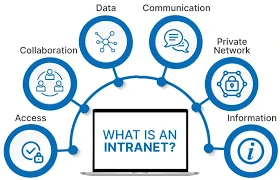
An intranet is a private network that is contained within an enterprise.
- It may consist of many interlinked local area networks.
- It may also use leased lines in the wide area network.
- It typically includes connections through one or more gateway computers to the outside Internet.
The main purposes of an intranet are:
- To share company information and computing resources among employees.
- To facilitate working in groups.
- To support teleconferences.
What is an extranet?
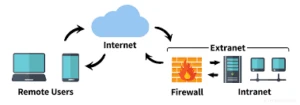
An extranet is a private network that uses Internet technology and the public telecommunication system to securely share part of a business’s information or operations with outsiders.
- Who can use it: suppliers, vendors, partners, customers or other businesses.
- Link to the intranet: it can be viewed as part of a company’s intranet that is extended to users outside the company.
- “State of mind”: it has also been described this way, as the Internet is seen as a way to do business with other companies and to sell products to customers.
What is the difference between the Internet, an intranet and an extranet?
| Feature | Internet | Intranet | Extranet |
|---|---|---|---|
| Type | Public, global | Private | Private |
| Users | Anyone with access | Employees of one organisation | Employees plus approved outsiders |
| Main use | Web, email, telephony, file sharing | Sharing company information and resources | Sharing part of a business’s information with partners and customers |
Evaluation
- Define networking, network design, network protocols and network topology.
- State two differences between a client/server network and a peer-to-peer network.
- Name three network topologies and describe one of them.
- Give two examples of network protocols and state what each does.
- Explain the meaning of Internet, intranet and extranet.
Assignment
State the two basic network design forms, then write short notes on an intranet and an extranet.
Teaching guide
Instructional techniques
- Identification
- Explanation
- Questions and answers
- Demonstration
- Videos from source
Instructional materials
- Videos
- Loudspeaker
- Pictures
- Data Processing for Senior Secondary Education by Hiit Plc
- WAPB Computer Studies for Senior Secondary I by Adekunle et al
- Online materials
Closing the lesson
- The teacher commends the students positively.
This term's Data Processing topics
SS3 First Term · 9 topics
Get Data Processing as PDF and Word
Every week of SS3 Data Processing, First Term, formatted and ready to print. Ad-free, and the copy lock comes off.
Get this term Card, bank transfer, USSD or OPay
SS3 Data Processing Lesson Notes for Other Topics
Computer Networking
Read the full lesson note.
Types of Network Devices
Read the full lesson note.
Internet I - Electronic Mail/ E-Mail Accounts
Read the full lesson note.
Internet II - Internet & Search Engines
Read the full lesson note.
Computer Virus
Read the full lesson note.
Maintenance of Computer I
Read the full lesson note.
Maintenance of Computer II
Read the full lesson note.

Career Opportunities in Data Processing
Read the full lesson note.
Introduction to Application Package
Read the full lesson note.
Word Processing
Read the full lesson note.
Word Processing II
Read the full lesson note.
Spreadsheet
Read the full lesson note.
Graphic Package - Corel Draw
Read the full lesson note.
Database Management System (DBMS)
Read the full lesson note.
Lesson Notes for Other Classes

SS1 Lesson Note
The complete lesson note to guide your studies.

SS2 Lesson Note
The complete lesson note to guide your studies.
