
The Eye – SS3 Biology Lesson Note (First Term)
Download this term · ₦1,000Lesson note at a glance
- Subject
- Biology
- Class
- SS3
- Term
- First Term
- Topic
- The Eye
- Order
- Topic 4 of 5 this term
- Reading time
- 6 min
The eye is the sense organ for sight, which detects light and changes it into nerve signals for the brain.
Behavioural objectives
By the end of the lesson, students should be able to:
- Describe the structure of the eye.
- State the functions of the various parts of the eye.
- Explain the role of the eye in image formation and accommodation.
- Identify common eye defects and how each is corrected.
- Identify common problems and diseases of the eye.
Instructional techniques and materials
Instructional techniques
- Identification: students name the parts on a labelled diagram.
- Explanation: the teacher explains the functions of each part.
- Questions and answers: short oral checks during the lesson.
- Demonstration: show pupil size changing in bright and dim light.
- Videos: short clips on image formation and eye defects.
Instructional materials
- Videos and loudspeaker
- Textbook
- Pictures and charts of the eye
What is the eye?
The eye is the organ of vision in humans and many animals.
- It detects light and converts it into electrical signals (nerve impulses).
- The optic nerve carries the signals to the brain for interpretation.
- It forms images and adjusts its focus for near and distant objects.
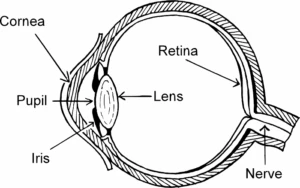
What are the main parts of the eye?
The main parts of the eye are the sclera, cornea, iris, pupil, lens, retina, optic nerve and the fluids inside the eyeball.
Outer parts
- Sclera: the tough, white outer layer that protects the eye and gives it support.
- Cornea: the transparent front of the eye, which bends light and does most of the focusing.
Parts that control and focus light
- Iris: the coloured part around the pupil, which controls the size of the pupil.
- Pupil: the opening in the centre of the iris, which lets light into the eye.
- Lens: a transparent, flexible structure behind the iris that focuses light onto the retina.
- Ciliary muscles: muscles that change the shape of the lens during accommodation.
Inner parts
- Retina: the innermost layer, holding light-sensitive cells (rods and cones) that change light into nerve signals.
- Optic nerve: carries nerve signals from the retina to the brain for visual processing.
- Blind spot: the point where the optic nerve leaves the eye, with no light-sensitive cells.
Fluids in the eye
- Aqueous humour: a clear fluid between the cornea and lens, which helps to maintain eye pressure.
- Vitreous humour: a clear, gel-like substance filling the large cavity behind the lens, which keeps the eyeball in shape.
What are rods and cones?
Rods and cones are the two kinds of light-sensitive cells in the retina.
- Rods: cells that work in dim light and give black-and-white vision.
- Cones: cells that work in bright light and detect colour.
| Feature | Rods | Cones |
|---|---|---|
| Light needed | Dim light | Bright light |
| Type of vision | Black and white | Colour |
| Fault leads to | Night blindness | Colour blindness |
How does the eye control the amount of light entering?
The iris changes the size of the pupil to control how much light enters the eye.
| Condition | Pupil | Reason |
|---|---|---|
| Bright light | Becomes smaller (constricts) | Protects the retina from too much light |
| Dim light | Becomes larger (dilates) | Lets in more light so we can see |
What are the functions of the eye?
The eye has two primary functions: image formation and accommodation.
How is an image formed in the eye?
An image is formed when light from an object is refracted (bent) to focus on the retina.
- Light from an object enters through the cornea, which bends it most.
- The light passes through the aqueous humour and the pupil.
- The lens refracts the light further to fine-focus it.
- The light passes through the vitreous humour to the retina.
- A small, inverted image forms on the retina.
- Rods and cones change the image into electrical signals.
- The optic nerve carries the signals to the brain, which interprets the image the right way up.
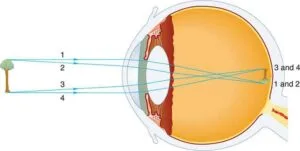
What is accommodation?
Accommodation is the ability of the eye to adjust its focus for objects at different distances.
- The ciliary muscles change the shape of the lens.
- This keeps images of near and distant objects sharply focused on the retina.
| Feature | Near object | Distant object |
|---|---|---|
| Ciliary muscles | Contract | Relax |
| Suspensory ligaments | Slacken | Pulled tight |
| Lens shape | Thicker (more curved) | Thinner (less curved) |
| Bending of light | Stronger | Weaker |
What are the common eye defects?
There are four common eye defects: myopia, hypermetropia, presbyopia and astigmatism.
Myopia (nearsightedness)
- Problem: difficulty seeing distant objects clearly.
- Cause: light focuses in front of the retina, often because the eyeball is too long.
- Correction: concave lenses.
Hypermetropia (farsightedness)
- Problem: difficulty focusing on close objects.
- Cause: light focuses behind the retina, often because the eyeball is too short.
- Correction: convex lenses.
Presbyopia
- Problem: an age-related difficulty with near vision.
- Cause: the lens loses elasticity, so it cannot focus on close objects.
- Correction: reading glasses or bifocals.
Astigmatism
- Problem: distorted or blurred vision at any distance.
- Cause: irregular curvature of the cornea or lens.
- Correction: cylindrical lenses.
Summary of eye defects
| Defect | Difficulty | Where light focuses | Correction |
|---|---|---|---|
| Myopia | Distant objects | In front of the retina | Concave lens |
| Hypermetropia | Near objects | Behind the retina | Convex lens |
| Presbyopia | Near objects (with age) | Behind the retina | Reading glasses or bifocals |
| Astigmatism | Blurred vision at all distances | Unevenly, because of uneven curvature | Cylindrical lens |
What are the common eye problems and diseases?
Common eye problems include cataract, night blindness, colour blindness, glaucoma, dry eye syndrome and conjunctivitis.
Cataract
- The lens becomes cloudy, which blurs vision.
- It is common with ageing but can also follow injury or other medical conditions.
- Treatment: surgical removal of the affected lens.
Night blindness (nyctalopia)
- Difficulty seeing in low light.
- It is often linked to vitamin A deficiency or conditions affecting the retina.
- Treatment: vitamin A supplements, foods rich in vitamin A, or treating the underlying cause.
Colour blindness
- Inability to tell certain colours apart, because the colour-sensitive cones are faulty or missing.
- Red and green are most commonly confused.
- It is inherited and has no cure, but special lenses may help.
Glaucoma
- Raised pressure inside the eye (intraocular pressure) damages the optic nerve.
- It can cause vision loss and blindness if untreated.
- Treatment: medication or surgery to reduce the pressure.
Dry eye syndrome
- The eyes make too few tears, or the tears are of poor quality.
- It causes discomfort, itching and blurred vision.
- Treatment: artificial tears, lifestyle changes or medical care.
Conjunctivitis
- Inflammation of the conjunctiva, the thin covering at the front of the eye.
- The eye becomes red, itchy and watery.
- It can be caused by bacteria, viruses or allergy, and infections spread by contact.
- Treatment: see a health worker for treatment, and wash hands often.
How can we care for our eyes?
- Diet: eat foods rich in vitamin A, such as carrots, liver and green vegetables.
- Hygiene: wash hands before touching the eyes and do not share towels.
- Protection: avoid looking at the sun and wear goggles when working with dust or chemicals.
- Reading: read in good light and hold books at a comfortable distance.
- Check-ups: have regular eye tests, and treat injuries or infections early.
Evaluation
- Name the eye defect corrected by a concave lens and state where light focuses in it.
- State the two primary functions of the eye.
- Describe what happens to the pupil in bright light.
- State the change in the lens when the eye focuses on a near object.
- Mention three eye problems or diseases.
Assignment
Describe how light forms an image on the retina, then state how myopia and hypermetropia are corrected.
This term's Biology topics
SS3 First Term · 5 topics
Get Biology as PDF and Word
Every week of SS3 Biology, First Term, formatted and ready to print. Ad-free, and the copy lock comes off.
Get this term Card, bank transfer, USSD or OPay
SS3 Biology Lesson Notes for Other Topics
Regulation Of Internal Environment II
Read the full lesson note.
Peripheral Nervous System
Read the full lesson note.
Sense Organ
Read the full lesson note.
Genetics
Read the full lesson note.
Chromosomes
Read the full lesson note.
Variation
Read the full lesson note.
Evolution
Read the full lesson note.
Adaptation
Read the full lesson note.
Biological diagrams/drawing
Read the full lesson note.
Spelling Drills of Biological Technical Terms
Read the full lesson note.
Lesson Notes for Other Classes

SS1 Lesson Note
The complete lesson note to guide your studies.

SS2 Lesson Note
The complete lesson note to guide your studies.
