
Biological Diagrams/drawing – SS3 Biology Lesson Note (Second Term)
Download this term · ₦1,000Lesson note at a glance
- Subject
- Biology
- Class
- SS3
- Term
- Second Term
- Topic
- Biological Diagrams/drawing
- Order
- Topic 5 of 6 this term
- Reading time
- 8 min
A biological diagram is a neat, labelled drawing of a living structure, such as the heart, brain, flower or neuron. It shows the parts and their positions accurately so that an examiner can see what you know.
Behavioural objectives
- State the points to remember when drawing a biological diagram.
- Explain why labelling and shading matter in a diagram.
- Draw and label the human heart, human brain, flower, mitochondrion, flowering plant and nerve cell (neuron).
- Name the important diagram topics in biology.
What are the key terms in biological drawing?
Key terms in biological drawing are the words used to describe how a diagram is drawn and labelled.
- Label: the name of a part, written at the end of a label line.
- Label line: a straight ruled line that joins a name to the part it names.
- Title: a short heading written below the diagram to say what it shows.
- Proportion: the correct size of each part compared with the other parts.
- Shading: light pencil marks or dots that show thicker or darker parts.
- Section: a drawing of a structure as if it were cut open, for example a longitudinal (lengthwise) section.
Which diagram topics are important in biology?
The structures below are often asked for in WAEC, NECO and school examinations, so practise each one until you can draw it from memory.
- Human heart: chambers, valves and large blood vessels.
- Human brain: cerebrum, cerebellum and medulla oblongata.
- Flower: male and female parts with the outer rings.
- Mitochondrion: membranes, cristae and matrix.
- Flowering plant: shoot system and root system.
- Nerve cell (neuron): cell body, dendrites and axon.
- Spinal cord: diagram of the cord and its covering.
- Liver: diagram of the organ and its vessels.
- Skin: section showing its layers.
- Tongue: diagram showing the taste areas.
- Sycon: section of this simple sponge.
- Human eye and human ear: two separate diagrams of the sense organs.
- Kidney: section of the excretory organ.
- Tooth: section showing its parts.
What should you remember when drawing a diagram?
Five points help you draw a good biological diagram: neatness, size, labelling, shading and practice.
- Neatness: make sure that the diagram is neat and clear.
- Size: a good diagram is large and drawn with a sharp pencil.
- Labelling: an unlabelled diagram is an incomplete diagram.
- Shading: use shading wherever possible, because a well-presented diagram can fetch more marks.
- Practice: practise often, so that you draw faster and make fewer mistakes.
How do you present a diagram step by step?
A biological diagram is presented in seven steps, from reading the question to shading.
- Read the question to see exactly which structure, and which view (for example a longitudinal section), is required.
- Use a sharp HB pencil. Draw with single, continuous lines and rub out mistakes cleanly.
- Draw the diagram large, using at least half of the page, with the correct shape and proportions.
- Draw label lines with a ruler. Each line should touch the part it names, should not cross another line and should have no arrowhead.
- Write the names horizontally in clear print, in a neat column at the side of the diagram.
- Write a title below the diagram and underline it, for example: Longitudinal section of a flower.
- Shade lightly with pencil (or use dots) only where it shows thicker or darker parts. Heavy shading hides the details.
What mistakes lose marks in a diagram?
Six common mistakes lose marks in a diagram, and each has a simple correction.
| Mistake | Effect | Correction |
|---|---|---|
| No labels | Label marks are lost | Name every part shown |
| Small, crowded drawing | Parts cannot be seen | Use at least half of the page |
| Label lines that cross | The reader cannot tell which name belongs to which part | Draw straight lines with a ruler |
| Arrowheads on label lines | The diagram looks untidy | End each line on the part, with no arrowhead |
| Heavy shading | Details are hidden | Shade lightly or use dots |
| No title | The examiner cannot tell what is shown | Write and underline a title below |
Why do labelling and shading matter?
Labelling shows that you know the parts, and shading shows thickness and depth, so both earn marks.
- Labelling shows knowledge: it proves that you know the name and position of each part.
- Separate marks: marks are usually given for the drawing and for the labels, so a good drawing with no labels loses marks.
- Shading shows depth: it separates parts such as thick muscle walls and hollow chambers.
- Shading helps reading: it makes the diagram easier to read.
How do you draw common biological diagrams?
Each common diagram is drawn by starting with the outline, adding the inner parts in order, then labelling and shading.
How do you draw the human heart?
The human heart is the muscular organ that pumps blood round the body.
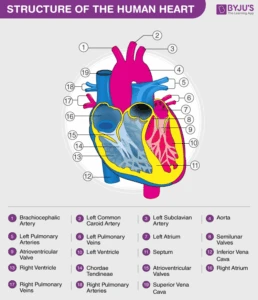
- Draw the outline of the heart first.
- Draw the septum, which divides the left and right sides.
- Mark the four chambers: two atria above and two ventricles below.
- Add the large vessels: vena cava, aorta, pulmonary artery and pulmonary vein.
- Show the tricuspid valve (right side) and the bicuspid valve (left side).
- Draw the wall of the left ventricle thickest, then label and shade.
- Theory: Human Heart
How do you draw the human brain?
The human brain is the organ inside the skull that controls the activities of the body.
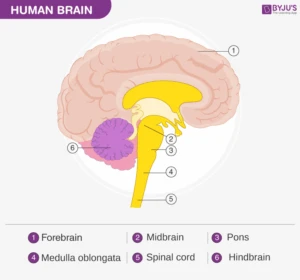
- Start with the large cerebrum, with its creases and folds.
- Add the cerebellum beneath the back of the cerebrum.
- Add the medulla oblongata, which joins the spinal cord.
- If asked, add the pituitary gland and hypothalamus.
- Shade the different areas lightly to fetch more marks.
- Theory: Human Brain
How do you draw a flower?
A flower is the reproductive part of a flowering plant, made of four rings of parts on a receptacle.

- Stamens: the male parts, each made of an anther and a filament.
- Carpel: the female part, made of stigma, style and ovary containing ovules.
- Sepals and petals: the outer rings that surround the stamens and carpel.
- Receptacle: the swollen stalk tip that holds all the parts.
- Tip: show the male and female parts separately and label them correctly.
- Draw the receptacle at the base.
- Add the sepals and petals around it.
- Draw the carpel in the centre, with stigma, style and ovary.
- Draw the stamens beside the carpel, each with an anther and a filament.
- Label, give a title and shade lightly.
- Theory: Parts of a Flower
How do you draw a mitochondrion?
A mitochondrion is a small cell organelle where aerobic respiration releases energy for the cell.
- Mitochondria: cell organelles found in animal and plant cells (singular: mitochondrion).
- Shape: a small, oval structure.
- Outer membrane: smooth, and covers the whole organelle.
- Inner membrane: folded inwards.
- Cristae: the folds of the inner membrane.
- Matrix: the fluid inside the inner membrane.
- Function: the site of aerobic respiration, which releases energy for the cell.
- Draw a large oval for the outer membrane.
- Draw a second oval inside it for the inner membrane.
- Draw the cristae as folds of the inner membrane pointing into the matrix.
- Label the outer membrane, inner membrane, cristae and matrix.
- Theory: Mitochondria
How do you draw a flowering plant?
A flowering plant (angiosperm) is a plant that produces flowers and has a shoot system and a root system.

- Flowering plants: also called angiosperms, members of the plant kingdom.
- Shoot system: the part above the ground, with stem, leaves, buds, flower and fruit.
- Root system: the part below the ground, with the main root and lateral roots.
- Node and internode: a node is where a leaf joins the stem. An internode is the stem between two nodes.
- Theory: Morphology Of Flowering Plants
How do you draw a nerve cell (neuron)?
A neuron is a nerve cell that passes messages to other neurons and cells as electrical impulses.
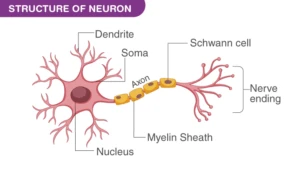
- Neuron: another name for a nerve cell. It passes messages to other neurons and cells as electrical impulses.
- Cell body: the main part, containing the nucleus.
- Dendrites: short branching fibres on one side of the cell body.
- Axon: a long fibre on the other side, often covered by a myelin sheath.
- Axon terminals: the endings of the axon.
- Draw the cell body and put the nucleus inside it.
- Draw short, branching dendrites on one side.
- Draw a long axon leaving the opposite side.
- Show the myelin sheath along the axon, then the axon terminals at the end.
- Label each part and give a title.
Which parts must be labelled on each diagram?
The table lists the main parts to label on each of the six common diagrams.
| Diagram | Main parts to label |
|---|---|
| Human heart | Right and left atria, right and left ventricles, septum, tricuspid valve, bicuspid valve, vena cava, aorta, pulmonary artery, pulmonary vein |
| Human brain | Cerebrum, cerebellum, medulla oblongata, spinal cord, and usually the pituitary gland and hypothalamus |
| Flower | Sepal, petal, stamen (anther and filament), carpel (stigma, style, ovary, ovule), receptacle |
| Mitochondrion | Outer membrane, inner membrane, cristae, matrix |
| Flowering plant | Flower, fruit, leaf, stem, node, internode, bud, main root, lateral roots |
| Neuron | Dendrites, cell body, nucleus, axon, myelin sheath, axon terminals |
Evaluation
- List four points to remember when drawing a biological diagram.
- Why is an unlabelled diagram considered incomplete?
- How can shading help you in an examination?
- Name three of the important diagram topics in biology.
- What is another name for a nerve cell?
Assignment
Draw a neat diagram of the human heart and another of the flower, label each fully, give each a title and shade where possible, using the theory links in this note to check the parts.
This term's Biology topics
SS3 Second Term · 6 topics
- Chromosomes
- Variation
- Evolution
- Adaptation
- Biological Diagrams/drawing
- Spelling Drills of Biological Technical Terms
Get Biology as PDF and Word
Every week of SS3 Biology, Second Term, formatted and ready to print. Ad-free, and the copy lock comes off.
Get this term Card, bank transfer, USSD or OPay
SS3 Biology Lesson Notes for Other Topics
Chromosomes
Read the full lesson note.

Variation
Read the full lesson note.

Evolution
Read the full lesson note.

Adaptation
Read the full lesson note.
Spelling Drills of Biological Technical Terms
Read the full lesson note.

Regulation Of Internal Environment II
Read the full lesson note.

Peripheral Nervous System
Read the full lesson note.

Sense Organ
Read the full lesson note.

The Eye
Read the full lesson note.
Genetics
Read the full lesson note.
Lesson Notes for Other Classes

SS1 Lesson Note
The complete lesson note to guide your studies.

SS2 Lesson Note
The complete lesson note to guide your studies.
