
Chromosomes – SS3 Biology Lesson Note (Second Term)
Download this term · ₦1,000Lesson note at a glance
- Subject
- Biology
- Class
- SS3
- Term
- Second Term
- Topic
- Chromosomes
- Order
- Topic 1 of 6 this term
- Reading time
- 8 min
A chromosome is a thread-like structure in the nucleus of a eukaryotic cell, made of DNA and protein, that carries genes from parents to offspring.
Behavioural objectives
By the end of the lesson, students should be able to:
- describe the location and structure of chromosomes;
- distinguish between autosomes and sex chromosomes;
- explain the role of chromosomes in the transmission of hereditary characters;
- list examples of sex-linked traits and other inherited conditions in human beings;
- calculate simple probabilities in genetics;
- state applications of the principles of heredity in agriculture and medicine.
Where are chromosomes found?
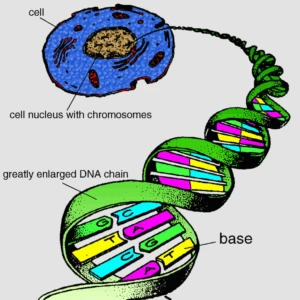
Chromosomes are found in the nucleus of eukaryotic cells, where they occur in pairs.
- Chromatin: thread-like granules in the nucleus that condense into chromosomes.
- Homologous chromosomes: a pair of chromosomes of the same shape and size, one from each parent.
- Diploid number (2n): the number of chromosomes in each somatic (body) cell. In humans it is 46, in 23 pairs.
- Haploid number (n): the number of chromosomes in a gamete. In humans it is 23.

What is the structure of a chromosome?
A chromosome is made of two chromatids joined at a centromere, and each chromatid contains DNA wound around protein.
- Chromatids: the two identical threads that make up one chromosome.
- Centromere: the point where the two chromatids are joined.
- Protein: protein units around which the DNA strand is coiled.
- DNA: deoxyribonucleic acid, a double helix that runs through the chromosome.
- Genes: segments of the DNA arranged along its length.
What is DNA?
DNA is a very large molecule made of repeating units called nucleotides, arranged as a double helix.
- Deoxyribose: the sugar part of each nucleotide.
- Phosphate: the phosphate part of each nucleotide.
- Nitrogenous base: adenine, guanine, thymine or cytosine.
- Complementary strands: the two helical chains, because the bases on one strand fix the bases on the other.
| Base | Always pairs with |
|---|---|
| Adenine | Thymine |
| Guanine | Cytosine |
What are condensation and replication?
Condensation is the tight coiling of DNA that makes chromosomes short and visible, and replication is the process by which DNA makes an exact copy of itself.
Condensation
- Just before cell division, the protein bundles come together.
- The DNA strands coil tightly around them.
- The chains shorten and become visible under the light microscope.
Replication
- Gene content: each DNA molecule carries thousands of genes.
- Copying: the double helix unwinds, and each strand guides the building of a new complementary strand.
- Importance: replication is the basis for passing hereditary material from parents to offspring.
What are autosomes and sex chromosomes?
Autosomes are chromosomes that do not determine sex, while sex chromosomes are the pair that determines sex.
| Feature | Autosomes | Sex chromosomes |
|---|---|---|
| Number in humans | 44 (22 pairs) | 2 (one pair) |
| Shape and size | Similar in males and females | Differ between males and females (X and Y) |
| Genotype | Not applicable | XX in females, XY in males |
| Function | Carry genes for body characters | Determine sex and carry sex-linked genes |
Sex chromosomes in other organisms
- Birds, moths and butterflies: the female is the sex with two different chromosomes (ZW) and the male has two alike (ZZ). Some texts write these as XY and XX.
- Certain grasshoppers: the Y chromosome is absent, so the male is XO.
What is the role of chromosomes in the transmission of hereditary characters?
Chromosomes carry the genes, so they pass characters from parents to offspring.
- Genes: the units of hereditary characters, located on the chromosomes of body cells.
- Homologous pairs: carry genes for the same characteristics, for example tallness and shortness.
- Loci: genes for the same character occupy identical positions (loci) on the homologous pair.
- Genotype: the genes on a homologous pair decide whether the individual is homozygous or heterozygous for a character.
Key terms in heredity
| Term | Meaning |
|---|---|
| Homozygous | Two identical genes for a character, for example AA or aa |
| Heterozygous | Two different genes for a character, for example Aa (hybrid) |
| Dominant gene | A gene whose effect shows when present in one copy |
| Recessive gene | A gene whose effect shows only when two copies are present |
| Genotype | The genes an organism carries for a character |
| Phenotype | The visible expression of the genes |
How do chromosomes transmit hereditary characters?
Chromosomes transmit characters by passing genes into gametes in meiosis and joining them at fertilisation.
- The chromosomes pass the genes into the gametes during meiosis.
- Homologous chromosomes separate into two daughter cells in the first stage of meiosis.
- The two chromatids of each chromosome separate in the second stage of meiosis. Each gamete has one set of chromosomes and one copy of each gene.
- At fertilisation, the gametes fuse to form a zygote. The zygote gets one gene for each character from the egg and one from the sperm.
- If the two genes are the same, the offspring is homozygous. If they are different, it is heterozygous (hybrid).
What are sex-linked traits?
Sex-linked traits are characteristics whose genes are carried on the X chromosome instead of on autosomes.
- Inheritance: the genes are inherited along with the X chromosome.
- Control: they are controlled by a recessive gene.
- In males: a male (XY) has only one X chromosome, so a single recessive gene shows.
- In females: a female (XX) shows the trait only when both X chromosomes carry the recessive gene.
Examples of sex-linked traits
- Colour blindness: a colour-blind person cannot tell near colours apart. The gene affecting the cone cells (light receptors) in the retina is abnormal.
- Haemophilia: bleeding takes an abnormally long time to stop, or does not stop, because blood clots very slowly or not at all. Small injuries can cause the victim to bleed to death. Queen Victoria’s lineage in the British Royal Family is a known example.
- Baldness: a recessive gene makes the hair on the upper head fall out early. It is more common in men.
Other inherited conditions controlled by recessive genes
Albinism and sickle cell anaemia are controlled by recessive genes carried on autosomes.
- Albinism: the skin is not pigmented because the pigment melanin is lacking.
- Sickle cell anaemia: the recessive gene makes the haemoglobin abnormal, so some red blood cells become sickle-shaped.
Effects of sickle cell anaemia
- The abnormal haemoglobin carries oxygen poorly.
- When oxygen is low, the red blood cells become sickle-shaped.
- The sickled cells block the small blood vessels and hinder blood flow.
- The affected body part receives less blood, oxygen and nutrients.
- The victim goes into crisis, with pains in the bones and joints.
What is probability in genetics?
Probability is the chance that an event will occur, expressed as a number from 0 to 1.
- Formula: probability = number of times an event occurs ÷ total number of trials.
- Mendel: Gregor Mendel’s work was based on probability.
Principles of probability
- The result of one trial of a chance event does not affect the result of later trials of the same event.
- The chance that two independent events occur together is the product of their separate chances.
Worked example: two carriers of the albino gene (Aa × Aa)
| Gametes | A | a |
|---|---|---|
| A | AA (normal) | Aa (carrier) |
| a | Aa (carrier) | aa (albino) |
- Albino child: 1 in 4, or ¼.
- Two albino children in a row: ¼ × ¼ = 1/16.
Worked example: sickle cell anaemia
| Parents | Children | Chance of sickle cell anaemia |
|---|---|---|
| HbAHbA × HbAHbS | ½ HbAHbA, ½ HbAHbS | 0 |
| HbAHbS × HbAHbS | ¼ HbAHbA, ½ HbAHbS, ¼ HbSHbS | ¼ |
Worked example: sex of a child (XX × XY)
- Female gametes: all carry X.
- Male gametes: half carry X and half carry Y.
- Result: the chance of a girl (XX) is ½ and the chance of a boy (XY) is ½.
What are the applications of the principles of heredity?
The principles of heredity are used in agriculture to improve crops and animals, and in medicine to prevent and diagnose disease.
Applications in agriculture
- Breeding methods: cross-fertilisation and self-fertilisation procedures.
- Early maturity: development of early maturing varieties.
- Disease resistance: development of disease-resistant varieties.
- Adaptation: production of crops and animals that suit the climate.
- Yield: improvement of the quality and quantity of products.
Applications in medicine
- Paternity: determination of the father of a child.
- Blood transfusion: matching blood groups.
- Diagnosis: identifying diseases.
- Sex determination: finding the sex of a baby.
- Marriage counselling: avoiding genetic disorders in children.
- Choice of sex: knowing and choosing the sex of a baby.
- Test tube babies: development of in vitro fertilisation.
Biotechnology and genetic engineering
- Biotechnology: the use of living things or their parts to make useful products. These applications belong to it.
- Genetic engineering: the manipulation of DNA for the benefit of humanity.
Evaluation
- Define a chromosome and describe its structure.
- Differentiate between autosomes and sex chromosomes.
- Give three examples of sex-linked traits in human beings.
- State five applications of genetics in medicine.
- What is the probability of a child with sickle cell anaemia from parents with genotypes (a) AA and AS, and (b) AS and AS?
Assignment
Read College Biology, chapter 18, pages 410 to 412. Then answer: a heterozygous (Aa) man with normal skin colour marries an albino woman (aa). Draw a Punnett square and state the probability that their child is albino.
References
- Modern Biology for Senior Secondary Schools by S.T. Ramalingam
- Essential Biology by M.C. Michael
- College Biology by Idodo-Umeh
- SSCE past questions and answers
- UTME, SSCE and Cambridge past questions and answers
- Biology practical text
This term's Biology topics
SS3 Second Term · 6 topics
Get Biology as PDF and Word
Every week of SS3 Biology, Second Term, formatted and ready to print. Ad-free, and the copy lock comes off.
Get this term Card, bank transfer, USSD or OPay
SS3 Biology Lesson Notes for Other Topics
Variation
Read the full lesson note.
Evolution
Read the full lesson note.
Adaptation
Read the full lesson note.
Biological diagrams/drawing
Read the full lesson note.
Spelling Drills of Biological Technical Terms
Read the full lesson note.
Regulation Of Internal Environment II
Read the full lesson note.
Peripheral Nervous System
Read the full lesson note.
Sense Organ
Read the full lesson note.
The Eye
Read the full lesson note.
Genetics
Read the full lesson note.
Lesson Notes for Other Classes

SS1 Lesson Note
The complete lesson note to guide your studies.

SS2 Lesson Note
The complete lesson note to guide your studies.
