
Peripheral Nervous System – SS3 Biology Lesson Note (First Term)
Download this term · ₦1,000Lesson note at a glance
- Subject
- Biology
- Class
- SS3
- Term
- First Term
- Topic
- Peripheral Nervous System
- Order
- Topic 2 of 5 this term
- Reading time
- 5 min
The peripheral nervous system (PNS) is the network of nerves that connects the brain and spinal cord to the rest of the body and the external environment.
Behavioural objectives
- Define the peripheral nervous system.
- Describe a flowchart representing the different parts of the PNS.
- Identify the systems that make up the PNS.
- Compare the sympathetic and parasympathetic nervous systems.
- State the functions of the PNS.
Instructional techniques
- Identification
- Explanation
- Questions and answers
- Demonstration
- Videos from source
Instructional materials
- Videos
- Loudspeaker
- Textbook
- Pictures
What is the peripheral nervous system?
The peripheral nervous system is made up of all the nerves found outside the brain and spinal cord.
- Nervous system: the controlling system of the body, made up of nerve cells and organs.
- Central nervous system (CNS): the brain and the spinal cord.
- Peripheral nervous system (PNS): the nerves that connect the brain and spinal cord to the rest of the body.
- Nerve: a bundle of nerve fibres that carries impulses.
- Impulse: the electrical signal carried along a nerve fibre.
What are the parts of the PNS?
The PNS divides into two systems, the somatic and the autonomic nervous systems.
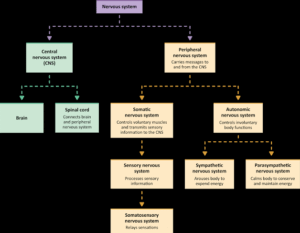
- Peripheral nervous system: divides into the somatic and autonomic nervous systems.
- Somatic nervous system: made up of cranial nerves and spinal nerves.
- Autonomic nervous system: made up of the sympathetic and parasympathetic systems.
What is the difference between the CNS and the PNS?
The CNS processes information and gives commands, while the PNS carries impulses between the CNS and the body.
- CNS: the brain and spinal cord, protected by the skull and vertebral column.
- PNS: the nerves that lie outside the brain and spinal cord.
| Feature | CNS | PNS |
|---|---|---|
| Parts | Brain and spinal cord | Cranial nerves, spinal nerves and their branches |
| Position | Inside the skull and vertebral column | Outside the brain and spinal cord |
| Main role | Processes information and gives commands | Carries impulses between the CNS and the body |
What are the types of nerves in the PNS?
There are three types of nerves: sensory, motor and mixed nerves.
- Sensory nerve: carries impulses from sense organs and receptors to the CNS.
- Motor nerve: carries impulses from the CNS to muscles and glands.
- Mixed nerve: contains both sensory and motor fibres, as in the spinal nerves.
What are the two divisions of the PNS?
The two divisions of the PNS are the somatic nervous system and the autonomic nervous system.
- Somatic nervous system: serves skeletal muscles and is under voluntary control.
- Autonomic nervous system: serves involuntary organs and smooth muscles.
What is the somatic nervous system?
The somatic nervous system is the part of the PNS that serves skeletal muscles and the sense organs.
- Main function: transfers impulses from the CNS to skeletal muscles.
- Sensory role: also carries impulses from sense organs, such as the eye and skin, to the CNS.
- Example: moving your hand to pick up a pen is a voluntary action.
- Parts: cranial nerves and spinal nerves.
What are cranial nerves?
Cranial nerves are the 12 pairs of nerves that emerge from the brain.
- Number: 12 pairs.
- Origin: they emerge from the brain.
- Optic nerve: carries impulses from the eye to the brain.
- Olfactory nerve: carries impulses for smell from the nose to the brain.
What are spinal nerves?
Spinal nerves are the 31 pairs of nerves that emerge from the spinal cord.
- Number: 31 pairs.
- Origin: they emerge from the spinal cord through a dorsal root and a ventral root.
- Dorsal root: carries sensory fibres into the spinal cord.
- Ventral root: carries motor fibres out of the spinal cord.
- Junction of the roots: the two roots join to form one mixed spinal nerve.
What is the autonomic nervous system?
The autonomic nervous system is the part of the PNS that controls involuntary organs and smooth muscles without conscious thought.
- Main function: relays impulses from the CNS to involuntary organs and smooth muscles.
- Examples of organs served: heart, stomach, intestines, blood vessels and glands.
- Control: it works without conscious thought.
- Parts: the sympathetic and parasympathetic nervous systems.
- Working together: the two parts have opposite effects on the same organ and keep it balanced.
What is the sympathetic nervous system?
The sympathetic nervous system prepares the body for action in times of danger, fear or excitement.
- Origin: nerves arising from the thoracic and lumbar regions of the spinal cord.
- Role: prepares the body for violent action in abnormal conditions, such as danger or fear.
- Hormone: its action is generally supported by adrenaline.
- Example: your heart pounds when a loud bang startles you.
What is the parasympathetic nervous system?
The parasympathetic nervous system returns the body to normal conditions when the danger or action is over.
- Origin: nerves from the head and neck region (cranial) and from the sacral region of the spinal cord.
- Role: re-establishes normal conditions when the violent action is over.
- Example: your heart rate slows and digestion speeds up when you rest after a meal.
What is the difference between the sympathetic and parasympathetic systems?
The sympathetic system speeds up body activities for action, while the parasympathetic system slows them down to normal.
| Organ or feature | Sympathetic | Parasympathetic |
|---|---|---|
| Origin | Thoracic and lumbar spinal cord | Cranial and sacral regions |
| Overall effect | Prepares the body for action | Returns the body to normal |
| Heart rate | Increases | Decreases |
| Pupil of the eye | Dilates | Constricts |
| Digestion | Slows down | Speeds up |
| Breathing rate | Increases | Decreases |
What is the difference between the somatic and autonomic systems?
The somatic system is under voluntary control, while the autonomic system works involuntarily.
| Feature | Somatic | Autonomic |
|---|---|---|
| Organs served | Skeletal muscles | Involuntary organs and smooth muscles |
| Control | Voluntary | Involuntary |
| Parts | Cranial and spinal nerves | Sympathetic and parasympathetic |
What are the functions of the peripheral nervous system?
The PNS connects the CNS to the body and helps to control muscles, glands and internal conditions.
- Connection: connects the brain and spinal cord to the rest of the body and the external environment.
- Homeostasis: regulates the internal conditions of the body.
- Muscle control: regulates the strength of muscle contraction.
- Secretions: controls the release of secretions from most exocrine glands.
Evaluation
- What is the PNS?
- What are the two divisions of the peripheral nervous system?
- State two differences between the central nervous system and the peripheral nervous system.
- State two effects of the sympathetic nervous system on the body.
- How many pairs of cranial nerves and spinal nerves does a human have?
Assignment
- Draw a flowchart of the peripheral nervous system, from the PNS down to the sympathetic and parasympathetic systems. Write one function beside each part.
This term's Biology topics
SS3 First Term · 5 topics
- Regulation of Internal Environment II
- Peripheral Nervous System
- Sense Organ
- The Eye
- Genetics
Get Biology as PDF and Word
Every week of SS3 Biology, First Term, formatted and ready to print. Ad-free, and the copy lock comes off.
Get this term Card, bank transfer, USSD or OPay
SS3 Biology Lesson Notes for Other Topics
Regulation Of Internal Environment II
Read the full lesson note.
Sense Organ
Read the full lesson note.
The Eye
Read the full lesson note.
Genetics
Read the full lesson note.
Chromosomes
Read the full lesson note.
Variation
Read the full lesson note.
Evolution
Read the full lesson note.
Adaptation
Read the full lesson note.
Biological diagrams/drawing
Read the full lesson note.
Spelling Drills of Biological Technical Terms
Read the full lesson note.
Lesson Notes for Other Classes

SS1 Lesson Note
The complete lesson note to guide your studies.

SS2 Lesson Note
The complete lesson note to guide your studies.
