
Logarithm – SS2 Mathematics Lesson Note (First Term)
Download this term · ₦1,000Lesson note at a glance
- Subject
- Mathematics
- Class
- SS2
- Term
- First Term
- Topic
- Logarithm
- Order
- Topic 1 of 8 this term
- Reading time
- 4 min
The base ten logarithm of a number is the power to which 10 is raised to give that number.
Behavioural objectives
By the end of the lesson, students should be able to:
- write large and small numbers in standard form;
- add and subtract numbers in standard form and leave the answer in standard form;
- state the base ten logarithm of a number and identify its integer part;
- use log tables to find the complete logarithm of a number greater than one;
- multiply and divide numbers greater than one using logarithms.
What is standard form?
Standard form is a way of writing a number as A × 10x, where 1 ≤ A < 10 and x is an integer.
- A: a number from 1 up to, but not including, 10.
- x: the power of 10, which must be a whole number (positive, negative or zero).
What are large numbers and small numbers?
Numbers are grouped into two kinds: large numbers and small numbers.
- Large numbers: numbers greater than or equal to 1. The power x is zero or positive.
- Small numbers: numbers less than 1. The power x is negative.
How do we write numbers as powers of ten?
A number such as 10000 can be written as 10x, where x is the number of places the decimal point moves.
| Number | Power of ten |
|---|---|
| 10000 | 104 |
| 100 | 102 |
| 10 | 101 |
| 1 | 100 |
| 0.1 | 10-1 |
| 0.001 | 10-3 |
How do we write a number in standard form?
- Place the decimal point after the first non-zero digit to get A.
- Count the places the point has moved.
- For a whole number, the point moves to the left, so x is positive.
- For a number less than 1, the point moves to the right, so x is negative.
- Write A × 10x.
Note: One-tenth, one-hundredth and so on are written as negative powers of 10.
Worked examples on standard form
Example 1. Express in standard form: (a) 0.08356 (b) 832.8
- (a) 0.08356 = 8.356 × 10⁻²
- (b) 832.8 = 8.328 × 10²
Example 2. Express the following in standard form:
| Number | Standard form |
|---|---|
| 39.32 | 3.932 × 101 |
| 4.83 | 4.83 × 100 |
| 0.005321 | 5.321 × 10⁻³ |
How do we add and subtract numbers in standard form?
Make the powers of 10 the same, then add or subtract the numbers in front and keep the common power of 10.
- Check the powers of 10 in both numbers.
- If they differ, rewrite the number with the smaller power so that it uses the larger power.
- Add or subtract the numbers in front.
- Keep the common power of 10.
- Make sure the answer is still in standard form.
Example. Evaluate the following, leaving your answer in standard form:
- 4.72 × 10³ + 3.648 × 10³
- 6.142 × 10⁵ + 7.32 × 10⁴
- 7.113 × 10⁻⁵ – 8.13 × 10⁻⁶
Solution
(i) 4.72 × 10³ + 3.648 × 103
= (4.72 + 3.648) × 103
= 8.368 × 10³
(ii) 6.142 × 10⁵ + 7.32 × 104
= 6.142 × 10⁵ + 0.732 × 105
= (6.142 + 0.732) × 105
= 6.874 × 10⁵
(iii) 7.113 × 10⁻⁵ – 8.13 × 10-6
= 7.113 × 10⁻⁵ – 0.813 × 10-5
= (7.113 – 0.813) × 10-5
= 6.3 × 10⁻⁵
What is a logarithm?
The base ten logarithm of a number is the power to which 10 is raised to give that number.
- Example: 628000 = 105.7980, so log 628000 = 5.7980.
- Integer part: the whole-number part of the logarithm, also called the characteristic.
- Decimal part: the part after the decimal point, also called the mantissa.
- Link with standard form: in A × 10x, the power x is the integer part of the logarithm.
How do we find the logarithm of a number greater than one?
Write the number in standard form, then add the power of 10 to the logarithm of A.
Example: find log 628000.
628000 = 6.28 × 10⁵
628000 = 100.7980 × 105
= 100.7980 + 5
= 105.7980
So log 628000 = 5.7980
- Integer part: 5, the power of 10 in standard form.
- Decimal part: 0.7980, the logarithm of 6.28 from the table.
For example, log 7853 has integer part 3 because 7853 = 7.853 × 10³.
How do we use log tables to find the complete logarithm?
- Write the number in standard form and note the power of 10. This is the integer part.
- Use the first two digits of A to pick the row in the log table.
- Use the third digit of A to pick the column.
- Read the value. If A has a fourth digit, add the mean difference for that digit from the same row.
- Write the integer part, then the decimal part from the table.
Quick rule: for a number greater than one, the integer part is the number of digits before the decimal point, minus 1.
Examples
Use log tables to find the complete logarithm of the following numbers:
| Number | Standard form | Complete logarithm |
|---|---|---|
| 80030 | 8.003 × 10⁴ | 4.9033 |
| 8 | 8 × 100 | 0.9031 |
| 135.80 | 1.358 × 10² | 2.1329 |
How do we multiply and divide numbers greater than one using logarithms?
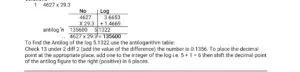
Add the logarithms to multiply and subtract them to divide, then find the number that has the answer as its logarithm.
- Find the logarithm of each number from the log table.
- For multiplication, add the logarithms.
- For division, subtract the logarithm of the divisor from the logarithm of the dividend.
- Use the antilogarithm table to find the number whose logarithm is the result.
- Multiplication law: log (a × b) = log a + log b.
- Division law: log (a ÷ b) = log a – log b.
Examples
Evaluate using logarithms.
- 4627 × 29.3
- 8198 ÷ 3.905
- 48.63 × 8.53

Evaluation
- Use the table to find the complete logarithm of: (a) 183 (b) 89500 (c) 10.1300 (d) 7
- Express in standard form: (a) 4520 (b) 0.00673
- State the integer part of the logarithm of 4520.
- Evaluate, leaving your answer in standard form: 3.5 × 10⁴ + 2.1 × 10³
Assignment
Answer all parts of this task.
- Express in standard form: (a) 6395 (b) 0.0407
- Evaluate, leaving your answer in standard form: 5.2 × 10³ + 2.4 × 10³
- Use log tables to find the complete logarithm of (a) 2750 (b) 90.5
This term's Mathematics topics
SS2 First Term · 8 topics
Get Mathematics as PDF and Word
Every week of SS2 Mathematics, First Term, formatted and ready to print. Ad-free, and the copy lock comes off.
Get this term Card, bank transfer, USSD or OPay
SS2 Mathematics Lesson Notes for Other Topics
Logarithm II
Read the full lesson note.

Sequence And Series - Arithmetic Progression
Read the full lesson note.
Geometric Progression
Read the full lesson note.
Factorization Of Quadratic Equations
Read the full lesson note.
Factorization Of Quadratic Equations II - - Word Problems
Read the full lesson note.
Simultaneous Linear Equation
Read the full lesson note.
Simultaneous Linear Equation II
Read the full lesson note.
Straight Lines Graphs
Read the full lesson note.

Inequalities
Read the full lesson note.
Circle Theorem
Read the full lesson note.

Trigonometric Ratios
Read the full lesson note.
Algebraic Fractions
Read the full lesson note.

Surds
Read the full lesson note.

Chords Properties Of Circle
Read the full lesson note.

Graph Of Linear Inequality In Two Variables
Read the full lesson note.
Lesson Notes for Other Classes

SS1 Lesson Note
The complete lesson note to guide your studies.

SS3 Lesson Note
The complete lesson note to guide your studies.
