
Inequalities – SS2 Mathematics Lesson Note (Second Term)
Lesson note at a glance
- Class
- SS2
- Subject
- Mathematics
- Term
- Second Term
- Reading time
- 5 min
An inequality is a statement that compares two expressions using a symbol such as < or >.
Behavioural objectives
By the end of the lesson, students should be able to:
- state the rules for solving inequalities;
- solve linear inequalities in one variable;
- represent linear inequalities on a number line;
- say what a solution of an inequality in two variables is;
- express an inequality in two variables with y in terms of x to find the boundary values of the solution region.
What are the inequality symbols?
There are four inequality symbols: less than, greater than, less than or equal to, and greater than or equal to.
| Symbol | Meaning | Example |
|---|---|---|
| < | is less than | x < 8: x can be 7, 0 or -3, but not 8 |
| > | is greater than | x > 2: x can be 3 or 10, but not 2 |
| ≤ | is less than or equal to | x ≤ 5: x can be 5 or any smaller number |
| ≥ | is greater than or equal to | x ≥ -3: x can be -3 or any larger number |
- Solution: any value of the variable that makes the inequality true.
- Difference from an equation: an inequality usually has many solutions, not just one.
What are the rules for solving inequalities?
There are three rules for solving inequalities, and they are used to find all values of the variable that satisfy it.
Rule 1: add or subtract
- Add the same number or expression to both sides, or subtract it from both sides.
- Keep the inequality sign.
- Example: x – 3 > 2 gives x > 5.
Rule 2: multiply or divide by a positive number
- Multiply or divide both sides by the same positive number.
- Keep the inequality sign.
- Example: 2x < 8 gives x < 4.
Rule 3: multiply or divide by a negative number
- Multiply or divide both sides by the same negative number.
- Reverse the inequality sign.
- Example: -2x < 8 gives x > -4.
What is a linear inequality in one variable?
A linear inequality in x is an inequality in which the highest power of x is one (unity).
- Example: 3x – 1 > x + 1 is a linear inequality in one variable x.
- Not linear: x2 > 4 is not linear, because the highest power of x is two.
How do you show a linear inequality on a number line?
A number line shows all the values of x that satisfy a linear inequality in one variable.
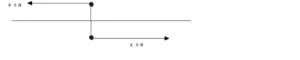
- Dividing point: a point x = a divides the number line into two parts, x < a and x > a.
- Open circle: used when the point is not included (< or >).
- Closed circle: used when the point is included (≤ or ≥).
- Arrow: drawn from the circle towards the values that satisfy the inequality.

When x = a is included, the number line becomes:
A line segment from a to b is shown below.

How do you solve linear inequalities and show the answer on a number line?
To solve a linear inequality, collect the x terms on one side and the numbers on the other, then apply the three rules.
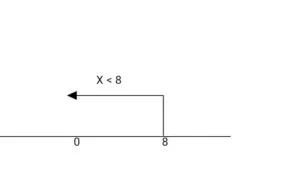
Example 1: 4x + 8 < 3x + 16
- Subtract 8 from both sides: 4x < 3x + 8.
- Subtract 3x from both sides: 4x – 3x < 8.
- Simplify: x < 8.
Example 2: 3(x – 6) < 9(x – 1)
- Open the brackets: 3x – 18 < 9x – 9.
- Collect like terms: 3x – 9x < -9 + 18.
- Simplify: -6x < 9.
- Divide both sides by -6 and reverse the sign: x > 9/(-6).
- Simplify: x > -3/2.
Example 3: 5 – 2x ≤ 11
- Subtract 5 from both sides: -2x ≤ 6.
- Divide both sides by -2 and reverse the sign: x ≥ -3.
- On the number line, draw a closed circle at -3 and an arrow to the right.
- Check: put x = 0 into 5 – 2x ≤ 11. This gives 5 ≤ 11, which is true.
What is a linear inequality in two variables?
A linear inequality in two variables x and y is an inequality that has one of four forms, where a, b and c are constants.
- ax + by ≤ c: less than or equal to.
- ax + by < c: less than.
- ax + by > c: greater than.
- ax + by ≥ c: greater than or equal to.
- Solution: any pair of numbers x and y that satisfies the inequality.
- Solution set: a region in the x-y plane, because each pair (x, y) is a point.
How do you find the solution set of 5x + 2y < 17?
The solution set of 5x + 2y < 17 is the region of the x-y plane on one side of the line 5x + 2y = 17.
Checking a pair of values
- A solution: x = 2 and y = 3 gives 5(2) + 2(3) = 16, and 16 is less than 17.
- Not a solution: x = 4 and y = 2 gives 5(4) + 2(2) = 24, and 24 is not less than 17.
- Many solutions: the pair (2, 3) is not the only one. There are infinitely many.
Finding the region
- Express y in terms of x. Start with 5x + 2y < 17.
- Subtract 5x from both sides: 2y < -5x + 17.
- Divide both sides by 2 (a positive number, so the sign stays): y < -5x/2 + 17/2.
- Find the boundary values by using the line 5x + 2y = 17.
- Draw the boundary line through the two points found.
- Shade the side of the line that satisfies the inequality.
Boundary values of 5x + 2y = 17
| Condition | Working | Point |
|---|---|---|
| x = 0 | 2y = 17, so y = 8.5 | (0, 8.5) |
| y = 0 | 5x = 17, so x = 3.4 | (3.4, 0) |
Drawing and shading
- Type of line: draw a broken (dashed) line for < or >, because points on the line are not solutions.
- Solid line: use it for ≤ or ≥, because points on the line are solutions.
- Test point: try (0, 0). Then 5(0) + 2(0) = 0, which is less than 17.
- Shading: shade the side of the line that contains (0, 0), which is below the line.
Evaluation
- What happens to the inequality sign when you multiply both sides by a negative number?
- What makes an inequality a linear inequality in x?
- Show that x = 2 and y = 3 is a solution of 5x + 2y < 17.
- Express 5x + 2y < 17 with y as the subject.
- Solve 2x + 3 > 11 and state which circle you would use on the number line.
Assignment
- Solve 3x – 1 > x + 1 and show the solution on a number line.
- Give two other pairs of numbers x and y that satisfy 5x + 2y < 17, and check each pair.
This term's Mathematics topics
SS2 Second Term · 7 topics
SS2 Mathematics Lesson Notes for Other Topics
Straight Lines Graphs
Read the full lesson note.
Circle Theorem
Read the full lesson note.

Trigonometric Ratios
Read the full lesson note.

Algebraic Fractions
Read the full lesson note.

Surds
Read the full lesson note.
Chords Properties Of Circle
Read the full lesson note.

Logarithm
Read the full lesson note.

Logarithm II
Read the full lesson note.

Sequence And Series - Arithmetic Progression
Read the full lesson note.

Geometric Progression
Read the full lesson note.
Factorization Of Quadratic Equations
Read the full lesson note.
Factorization Of Quadratic Equations II - - Word Problems
Read the full lesson note.
Simultaneous Linear Equation
Read the full lesson note.
Simultaneous Linear Equation II
Read the full lesson note.
Graph Of Linear Inequality In Two Variables
Read the full lesson note.
Lesson Notes for Other Classes

SS1 Lesson Note
The complete lesson note to guide your studies.

SS3 Lesson Note
The complete lesson note to guide your studies.
