
Distribution – SS2 Marketing Lesson Note (First Term)
Download this term · ₦1,000Lesson note at a glance
- Subject
- Marketing
- Class
- SS2
- Term
- First Term
- Topic
- Distribution
- Order
- Topic 1 of 6 this term
- Reading time
- 4 min
Distribution is the process of moving a product from its manufacturing source to its customers.
Behavioural objectives
- Define distribution.
- Name the three types of distribution.
- Describe each type of distribution and give examples of suitable products.
- State the essential aims of distribution.
- Describe the main channels of distribution and the work of middlemen.
- List the modes of transport used in physical distribution.
What is distribution?
Distribution is the process of moving a product from its manufacturing source to its customers.
- Marketing mix: distribution is the place element, one of the elements of the marketing mix.
- Activities covered: channels of distribution, transportation, warehousing and storage.
- Place utility: once goods are produced, marketers must create ways for the product to reach the consumer at the right place.
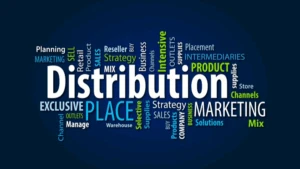
What are the channels of distribution?
A channel of distribution is the route a product follows from the producer to the final consumer.
- Producer to consumer: the direct channel, for example a farmer selling at the farm gate or a factory shop.
- Producer to retailer to consumer: a large retailer, such as a supermarket, buys straight from the producer.
- Producer to wholesaler to retailer to consumer: the usual channel for many goods, such as provisions and toiletries.
- Producer to agent to wholesaler to retailer to consumer: an agent finds buyers for the producer.
What do middlemen do in distribution?
A middleman is a person or firm that stands between the producer and the consumer.
- Wholesaler: buys goods in bulk from producers and sells in smaller quantities to retailers.
- Retailer: sells goods in small quantities to final consumers, for example a shop or supermarket.
- Agent: arranges sales for the producer and earns a commission, usually without owning the goods.
What are the types of distribution?
There are three major types of distribution: intensive, selective and exclusive.
1. Intensive distribution
Intensive distribution is a strategy in which firms make their products available in as many outlets as possible.
- Aim: to ensure maximum brand exposure and consumer convenience.
- Suitable products: soft drinks, toothpaste, candy and bread.
- Promotion: the burden of advertising and promotion rests on the manufacturer.
2. Selective distribution
Selective distribution is a strategy in which firms use only a few outlets to sell their products.
- Aim: to allow producers to concentrate on potentially profitable accounts.
- Consumer shopping goods: for example furniture and electrical appliances.
- Consumer speciality goods: for example cars, jewellery, expensive fine clothes and high-quality musical instruments.
- Industrial accessory equipment: also commonly sold this way.
3. Exclusive distribution
Exclusive distribution is a strategy in which a supplier or manufacturer agrees to use only one wholesaling middleman or retailer in a particular market or region.
- Reason 1: to gain more aggressive selling support from the wholesaler.
- Reason 2: when channel control is important to the manufacturer.
- Example: a sole distributor appointed for one brand of machinery in a region.
Comparison of the three types
| Type | Number of outlets | Example products |
|---|---|---|
| Intensive | As many as possible | Soft drinks, toothpaste, candy, bread |
| Selective | A few | Furniture, electrical appliances, jewellery |
| Exclusive | Only one in a market or region | Goods where channel control matters |
What is physical distribution?
Physical distribution is the actual movement and holding of goods, through transportation, warehousing and storage.
- Transportation: carrying goods from the producer to wholesalers, retailers or consumers.
- Warehousing: keeping goods in a building until they are needed by buyers.
- Storage: holding goods safely so that they do not spoil or get damaged.
What are the modes of transport?
| Mode | Use in distribution |
|---|---|
| Road | Door-to-door delivery of many goods by lorry, van or truck. |
| Rail | Carries heavy and bulky goods over long distances. |
| Water | Carries bulky goods by boat and ship, including imports and exports. |
| Air | Fast delivery of urgent, light or perishable goods. |
| Pipeline | Moves liquids and gases such as crude oil and petroleum products. |
What are the essential aims of distribution?
The essential aims of distribution are to get the right goods to the right place at the right time and at a cost the supplier can bear.
- Right goods: deliver the goods the customer ordered.
- Right time: deliver when the customer needs the goods.
- Customers’ requirements: meet what customers want in quantity and condition.
- Right place: move goods to the place where customers can buy them.
- Acceptable cost: keep distribution within a cost framework acceptable to the supplier.
Evaluation
- Define distribution.
- Name the three types of distribution.
- Describe intensive distribution and give two examples of products suited to it.
- Why do firms use selective distribution?
- List the essential aims of distribution.
Assignment
Explain exclusive distribution, state when a manufacturer would adopt it, and give three examples of goods that suit selective distribution.
This term's Marketing topics
SS2 First Term · 6 topics
Get Marketing as PDF and Word
Every week of SS2 Marketing, First Term, formatted and ready to print. Ad-free, and the copy lock comes off.
Get this term Card, bank transfer, USSD or OPay
SS2 Marketing Lesson Notes for Other Topics
Channels Of Distribution
Read the full lesson note.
Modes Of Transportation
Read the full lesson note.
Choice Of Transportation
Read the full lesson note.
Choice Of Distribution Channel
Read the full lesson note.
Transportation
Read the full lesson note.

Documents Used In Transportation
Read the full lesson note.

Warehousing
Read the full lesson note.
Primary And Secondary Products
Read the full lesson note.

Facilitators
Read the full lesson note.
Food Processing Industries
Read the full lesson note.

Banks
Read the full lesson note.
Co-Operative Societies
Read the full lesson note.

Basins And Boards
Read the full lesson note.
Microfinance Companies
Read the full lesson note.
Marketing Of Mineral Products
Read the full lesson note.
Lesson Notes for Other Classes

SS1 Lesson Note
The complete lesson note to guide your studies.

SS3 Lesson Note
The complete lesson note to guide your studies.
