
Circle I: Introduction of a Circle & its Properties – SS2 Further Mathematics Lesson Note (Second Term)
Download this term · ₦1,000Lesson note at a glance
- Subject
- Further Mathematics
- Class
- SS2
- Term
- Second Term
- Topic
- Circle I: Introduction of a Circle & its Properties
- Order
- Topic 1 of 10 this term
- Reading time
- 3 min
A circle is a round shape with a centre and a curved outer boundary called the circumference. Its parts include the arc, radius, chord and diameter, and it can be divided into regions called sectors, semicircles and segments. The length of an arc and the perimeter of a sector are found from the angle at the centre.
Behavioural objectives
By the end of the lesson, students should be able to:
- name and describe the parts of a circle;
- distinguish between a sector, a semicircle and a segment;
- calculate the length of an arc using the angle at the centre;
- calculate the perimeter of a sector.
What are the parts of a circle?
- The centre is the point in the middle of a circle.
- The circumference is the curved outer boundary of the circle.
- An arc is a curved part of the circumference.
- A radius is any straight line joining the centre to the circumference. The plural of radius is radii.
- A chord is any straight line joining two points on the circumference.
- A diameter is a straight line which divides the circle into two equal parts. It is also any chord which goes through the centre of the circle.
What are the regions of a circle?
- A sector is the region between two radii and the circumference.
- A semicircle is the region between a diameter and the circumference, that is, half of the circle.
- A segment is the region between a chord and the circumference.
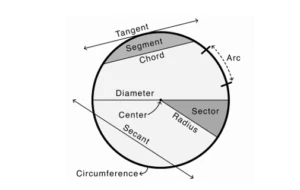
How do you find the length of an arc and the perimeter of a sector?
Take a circle with centre O and radius r. The circumference of the circle is 2πr.
Length of an arc
The length, L, of arc XY is given as:
L = (θ ÷ 360°) × 2πr
where θ is the angle subtended at the centre by arc XY and r is the radius of the circle.
Perimeter of a sector
The perimeter of sector XOY = r + r + L, where L is the length of arc XY. Therefore:
Perimeter of sector XOY = 2r + (θ ÷ 360°) × 2πr
Worked examples
Example 1
An arc of length 28 cm subtends an angle of 240° at the centre of a circle. In the same circle, what angle does an arc of length 35 cm subtend? (Take π as 22/7.)
Solution
First find the radius, using L = (θ ÷ 360°) × 2πr, with L = 28 cm and θ = 240°.
28 = (240 ÷ 360) × 2 × (22 ÷ 7) × r
28 = (2 ÷ 3) × (44 ÷ 7) × r
28 = 88r ÷ 21
r = (28 × 21) ÷ 88 = 147 ÷ 22 cm
Now use the same radius with L = 35 cm.
35 = (θ ÷ 360) × 2 × (22 ÷ 7) × (147 ÷ 22)
35 = (θ ÷ 360) × 42
θ = (35 × 360) ÷ 42 = 300°
Thus, when the length of the arc is 35 cm, the angle subtended at the centre is 300°.
Example 2
Calculate the perimeter of a sector of a circle of radius 7 cm, the angle of the sector being 108°. (Take π as 22/7.)
Solution
Perimeter of a sector = 2r + (θ ÷ 360°) × 2πr
= 2 × 7 + (108 ÷ 360) × 2 × (22 ÷ 7) × 7
= 14 + (108 ÷ 360) × 44
= 14 + (3 ÷ 10) × 44
= 14 + 132 ÷ 10
= 14 + 13.2
= 27.2 cm
Evaluation
- Define a chord and a diameter.
- State the difference between a sector and a segment.
- Write the formula for the length of an arc and the formula for the perimeter of a sector.
- Calculate the perimeter of a sector of a circle of radius 14 cm, if the angle of the sector is 90°. (Take π as 22/7.)
Assignment
Calculate the length of an arc and the perimeter of the sector of a circle of radius 21 cm, if the angle of the sector is 60°. (Take π as 22/7.)
This term's Further Mathematics topics
SS2 Second Term · 10 topics
- Circle I: Introduction of a Circle & its Properties
- Circle II: Length of Chord & Perimeter of a Segment
- Circle III
- Probability
- Permutation
- Combination
- Binomial Expansion
- Work, Energy and Power
- Projectile
- Introduction to Operational Research
Get Further Mathematics as PDF and Word
Every week of SS2 Further Mathematics, Second Term, formatted and ready to print. Ad-free, and the copy lock comes off.
Get this term Card, bank transfer, USSD or OPay
SS2 Further Mathematics Lesson Notes for Other Topics
Circle II - Length of Chord & Perimeter of a Segment
Read the full lesson note.
Circle III
Read the full lesson note.
Probability
Read the full lesson note.
Permutation
Read the full lesson note.
Combination
Read the full lesson note.

Binomial Expansion
Read the full lesson note.
Work, Energy And Power
Read the full lesson note.
Projectile
Read the full lesson note.
Introduction To Operational Research
Read the full lesson note.
Quadratic Equations - - Sum & Product of Roots
Read the full lesson note.
Quadratic Equations II - Tangents & Normal to Curves
Read the full lesson note.
Polynomials
Read the full lesson note.
Logical Reasoning
Read the full lesson note.
Trigonometric Functions
Read the full lesson note.
Trigonometric Functions II - Graph of SINE & COSINE of Angles
Read the full lesson note.
Lesson Notes for Other Classes

SS1 Lesson Note
The complete lesson note to guide your studies.

SS3 Lesson Note
The complete lesson note to guide your studies.
