
Binomial Expansion – SS2 Further Mathematics Lesson Note (Second Term)
Lesson note at a glance
- Class
- SS2
- Subject
- Further Mathematics
- Term
- Second Term
- Reading time
- 4 min
A binomial expansion is the writing out of a two-term expression such as (𝑥 + 𝑦)ⁿ as a sum of separate terms.
- Binomial: an expression with two terms, such as (𝑥 + 𝑦) or (2𝑥 − 3).
- Number of terms: the expansion of (𝑥 + 𝑦)ⁿ has (𝑛 + 1) terms.
- Powers of 𝑥: they fall from 𝑛 down to 0.
- Powers of 𝑦: they rise from 0 up to 𝑛.
- Sum of powers: the powers in each term add up to 𝑛.
Behavioural objectives
By the end of the lesson, students should be able to:
- write down the rows of Pascal’s triangle;
- state the features of Pascal’s triangle;
- use Pascal’s triangle to expand and simplify binomials such as (2𝑥 + 3𝑦)⁴ and (𝑥 − 2𝑦)⁵;
- use Pascal’s triangle to evaluate a number such as (1.01)⁴ correct to a stated number of decimal places;
- state the binomial expansion formula and its general term.
What is Pascal’s triangle?
Pascal’s triangle is an array of numbers that gives the coefficients of the terms in the expansion of a binomial such as (𝑥 + 𝑦)ⁿ.
Look at the expansion of each of the following:
- (𝑥 + 𝑦)⁰ = 1
- (𝑥 + 𝑦)¹ = 1𝑥 + 1𝑦
- (𝑥 + 𝑦)² = 1𝑥² + 2𝑥𝑦 + 1𝑦²
- (𝑥 + 𝑦)³ = 1𝑥³ + 3𝑥²𝑦 + 3𝑥𝑦² + 1𝑦³
- (𝑥 + 𝑦)⁴ = 1𝑥⁴ + 4𝑥³𝑦 + 6𝑥²𝑦² + 4𝑥𝑦³ + 1𝑦⁴
- (𝑥 + 𝑦)⁵ = 1𝑥⁵ + 5𝑥⁴𝑦 + 10𝑥³𝑦² + 10𝑥²𝑦³ + 5𝑥𝑦⁴ + 1𝑦⁵
The coefficients can be displayed in an array as follows:
| Power (𝑛) | Coefficients |
|---|---|
| 0 | 1 |
| 1 | 1 1 |
| 2 | 1 2 1 |
| 3 | 1 3 3 1 |
| 4 | 1 4 6 4 1 |
| 5 | 1 5 10 10 5 1 |
| 6 | 1 6 15 20 15 6 1 |
| 7 | 1 7 21 35 35 21 7 1 |
This array of coefficients is called Pascal’s triangle.
How do we build the rows of Pascal’s triangle?
Each row is built from the row above it by adding neighbouring numbers.
- Start with row 0, which is 1.
- Write 1 at the start and the end of every new row.
- Each middle number is the sum of the two numbers directly above it.
- Continue until you reach the row you need.
- Row 5 to row 6: 1, (1 + 5), (5 + 10), (10 + 10), (10 + 5), (5 + 1), 1 gives 1 6 15 20 15 6 1.
- Row 7 to row 8: the same rule gives 1 8 28 56 70 56 28 8 1.
What are the features of Pascal’s triangle?
- Symmetry: each line of coefficients reads the same from left to right and right to left.
- Building rule: each line can be obtained from the line immediately before it.
- Ends: the first and last coefficient in every row is 1.
- Second number: the second coefficient in row 𝑛 is 𝑛.
- Number of terms: the expansion of (𝑥 + 𝑦)ⁿ has (𝑛 + 1) terms.
- Sum of powers: in each term, the powers of 𝑥 and 𝑦 add up to 𝑛.
- Change of powers: the power of 𝑥 decreases from term to term, while the power of 𝑦 increases.
- Row total: the numbers in row 𝑛 add up to 2ⁿ, for example row 5 gives 1 + 5 + 10 + 10 + 5 + 1 = 32.
How do we expand a binomial using Pascal’s triangle?
To expand (𝑎 + 𝑏)ⁿ, take the coefficients from row 𝑛 and attach falling powers of 𝑎 and rising powers of 𝑏.
- Write down row 𝑛 of Pascal’s triangle.
- Write the first term with the power 𝑛 on 𝑎 and the power 0 on 𝑏.
- In each next term, reduce the power of 𝑎 by 1 and raise the power of 𝑏 by 1.
- Put the coefficient in front of each term.
- Put brackets round any term that has a coefficient or a minus sign.
- Work out each term and simplify.
- Sign rule: for (𝑎 − 𝑏)ⁿ, treat the second term as (−𝑏), so the signs alternate + − + − and so on.
Example 1
By using Pascal’s triangle, expand and simplify completely (2𝑥 + 3𝑦)⁴.
- Row 4 is 1 4 6 4 1.
- (2𝑥 + 3𝑦)⁴ = (2𝑥)⁴ + 4(2𝑥)³(3𝑦) + 6(2𝑥)²(3𝑦)² + 4(2𝑥)(3𝑦)³ + (3𝑦)⁴
- = 16𝑥⁴ + 96𝑥³𝑦 + 216𝑥²𝑦² + 216𝑥𝑦³ + 81𝑦⁴
- Check of 2nd term: 4 × 8𝑥³ × 3𝑦 = 96𝑥³𝑦.
- Check of 3rd term: 6 × 4𝑥² × 9𝑦² = 216𝑥²𝑦².
Example 2
Using Pascal’s triangle, expand and simplify completely (𝑥 − 2𝑦)⁵.
- Row 5 is 1 5 10 10 5 1.
- (𝑥 − 2𝑦)⁵ = 𝑥⁵ + 5𝑥⁴(−2𝑦) + 10𝑥³(−2𝑦)² + 10𝑥²(−2𝑦)³ + 5𝑥(−2𝑦)⁴ + (−2𝑦)⁵
- = 𝑥⁵ − 10𝑥⁴𝑦 + 40𝑥³𝑦² − 80𝑥²𝑦³ + 80𝑥𝑦⁴ − 32𝑦⁵
- Odd powers of (−2𝑦): they give a negative term.
- Even powers of (−2𝑦): they give a positive term.
Example 3
Using Pascal’s triangle, expand and simplify (1.01)⁴ correct to 5 decimal places.
- Write 1.01 as (1 + 0.01) and use row 4, which is 1 4 6 4 1.
- (1.01)⁴ = 1 + 4(0.01) + 6(0.01)² + 4(0.01)³ + (0.01)⁴
- = 1 + 0.04 + 0.0006 + 0.000004 + 0.00000001
- = 1.04060401
- ≈ 1.04060 (5 d.p.)
What is the binomial expansion formula?
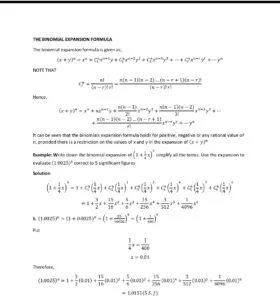
The binomial expansion formula gives any term of (𝑥 + 𝑦)ⁿ directly, without writing out Pascal’s triangle.
- Formula: (𝑥 + 𝑦)ⁿ = 𝑥ⁿ + 𝑛C1 𝑥ⁿ⁻¹𝑦 + 𝑛C2 𝑥ⁿ⁻²𝑦² + … + 𝑦ⁿ.
- Binomial coefficient: 𝑛C𝑟 = 𝑛! ÷ [𝑟!(𝑛 − 𝑟)!].
- General term: the (𝑟 + 1)th term is 𝑛C𝑟 𝑥ⁿ⁻ʳ𝑦ʳ.
- Link to Pascal’s triangle: 𝑛C𝑟 is the coefficient in row 𝑛, counting the first number as 𝑟 = 0.
- Examples: 5C2 = 10 and 7C3 = 35, as in rows 5 and 7.
- When to use it: use it when 𝑛 is large and Pascal’s triangle would be too long.
Evaluation
- Write down the row of Pascal’s triangle for 𝑛 = 5.
- How many terms are there in the expansion of (𝑥 + 𝑦)⁸?
- Use Pascal’s triangle to expand (𝑥 + 𝑦)⁶.
- Use Pascal’s triangle to expand and simplify completely (𝑥 + 2𝑦)⁴.
Assignment
- Use Pascal’s triangle to expand and simplify completely (𝑥 + 𝑦)¹¹. Hence, find the coefficients of the following:
- (a) 𝑥⁵𝑦⁶
- (b) 𝑥𝑦¹⁰
- (c) 𝑥⁹𝑦²
- (d) 𝑥⁴𝑦⁷
- Expand (3𝑥 − 𝑦)⁷ by using Pascal’s triangle.
- Given that (1 + 3𝑥)¹⁰ = 1 + 𝑃𝑥 + 𝑄𝑥² + 𝑅𝑥³ + ⋯, find the values of the integers 𝑃, 𝑄 and 𝑅.
- Express (1 − 2𝑥)³ − (1 + 2𝑥)³ in ascending powers of 𝑥 with integral coefficients.
- Expand (1 + 𝑥)⁵ in ascending powers of 𝑥. Hence, without using any calculating device, estimate (1.1)⁵, correct to four decimal places.
This term's Further Mathematics topics
SS2 Second Term · 10 topics
SS2 Further Mathematics Lesson Notes for Other Topics

Circle I - Introduction of a Circle & Its Properties
Read the full lesson note.

Circle II - Length of Chord & Perimeter of a Segment
Read the full lesson note.

Circle III
Read the full lesson note.

Probability
Read the full lesson note.
Permutation
Read the full lesson note.

Combination
Read the full lesson note.

Work, Energy And Power
Read the full lesson note.

Projectile
Read the full lesson note.

Introduction To Operational Research
Read the full lesson note.
Quadratic Equations - - Sum & Product of Roots
Read the full lesson note.
Quadratic Equations II - Tangents & Normal to Curves
Read the full lesson note.

Polynomials
Read the full lesson note.
Logical Reasoning
Read the full lesson note.
Trigonometric Functions
Read the full lesson note.
Trigonometric Functions II - Graph of SINE & COSINE of Angles
Read the full lesson note.
Lesson Notes for Other Classes

SS1 Lesson Note
The complete lesson note to guide your studies.

SS3 Lesson Note
The complete lesson note to guide your studies.
