
Citizenship Education – SS2 Civic Education Lesson Note (First Term)
Download this term · ₦1,000Lesson note at a glance
- Subject
- Civic Education
- Class
- SS2
- Term
- First Term
- Topic
- Citizenship Education
- Order
- Topic 1 of 8 this term
- Reading time
- 6 min
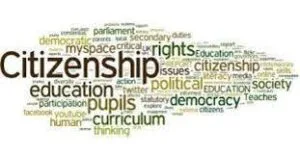
Citizenship education is the process by which the citizens of a state acquire relevant knowledge about their rights and obligations to become responsible citizens in the state.
Behavioural objectives
- Define citizenship education.
- State the primary objective of citizenship education.
- List the main rights and duties of a Nigerian citizen.
- Name the agencies that teach citizenship education.
- Explain the importance of citizenship education.
- Describe how citizenship education promotes unity, law and order, and political stability.
What is the primary objective of citizenship education?
The primary objective of citizenship education is to make citizens aware of their rights and duties.
- Rights: citizens learn the rights they are entitled to enjoy under the provisions of the constitution.
- Duties: citizens learn what they owe the state and other citizens.
What are the key terms in citizenship education?
- Citizen: a person who belongs to a state and enjoys its rights and protection, for example a Nigerian by birth.
- Citizenship: the legal status of belonging to a state, with the rights and duties that come with it.
- Right: a freedom or benefit that the law gives to every citizen.
- Obligation (duty): something a citizen must do for the state and for other citizens.
- Constitution: the supreme law of a country, which sets out rights, duties and how government works.
- Redress: a remedy sought when a right has been denied or violated.
How can a person become a Nigerian citizen?
The 1999 Constitution (Chapter III) provides for citizenship in three ways: by birth, by registration and by naturalisation.
Citizenship by birth
- Born in Nigeria: a person born in Nigeria whose parents or grandparents belong to a Nigerian community.
- Born abroad: a person born outside Nigeria to a Nigerian parent.
Citizenship by registration
- Who qualifies: a qualified person, such as a foreign woman married to a Nigerian man, who applies to be registered.
Citizenship by naturalisation
- Who qualifies: a foreigner who meets the legal conditions, including a period of residence, and is granted citizenship.
What are the rights of a Nigerian citizen?
Rights are the freedoms and benefits that Chapter IV of the 1999 Constitution gives to every citizen.
| Right | Meaning |
|---|---|
| Right to life | No one may be killed unlawfully. |
| Right to dignity of the human person | No one may be tortured, enslaved or treated in an inhuman way. |
| Right to personal liberty | No one may be arrested or detained except as the law allows. |
| Right to fair hearing | An accused person is tried by a fair and impartial court. |
| Right to private and family life | A citizen’s home, letters and phone calls are protected. |
| Freedom of thought, conscience and religion | A citizen may hold and practise a belief freely. |
| Freedom of expression and the press | A citizen may hold opinions and share information. |
| Freedom of peaceful assembly and association | A citizen may hold peaceful meetings and join groups. |
| Freedom of movement | A citizen may live and travel in any part of Nigeria. |
| Freedom from discrimination | No citizen is treated unfairly because of ethnic group, place of origin, sex or religion. |
What are the duties and obligations of a citizen?
Duties are the things a citizen must do for the state and for other citizens.
| Duty | Meaning |
|---|---|
| Obey the laws of the land | Follow the rules made by the government. |
| Pay taxes and levies | Give money that government uses to provide roads, schools and hospitals. |
| Vote in elections | Help to choose leaders. |
| Defend the nation when called upon | Serve the country in time of danger. |
| Respect the rights of other citizens | Do not interfere with what the law gives to others. |
| Protect public property | Take care of things that belong to everyone. |
| Report crime to the police | Help to keep the community safe. |
| Be loyal to the nation | Put the good of the country first. |
| Respect constituted authority | Obey lawful leaders and officers. |
| Take part in community development | Join in projects that improve the community. |
What is the difference between a right and a duty?
A right is what the state allows a citizen to enjoy, while a duty is what the citizen must do in return.
| Point | Right | Duty |
|---|---|---|
| Meaning | A freedom or benefit given by law | A task the citizen must carry out |
| Direction | Citizen receives from the state | Citizen gives to the state and others |
| Example | Right to life | Paying taxes |
Who teaches citizenship education?
Six main agencies teach citizenship education: the family, the school, religious bodies, the mass media, government agencies and civil society groups.
- The family: parents teach honesty, respect and obedience to children from an early age.
- The school: subjects such as Civic Education and Social Studies teach rights, duties and national values.
- Religious bodies: churches and mosques teach love, tolerance and good conduct.
- The mass media: radio, television, newspapers and online platforms inform citizens on public issues.
- Government agencies: the National Orientation Agency (NOA) educates the public on national values.
- Civil society groups: non-governmental organisations and youth bodies run enlightenment programmes.
Why is citizenship education important?
Citizenship education is important because it produces informed, law-abiding citizens who help the nation to grow.
- It helps citizens to know their rights: citizens learn their fundamental rights.
- They make sure these rights are not infringed.
- They seek redress when the state, an organisation or an individual denies or violates their rights.
- It promotes responsible citizenship: citizens become law-abiding in their dealings with the government and with fellow citizens.
- It promotes unity in a state: it teaches tolerance, love and hospitality, which are the basic ingredients of unity.
- Citizens learn to see beyond ethnic, tribal and religious lines.
- Diverse groups then live together peacefully.
- It promotes law and order: citizens respect the constitution and observe decorum in public places.
- They respect other people’s rights.
- They respect constituted authority.
- It prepares the youths for leadership: it gives young people the knowledge and skills needed to lead, and informed youths build a great nation.
- It promotes development and progress: unity and peace create a setting in which development can take place.
- It ensures political stability: a country whose people know their rights and duties tends to enjoy relative peace.
- Cases of human rights abuse are reduced.
- The level of acrimony is reduced, which keeps the country stable.
- It ensures good followership: it teaches values that help citizens to be loyal followers of their leaders and people in authority.
What are the signs of a citizen who has good citizenship education?
A well-educated citizen shows responsible behaviour in daily life.
- Obeys rules: follows traffic rules and school rules without being forced.
- Participates: votes, attends community meetings and pays taxes.
- Respects others: accepts people of other tribes and religions.
- Protects the common good: cares for public facilities such as roads, schools and water points.
- Stands for rights peacefully: uses courts and lawful means to seek redress.
Evaluation
- Define citizenship education.
- State the primary objective of citizenship education.
- List five reasons why citizenship education is important.
- Explain how citizenship education promotes unity in a state.
- Name four agencies that teach citizenship education.
Assignment
Explain how citizenship education promotes political stability and good followership in a country.
This term's Civic Education topics
SS2 First Term · 8 topics
- Citizenship Education
- Duties and Responsibilities of Citizens
- Skills Necessary for the Preservation of Our Traditions, Beliefs and Customs in Nigeria
- Capitalist Democracy
- How Political Parties Compete for Power Through Elections
- Poverty and its Effects
- Political Apathy
- Reasons Why Leaders Fail to Protect the Interest of Their Followers
Get Civic Education as PDF and Word
Every week of SS2 Civic Education, First Term, formatted and ready to print. Ad-free, and the copy lock comes off.
Get this term Card, bank transfer, USSD or OPay
SS2 Civic Education Lesson Notes for Other Topics
Duties And Responsibilities Of Citizens
Read the full lesson note.
Skills Necessary For The Preservation Of Our Traditions, Beliefs And Customs In Nigeria
Read the full lesson note.
Capitalist Democracy
Read the full lesson note.

How Political Parties Compete For Power Through Elections
Read the full lesson note.
Poverty And Its Effects
Read the full lesson note.
Political Apathy
Read the full lesson note.

Reasons Why Leaders Fail To Protect The Interest Of Their Followers
Read the full lesson note.

Popular Participation
Read the full lesson note.
How Popular Organisations Are Formed
Read the full lesson note.
Human Rights
Read the full lesson note.
Emergency
Read the full lesson note.

Drugs And Drugs Abuse
Read the full lesson note.

Effects Of Drugs Abuse
Read the full lesson note.
Activities Of Drug Enforcement Agencies
Read the full lesson note.
Meticulous Study & Analysis of Chapters 2-6 of Wuthering Heights
Read the full lesson note.
Lesson Notes for Other Classes

SS1 Lesson Note
The complete lesson note to guide your studies.

SS3 Lesson Note
The complete lesson note to guide your studies.
