Practical PV System Designs – SS1 Solar Photovoltaic Installation & Maintenance Lesson Note (Third Term)
Lesson note at a glance
- Subject
- Solar Photovoltaic Installation & Maintenance
- Class
- SS1
- Term
- Third Term
- Topic
- Practical PV System Designs
- Order
- Topic 5 of 8 this term
- Reading time
- 2 min
The Case Study – Meeting the Yusuf Family
The Yusuf family lives in a three-bedroom bungalow. They are tired of the constant noise from their “I-pass-my-neighbor” generator and the high cost of petrol. They want a solar system that can handle their basic needs at night.
The Yusuf Family’s Needs (The Load):
- 6 LED Bulbs: To keep the house bright (10W each).
- 2 Standing Fans: To keep the rooms cool at night (60W each).
- 1 LED TV: For news and football (100W).
- 1 Decoder: For the TV (20W).
- Phones: Charging 3 phones (10W each).
The Goal: They want these items to run for 8 hours every night after the sun goes down.
Step 1 – Calculating the Daily Energy Demand
First, we need to find out how much “energy” (Watt-hours) the Yusuf family consumes in one night.
| Item | Qty | Watts | Total Watts | Hours | Total Watt-hours (Wh) |
| LED Bulbs | 6 | 10W | 60W | 8 hrs | 480Wh |
| Fans | 2 | 60W | 120W | 8 hrs | 960Wh |
| LED TV | 1 | 100W | 100W | 5 hrs | 500Wh |
| Decoder | 1 | 20W | 20W | 5 hrs | 100Wh |
| Phones | 3 | 10W | 30W | 4 hrs | 120Wh |
| TOTAL | 330W | 2,160Wh |
Total Nightly Need: 2,160Wh (or roughly 2.2kWh).
Step 2 – Sizing the “Translator” (Inverter)
The total power used at the exact same time is 330 Watts. However, we must remember that fans have small motors that “kick” when they start.
- Total Running Watts: 330W.
- Safety Margin: We multiply by 1.25 (to give the inverter “breathing room”).
- 330W×1.25=412.5W.
The Decision: A 1KVA (800W) Inverter is perfect for this family. It can easily handle the 330W load and has enough extra strength to start the fans.
Step 3 – Sizing the “Energy Tank” (Batteries)
The Yusufs are using Tubular (Lead-Acid) batteries, so we must remember the 50% Depth of Discharge rule. We don’t want to drain them to zero!
- Energy Needed: 2,160Wh.
- To stay safe (50% DoD): We need a battery capacity of 2,160×2=4,320Wh.
- In Amp-Hours (Ah): Since it’s a 12V system: 4,320Wh÷12V=360Ah.
The Decision: We will buy two 200Ah batteries and connect them in Parallel. This gives them 400Ah total, which is plenty of “water in the tank” to last the whole night.

Shutterstock
Step 4 – Sizing the “Harvest” (Solar Panels)
To fill up a 2,160Wh “hole” left in the batteries every day, the panels must produce that much power in about 5 Peak Sun Hours.
- Energy Needed: 2,160Wh.
- Efficiency Loss (30% extra): 2,160×1.3=2,808Wh.
- Panel Watts Needed: 2,808Wh÷5 hours=561.6 Watts.
The Decision: We will buy two 300W Solar Panels. 300W×2=600W total. This is more than the 561W we calculated, so the batteries will get full even if the day is a bit cloudy.
Getty Images
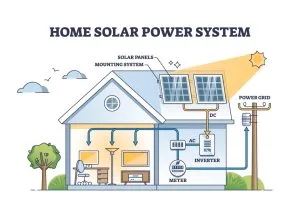
Final System Summary for the Yusuf Family:
- Panels: 2 x 300W (Monocrystalline)
- Controller: 60A MPPT
- Inverter: 1KVA Pure Sine Wave
- Batteries: 2 x 200Ah Tubular
Class Discussion:
- If the Yusuf family decides to buy a refrigerator next month, which part of this system will fail first?
- Why did we use a 60A controller instead of a 30A one? (Hint: Think about the 600W panels).
- What happens to this design if the family leaves the TV on for 12 hours instead of 5?
This term's Solar Photovoltaic Installation & Maintenance topics
SS1 Third Term · 8 topics
Third Term Solar Photovoltaic Installation & Maintenance Lesson Notes for Other Topics

Final SSCE Presentation
Read the full lesson note.

Mock Exam
Read the full lesson note.
Final Project Presentation
Read the full lesson note.
Comprehensive Revision II
Read the full lesson note.
Comprehensive Revision I
Read the full lesson note.
Practical: Business Simulation
Read the full lesson note.
Case Study of Nigerian Solar Projects
Read the full lesson note.

Project Management in Solar Installation
Read the full lesson note.
Customer Service and Support
Read the full lesson note.
Costing and Pricing Solar System
Read the full lesson note.

Business Skill in Solar Sector
Read the full lesson note.
Introduction to Solar Entrepreneurship
Read the full lesson note.
System Testing and Commissioning
Read the full lesson note.

PV System Installation Steps II
Read the full lesson note.
PV System Installation Steps I
Read the full lesson note.
Lesson Notes for Other Classes

Basic 1 Lesson Note
The complete lesson note to guide your studies.

Basic 2 Lesson Note
The complete lesson note to guide your studies.

Basic 3 Lesson Note
The complete lesson note to guide your studies.

Basic 4 Lesson Note
The complete lesson note to guide your studies.

Basic 5 Lesson Note
The complete lesson note to guide your studies.

Basic 6 Lesson Note
The complete lesson note to guide your studies.