Basic Electrical Concept – SS1 Solar Photovoltaic Installation & Maintenance Lesson Note (Second Term)
Download Lesson NoteLesson note at a glance
- Subject
- Solar Photovoltaic Installation & Maintenance
- Class
- SS1
- Term
- Second Term
- Topic
- Basic Electrical Concept
- Order
- Topic 1 of 8 this term
- Reading time
- 3 min
The “Water Pipe” Secret
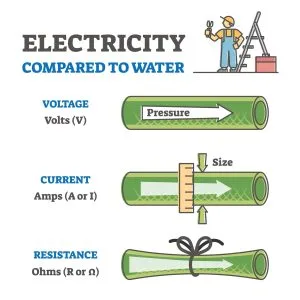
Electricity can be hard to see, but it is easy to understand if you think about a storage tank and a garden hose.
To get water to flow out of a hose, you need three things:
- Pressure (from the height of the tank).
- The Water itself (flowing through the hose).
- The Size of the hose (is it wide or narrow?).
In electricity, we have the exact same three things, but we give them “scientific” names:
- Voltage is the Pressure.
- Current is the Flow of water.
- Resistance is the size of the pipe.
Current and Voltage (The “Push” and the “Flow”)
- Voltage (Measured in Volts – V)
Think of Voltage as the “Force” or “Push” that moves electricity.
- In Nigeria, our wall sockets usually have 220 Volts.
- A small AA battery has 1.5 Volts.
- The Rule: The higher the Voltage, the more “push” the electricity has.
- Current (Measured in Amperes – A)
Current is the actual “stuff” moving through the wire. If you turn on many bulbs, you are asking for more “flow” (Current).
- The Hazard: Current is what actually gives you an electric shock!
- In Solar: We use thick wires for high current so the wires don’t melt.
Resistance and Power
- Resistance (Measured in Ohms – Ω)
Resistance is anything that tries to stop or slow down the flow of electricity.
- A thick wire has Low Resistance (electricity flows easily).
- A very thin or very long wire has High Resistance (it’s harder for electricity to get through).
- Heat: When electricity fights against resistance, it creates heat. This is how an electric iron or a boiling ring works!
- Power (Measured in Watts – W)
Power is the “Work” being done. It is the result of Voltage pushing Current.
- A 10W bulb is “weak” (uses little power).
- A 2000W AC is “strong” (uses a lot of power).
- The Formula: Power=Voltage×Current (P=V×I).
Ohm’s Law (The “Family” Relationship)
A man named George Ohm discovered that Voltage, Current, and Resistance are like a family—they are all connected. He created Ohm’s Law.
The Law says:
Voltage=Current×Resistance
(V=I×R)
Why does this matter in Solar? Imagine your solar battery is 12V (Pressure). If you use a wire with too much resistance (too thin), the “Pressure” will drop before it reaches your TV, and the TV won’t turn on.
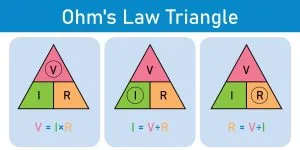
The Triangle Trick: To remember the formula, draw a triangle with V at the top, and I and R at the bottom.
- To find V: Cover V, you see I×R.
- To find I: Cover I, you see V÷R.
- To find R: Cover R, you see V÷I.
Summary and Class Activity
Key Summary Table
| Concept | What it is | Unit | Symbol |
| Voltage | The “Push” / Pressure | Volts | V |
| Current | The “Flow” / Movement | Amperes | A |
| Resistance | The “Obstacle” / Friction | Ohms | Ω |
| Power | The “Work” / Speed | Watts | W |
Class “Home Audit” Activity
Go home and look at the stickers on your appliances (Chargers, TV, Fans).
- Find one device that shows Watts (W). How many?
- Find your phone charger. Look for the “Output.” It might say 5V and 2A.
- Calculation: Using P=V×I, how many Watts is your charger? (5×2=?)
- Why do you think an electric heater has a thicker wire than a small desk lamp? (Hint: Think about Resistance and Heat).
This term's Solar Photovoltaic Installation & Maintenance topics
SS1 Second Term · 8 topics
Second Term Solar Photovoltaic Installation & Maintenance Lesson Notes for Other Topics
Mock SSCE
Read the full lesson note.
Mock Installation Project III
Read the full lesson note.
Mock Installation Project II
Read the full lesson note.
Mock Installation Project I
Read the full lesson note.
SSCE Past Questions - Practical
Read the full lesson note.

SSCE Past Questions (Theory)
Read the full lesson note.
Preparation for SSCE
Read the full lesson note.
Practical: Maintenance of Installed System
Read the full lesson note.
Monitoring and Performance Evaluation
Read the full lesson note.
PV System Maintenance II
Read the full lesson note.

PV System Maintenance I
Read the full lesson note.
Solar Water Pumping System
Read the full lesson note.
Solar Street Lightening System
Read the full lesson note.

Solar Home System
Read the full lesson note.
Advanced Wiring Techniques
Read the full lesson note.
Lesson Notes for Other Classes

Basic 1 Lesson Note
The complete lesson note to guide your studies.
Basic 2 Lesson Note
The complete lesson note to guide your studies.

Basic 3 Lesson Note
The complete lesson note to guide your studies.
Basic 4 Lesson Note
The complete lesson note to guide your studies.
Basic 5 Lesson Note
The complete lesson note to guide your studies.

Basic 6 Lesson Note
The complete lesson note to guide your studies.