Types of Solar Energy System – SS1 Solar Photovoltaic Installation & Maintenance Lesson Note (First Term)
Download Lesson NoteLesson note at a glance
- Subject
- Solar Photovoltaic Installation & Maintenance
- Class
- SS1
- Term
- First Term
- Topic
- Types of Solar Energy System
- Order
- Topic 3 of 7 this term
- Reading time
- 3 min
In Nigeria, when we talk about “Solar,” we aren’t just talking about one single thing. Depending on your house, your location, and your pocket, there are three main ways to set up your system:
- On-Grid System (Connected to the main power lines).
- Off-Grid System (Totally independent—just you and the sun).
- Hybrid System (A mix of both—the best of both worlds).
Understanding which one to choose depends on whether you have “NEPA” (the national grid) in your area and how much money you want to spend on batteries.
On-Grid Systems (The “Friend” of the Grid)
An On-Grid (or Grid-Tied) system is directly connected to the government’s electricity lines.
- How it works: Your solar panels make power during the day. You use what you need, and the rest is sent back to the national grid.
- The Catch: In Nigeria, if the national grid goes down (blackout), an on-grid system shuts off automatically for safety. This is to prevent your panels from sending electricity into a line that a technician might be trying to fix!
- Main Advantage: It is the cheapest to install because you don’t need expensive batteries.
- Application: Best for big businesses or homes in cities where the government light is very stable and they want to reduce their monthly electricity bills.

Off-Grid Systems (The “Independent” Warrior)
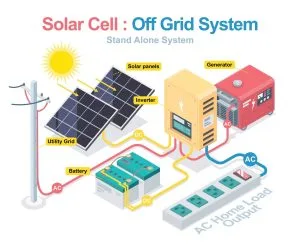
An Off-Grid system is completely disconnected from the national grid. It is a “Stand-Alone” system.
- How it works: Because there is no outside power, you must have a large bank of batteries. The panels charge the batteries during the day, and the batteries keep your lights on at night.
- The Catch: You have to be very careful with your power. If you leave the AC on for too long on a cloudy day, your batteries might run out, and you’ll be in the dark!
- Main Advantage: Total independence. You never have to worry about the grid “collapsing” or receiving an estimated bill.
- Application: Ideal for rural villages, farmhouses, or remote clinics where the national grid poles haven’t reached yet.
Hybrid Systems (The “Smart” Choice for Nigeria)
This is the most popular choice for modern Nigerian homes. A Hybrid system is connected to the grid but also has batteries.
- How it works: It uses solar first. If the sun isn’t enough, it uses the batteries. If the batteries are low, it automatically switches to the national grid or a generator.
- Energy Management: It is smart enough to choose the cheapest or most reliable source of power at any moment.
- Main Advantage: You have power 24/7. Even if the grid fails and it’s a rainy day, your batteries act as a backup.
- Application: Perfect for homes and small businesses in Nigerian cities where the grid is unreliable and frequent blackouts happen.
Summary and Comparison Table
| Feature | On-Grid | Off-Grid | Hybrid |
| Grid Connection | Yes | No | Yes |
| Needs Batteries? | No (Usually) | Yes (Mandatory) | Yes |
| Works in Blackout? | No | Yes | Yes |
| Cost | Lowest | Highest (due to batteries) | Mid-to-High |
| Independence | Low | High | Medium |
Class Discussion: Which one for who?
- If you are building a hospital in a remote village in Adamawa where there are no electricity poles, which system would you install?
- Why is an On-Grid system often frustrating for a Nigerian home during a “National Grid Collapse”?
- Between the “Initial Cost” (price to buy) and “Running Cost” (price to keep it going), which system is the most expensive over 10 years?
This term's Solar Photovoltaic Installation & Maintenance topics
SS1 First Term · 7 topics
First Term Solar Photovoltaic Installation & Maintenance Lesson Notes for Other Topics

Smart Solar Monitoring System
Read the full lesson note.
Environmental Impacts of PV Systems
Read the full lesson note.
Climate Change and Renewal Energy
Read the full lesson note.

Energy Policies in Nigeria
Read the full lesson note.
Hybrid Energy System
Read the full lesson note.

Smart Solar System
Read the full lesson note.
Advanced PV Technologies
Read the full lesson note.

Nigerian and International Standard
Read the full lesson note.
Energy Efficiency in Solar System
Read the full lesson note.

Safety in PV Installation
Read the full lesson note.

Electrical Codes and Regulations
Read the full lesson note.
Grid-Tied Solar Set-Up
Read the full lesson note.
Advanced PV System Design
Read the full lesson note.
Solar Energy Storage Technologies
Read the full lesson note.

Inverter: Meaning, Types & Ratings - (Components of PV System IV)
Read the full lesson note.
Lesson Notes for Other Classes

Basic 1 Lesson Note
The complete lesson note to guide your studies.

Basic 2 Lesson Note
The complete lesson note to guide your studies.

Basic 3 Lesson Note
The complete lesson note to guide your studies.

Basic 4 Lesson Note
The complete lesson note to guide your studies.
Basic 5 Lesson Note
The complete lesson note to guide your studies.

Basic 6 Lesson Note
The complete lesson note to guide your studies.