
Marketing Mix II: Marketing Environment – SS1 Marketing Lesson Note (Second Term)
Download Lesson NoteLesson note at a glance
- Subject
- Marketing
- Class
- SS1
- Term
- Second Term
- Topic
- Marketing Mix II: Marketing Environment
- Order
- Topic 2 of 10 this term
- Reading time
- 6 min
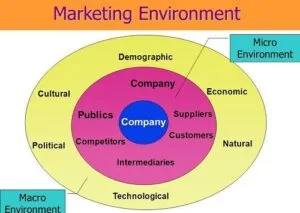
The marketing environment is all the elements that affect how a market performs. These include factors inside the market and factors outside it. Marketers study them to understand which forces influence the market and why it reacts to them as it does. They divide them into the micro-environment and the macro-environment.
Behavioural objectives
By the end of the lesson, students should be able to:
- Define the marketing environment.
- Distinguish between the micro-environment and the macro-environment.
- List the components of the micro-environment.
- Describe the different types of customers.
- Explain the political, economic, social, technological and cultural factors of the macro-environment.
- State the four stages of the economic cycle.
What is the marketing environment?
The idea behind defining the marketing environment is to understand what forces exert influence in the marketplace. The environments in which you will have to market your new product are a major factor in determining your strategy.
In a real-life marketing plan, you would spend a solid amount of time researching these environments. The marketing environment is everything an organisation must take into consideration when developing and presenting a new product.
What factors affect the marketing environment?
The marketing environment is made up of factors and forces that influence marketing. These forces can be internal, like departments other than marketing (for example, the finance department and the human resource department). They can also be external, like competitors, suppliers, and economic or political situations.
To understand them better, marketing personnel divide them into two categories: the micro-environment and the macro-environment.
What is the micro-environment?
The micro-environment refers to the forces or factors that are close to the company and affect its ability to serve its customers. These factors are suppliers, market intermediaries, customers, competitors and the public.
Suppliers
The suppliers to a firm can alter its competitive position and marketing capabilities. These are raw material suppliers, energy suppliers, and suppliers of labour and capital. The bargaining power of the supplier is at its greatest in the following situations:
- The seller firm is a monopoly or an oligopoly firm.
- The supplier is not obliged to contend with other substitute products for sale to the buyer group.
- The buyer is not an important customer.
- The supplier poses a real threat of forward integration.
Market intermediaries
Every producer has to have several intermediaries for promoting, selling and distributing the goods and serving ultimate consumers. These intermediaries may be individuals or business firms. They are the middlemen (wholesalers, retailers, agents, etc.), distributing agencies, market service agencies and financial institutions.
Customers
Customers may be classified as:
- Ultimate customers: These customers may be individuals and householders.
- Industrial customers: These customers are organisations which buy goods and services for producing other goods and services to fulfil other objectives.
- Resellers: They are the intermediaries who purchase goods to resell them at a profit. They can be wholesalers, retailers, distributors, etc.
- Government and other non-profit customers: These customers purchase goods and services and make them available to those for whom they are produced, for their consumption in most cases.
- International customers: These customers are individuals and organisations of other countries who buy goods and services either for consumption or for industrial use. Such buyers may be consumers, producers, resellers and governments.
Competitors
Competitors are those who sell goods and services of the same or similar description in the same market. Apart from competition on price, there is likely to be product differentiation. It is therefore necessary to build an efficient system of marketing. This will bring confidence and better results.
Public
The company must satisfy the people at large, along with its competitors and the consumers. This is necessary for future growth. The actions of the company influence the other groups that form the general public. A public is defined as ‘any group that has an actual or potential interest in or impact on a company’s ability to achieve its objective’. Public relations are a broad marketing operation which must be fully taken care of.
What is the macro-environment?
The macro marketing environment takes into account all factors that can influence an organisation but are outside its control. These are political, economic, socio-cultural and technological factors.
The political environment
These are laws, procedures, practices and policies formulated by the government to regulate and facilitate business activities. It also involves the stability or instability of the government.
The political environment includes all laws, government agencies and lobbying groups that influence or restrict individuals or organisations. Marketers need to be aware of these restrictions, as they can be complex.
Some products are regulated by both state and federal laws. There are even restrictions on who the target market may be for some products. For example, cigarettes should not be marketed to younger children. There are also many restrictions on subliminal messages and monopolies. As laws and regulations change often, this is a very important aspect for a marketer to monitor.
The economic environment
These factors consist of inflation, national income and the economic system of a country. They also include changes in the business cycle. A marketer should be able to adjust to such changes to operate successfully.
The economic environment also covers factors such as salary levels, credit trends and pricing patterns that affect consumers’ spending habits and purchasing power. This refers to the purchasing power of potential customers and how people spend their money. The economic cycle goes through four stages: prosperity, recession, depression and recovery.
Consumers spend more during the prosperity stage than in the depression stage, when the lowest amount of consumer spending takes place. Your marketing campaign, product offerings and pricing must take the current economic cycle into account to be successful.
The social environment
These are values and norms of the society, interest groups, reference groups and social class. These factors influence the buying decisions of consumers. The social environment also includes institutions and other forces that affect the basic values, behaviours and preferences of society, all of which affect consumer buying decisions.
The technological environment
These are changes or advancements in processes, equipment and devices that are used to accomplish the tasks of the marketer or an organisation. It is perhaps one of the fastest-changing factors in the macro-environment. It includes all developments, from antibiotics and surgery to nuclear missiles and chemical weapons to automobiles and credit cards.
As technology develops, it can create new markets and new uses for products. It also requires a company to stay ahead of others and update its technology as it becomes outdated. Companies must keep informed of trends so that they take part in new developments and avoid financial losses from outdated technology.
Cultural factors
These are ways of life of the people, such as language, aesthetics and their perception. A marketer should learn to adjust to the culture of the people for him or her to operate successfully.
Evaluation
- Define the marketing environment.
- Name the two categories into which marketing personnel divide the marketing environment.
- List the five components of the micro-environment.
- State the four stages of the economic cycle.
- Explain how the political environment can affect a marketer.
Assignment
- List and describe the types of customers in the micro-environment.
- Explain the technological environment and say why a company must keep up with technological change.
This term's Marketing topics
SS1 Second Term · 10 topics
Second Term Marketing Lesson Notes for Other Topics

Fund Management
Read the full lesson note.

Selling and Bargaining Skills
Read the full lesson note.
Purchase and Supply of Good Merchandising of Goods & Services
Read the full lesson note.
Identifying a Good Marketing Location and Setting up and Operating a marketing Outlet
Read the full lesson note.

Planning for a Personal Marketing Outlet
Read the full lesson note.
Internet Browsing and Electronic Marketing
Read the full lesson note.
Primary And Secondary Products
Read the full lesson note.

Documents Used In Transportation
Read the full lesson note.

Warehousing
Read the full lesson note.

Marketing Research
Read the full lesson note.

Marketing Planning Process
Read the full lesson note.
Organizational Buying Behaviour
Read the full lesson note.
Consumer And Organizational Behaviour II
Read the full lesson note.
Consumer And Organisational Behaviour I
Read the full lesson note.

Organizational Market
Read the full lesson note.
Lesson Notes for Other Classes

Basic 1 Lesson Note
The complete lesson note to guide your studies.

Basic 2 Lesson Note
The complete lesson note to guide your studies.

Basic 3 Lesson Note
The complete lesson note to guide your studies.

Basic 4 Lesson Note
The complete lesson note to guide your studies.

Basic 5 Lesson Note
The complete lesson note to guide your studies.

Basic 6 Lesson Note
The complete lesson note to guide your studies.

