
Classification of Products – SS1 Marketing Lesson Note (First Term)
Download this term · ₦1,000Lesson note at a glance
- Subject
- Marketing
- Class
- SS1
- Term
- First Term
- Topic
- Classification of Products
- Order
- Topic 6 of 8 this term
- Reading time
- 6 min
A product is anything that can be offered to a market to satisfy a want or need. Products are classified into industrial goods, primary products, secondary products and consumer goods. Consumer goods are further grouped as convenience, shopping and speciality goods.
Behavioural objectives
By the end of the lesson, students should be able to:
- define a product and give examples of things that can be marketed;
- state the difference between the product concept and the production concept;
- classify products into industrial, primary, secondary and consumer goods, with examples;
- describe convenience, shopping and speciality products;
- list reasons why new products may fail in the market.
What is a product?
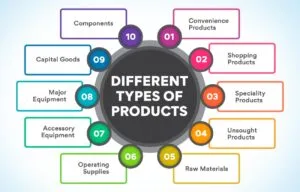
A product is anything that can be offered to a market for attention, acquisition, use or consumption to satisfy a want or need.
- Physical goods: items you can touch, such as bread, shoes and phones.
- Services: work done for a buyer, such as haircuts, banking and transport.
- Ideas: messages that are promoted, such as a road safety campaign.
- Events: occasions people pay to attend, such as a concert or football match.
- Experiences: memorable activities, such as a visit to a tourist centre.
- Persons: people who are promoted, such as a musician or a political candidate.
- Places: locations promoted to visitors, such as tourist resorts.
- Properties: land, houses and shares that are bought and sold.
- Organisations: bodies that promote their image, such as a bank or a school.
A buyer is not only buying the item. The buyer is also buying the benefits and satisfaction it will provide.
What is the difference between the product concept and the production concept?
The product concept is the belief that buyers prefer products with the best quality, performance and innovative features.
The production concept is the belief that buyers prefer products that are cheap and widely available, so a firm should focus on mass production and mass distribution.
| Point | Product concept | Production concept |
|---|---|---|
| Main focus | Quality, superior performance, innovative features | Mass production and mass distribution |
| Main appeal to buyers | A better product | Low price and easy availability |
Why must producers know the class of their products?
Producers must know the product category they belong to because it guides how they make, price and sell the product.
- Competition: the market is competitive, and producers ignore this at their own risk.
- Purchasing power: the economy of the nation affects how much consumers can spend.
- Quality: producers should make sure the product keeps the quality that consumers want.
What are the classes of products?
There are four main classes of products: industrial goods, primary products, secondary products and consumer goods.
What are industrial goods?
Industrial goods are raw materials that must be processed into semi-finished or finished goods.
- Raw cotton: processed into thread and cloth.
- Timber: processed into planks and furniture.
- Fresh tomatoes: processed into tomato paste when bought by a factory.
What are primary products?
Primary products are farm produce that has not undergone any processing.
- Yam tubers and cassava tubers: sold as harvested.
- Fresh fish: sold without smoking or drying.
- Fruits and fresh tomatoes: sold in their natural state.
What are secondary products?
Secondary products are farm produce that has undergone processing.
- Yam flour and corn flour: made by processing tubers and grain.
- Smoked fish and dry fish: fish that has been preserved.
- Tomato paste: made from fresh tomatoes.
- Garlic: listed as a processed item in this scheme of work.
What are consumer goods?
Consumer goods are goods bought from retail stores for personal, family or household use.
- Examples: tinned tomatoes, smoked fish, fruit juice and garlic.
- Grouping: they are divided into three subcategories based on consumer buying habits.
| Class | Meaning | Examples |
|---|---|---|
| Industrial goods | Raw materials to be processed | Raw cotton, timber |
| Primary products | Unprocessed farm produce | Yam tubers, fresh fish |
| Secondary products | Processed farm produce | Yam flour, smoked fish |
| Consumer goods | Goods bought for personal or household use | Fruit juice, tinned tomatoes |
What are the types of consumer goods?
There are three types of consumer goods: convenience goods, shopping goods and speciality goods.
What are convenience products?
Convenience products are items that the consumer buys often, with minimum shopping effort.
- Buying habit: they are habitual purchases, bought frequently but not in large quantities.
- Durability: they are non-durable goods, so they are “used up”.
- Examples: biscuits, newspapers, toilet soap and cigarettes.
- Location: consumers buy them from retail outlets very close to their homes.
What are shopping products?
Shopping products are products that consumers buy less often than convenience products and take time to locate.
- Price: they are relatively more expensive than convenience products.
- Effort: consumers are willing to spend more time looking for them.
- Examples: clothing, personal services, electronic products and household furnishings.
What are speciality products?
Speciality products are products that carry a high price tag compared with convenience and shopping products.
- Consumer choice: consumers are very selective and often know in advance the product they prefer.
- Shopping around: they do not compare products, but may choose the retailer that gives the best value.
- Market: the target market is generally very small.
- Outlets: sellers are so few that they are exclusive.
- Examples: luxury automobiles, expensive champagne and celebrity hair care experts.
| Point | Convenience | Shopping | Speciality |
|---|---|---|---|
| Price | Low | Higher | Highest |
| Buying effort | Minimum | Compares and searches | Knows the exact product wanted |
| Outlets | Many, close to home | Fewer | Very limited and exclusive |
| Example | Toilet soap | Clothing | Luxury car |
What are the types of convenience products?
There are three types of convenience products: staple, impulse and emergency products.
What are staple products?
Staple products are products bought often, regularly and without much thought.
- Examples: milk for breakfast, bread and tomato paste.
- Where sold: convenient places such as food stores and supermarkets.
- Branding: branding is important for staple products.
What are impulse products?
Impulse products are products bought without planning or search effort because of a strongly felt need.
- Example: children buy ice cream when they see a seller ringing a bell.
- Lost sale: if the buyer does not see the product on time, the need goes away and the sale is lost.
- Display: retailers place impulse products where they will be seen and bought.
What are emergency products?
Emergency products are products bought because of circumstances, when the need is great.
- Ambulance service: the price does not matter after an accident.
- Umbrella: the price does not matter during a rainstorm.
- Marketing mix: different types of marketing mix are required to meet emergency needs.
Why may new products fail in the market?
A new product may fail because of poor planning, strong competition, high costs or weak distribution.
- Inadequate market analysis: poor estimation of potential sales.
- No advantage: the product offers nothing better than what competitors offer.
- Poor follow-up: not enough support after the product is introduced.
- High production cost: costs higher than expected lead to a higher price.
- Competitor reaction: rivals increase promotion to protect their market share.
- Poor timing: launching in the off-season or off-peak period lowers demand.
- Technical problems: the product is technically deficient or has production faults.
- Poor corporate image: customers hesitate to patronise the firm’s product.
- Long test marketing: rivals have time to introduce similar products.
- Distribution problems: inadequate channels make the product unavailable to customers.
Evaluation
- Define a product and list four things that can be marketed.
- State the difference between primary products and secondary products, with two examples of each.
- Name the three subcategories of consumer goods.
- Why do retailers display impulse products conspicuously?
- State four reasons why a new product may fail in the market.
Assignment
Explain the difference between shopping products and speciality products, with two examples of each. Then describe emergency products and give two examples.
This term's Marketing topics
SS1 First Term · 8 topics
- Introduction to Marketing
- Introduction to Marketing II: Functions of Marketing
- Post Independence Era in the History of Marketing in Nigeria
- Marketing Concepts
- Marketing Concepts II: Difference Between Sales & Marketing Concept
- Classification of Products
- Classification of Products II: Industrial Goods
- Marketing Mix I
Get Marketing as PDF and Word
Every week of SS1 Marketing, First Term, formatted and ready to print. Ad-free, and the copy lock comes off.
Get this term Card, bank transfer, USSD or OPay
SS1 Marketing Lesson Notes for Other Topics

Introduction To Marketing
Read the full lesson note.

Introduction To Marketing II - Functions of Marketing
Read the full lesson note.

Post Independence Era in The History of Marketing in Nigeria
Read the full lesson note.
Marketing Concepts
Read the full lesson note.

Marketing Concepts II - Difference Between Sales & Marketing Concept
Read the full lesson note.
Classification Of Products II - Industrial Goods
Read the full lesson note.
Marketing Mix I
Read the full lesson note.
Marketing Mix II - Marketing Environment
Read the full lesson note.
Marketing Mix II - Marketing Environment
Read the full lesson note.
What Market Do
Read the full lesson note.
Types Of Market I
Read the full lesson note.

Organizational Market
Read the full lesson note.
Consumer And Organisational Behaviour I
Read the full lesson note.
Consumer And Organizational Behaviour II
Read the full lesson note.
Organizational Buying Behaviour
Read the full lesson note.
Lesson Notes for Other Classes

SS2 Lesson Note
The complete lesson note to guide your studies.

SS3 Lesson Note
The complete lesson note to guide your studies.
