
OYO – SS1 Nigerian History Lesson Note (Second Term)
Lesson note at a glance
- Class
- SS1
- Subject
- Nigerian History
- Term
- Second Term
- Reading time
- 8 min
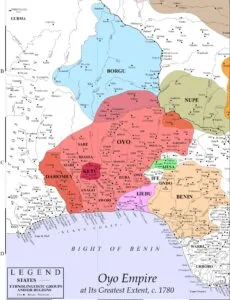
The Oyo Empire was a powerful Yoruba state in West Africa, in what is now south-western Nigeria and parts of the Republic of Benin.
Behavioural objectives
By the end of the lesson, students should be able to:
- State the origin of the Oyo Empire and name its founder.
- Describe the roles of the Alaafin, the Aremo and the Oyo Mesi.
- Explain how checks and balances worked in the Oyo political system.
- Describe the main parts of the Oyo economy.
- Give reasons for the decline and fall of the Oyo Empire.
- State the legacy of the Oyo Empire.
How was the Oyo Empire founded?
According to Yoruba tradition, the Oyo Empire was founded by Oranmiyan, a prince from Ile-Ife.
- Origin: Oyo traces its beginning to Ile-Ife, the sacred city of the Yoruba.
- Founder: Oranmiyan, who tradition links to Oduduwa, the legendary ancestor of the Yoruba.
- First capital: Old Oyo (Oyo-Ile), in the savannah north of the forest zone.
- Location: the site gave access to trade routes and good farmland.
- First Alaafin: tradition says Oranmiyan left Oyo and his son Ajaka became the first Alaafin.
- Alaafin: the title means “owner of the palace” in Yoruba.
- Date: the exact date is unclear, but it is often placed around the 14th century.
How did the empire grow?
Oyo grew from a small kingdom into an empire through trade, conquest and a strong army.
- Peak: the empire was at its greatest in the 17th and 18th centuries.
- Territory: it covered much of south-western Nigeria and reached west into present-day Benin Republic.
- Trade: it controlled routes between the forest and the savannah.
- Peoples: it brought many Yoruba and non-Yoruba peoples under its rule.
- Tribute: conquered states paid tribute to the Alaafin.
- Army: a strong military with cavalry (horsemen) kept the empire together.
How was the Oyo Empire governed?
Oyo was a monarchy in which the Alaafin ruled with a council of chiefs that limited his power.
Who was the Alaafin?
The Alaafin was the supreme ruler of the Oyo Empire.
- Status: he was seen as sacred and semi-divine.
- Succession: he came from the royal lineage and was chosen by the Oyo Mesi.
- Palace: he lived in a large palace in Oyo-Ile.
- Regalia: he wore a beaded crown and rich dress.
- Military role: he was commander-in-chief of the army.
- Wealth: he controlled the royal treasury and gifts from trade and tribute.
Who was the Aremo?
The Aremo was the eldest son of the Alaafin and held a special place in the palace.
- Privileges: he enjoyed royal rights while his father lived.
- Duties: he helped the Alaafin in administration.
- Custom: he was traditionally required to die when his father died.
- Purpose: the custom was meant to prevent quarrels over succession.
- Succession: the Aremo did not automatically become the next Alaafin.
- Later change: the custom was later abandoned.
What was the Oyo Mesi?
The Oyo Mesi was the council of seven chiefs that chose the Alaafin and checked his power.
- Leader: the Bashorun, who acted as prime minister.
- Selection: it chose the Alaafin from candidates in the royal family.
- Consent: its approval was needed for major decisions.
- Removal: it could call on a tyrannical Alaafin to commit suicide.
| Title | Role |
|---|---|
| Bashorun | Head of the council and prime minister. He consulted the Ifa oracle and led the move to remove an unfit Alaafin. |
| Agbaakin | Member of the council. |
| Samu | Member of the council. |
| Alapini | Member of the council. |
| Laguna | Member of the council. |
| Akinniku | Member of the council. |
| Asipa | Member of the council. |
Who were the Ogboni?
The Ogboni was a society of respected elders, led by the Oluwo, that checked the power of the chiefs.
- Leader: the Oluwo.
- Role: it represented the authority of the ancestors and the earth.
- Check: it helped limit the power of the Bashorun and the Oyo Mesi.
How did checks and balances work?
Checks and balances means that no single person or group in Oyo held all the power.
- Alaafin: held supreme authority but was limited by the Oyo Mesi.
- Bashorun: could oppose the Alaafin’s decisions.
- Ogboni: checked the power of the chiefs.
- Are-Ona-Kakanfo: led the army but could not live in the capital.
- Religion: priests and Ifa gave spiritual checks on rulers.
- Result: the system gave stability and helped Oyo last for centuries.
How was the Oyo army organised?
The Oyo army was headed by the Are-Ona-Kakanfo, the military commander (Generalissimo).
- Residence: he lived outside the capital, often in a provincial town.
- Duty: he was expected to win or die, and never to return defeated.
- Cavalry: horsemen were rare in forest kingdoms. Horses were brought from the north.
- Infantry: foot soldiers formed most of the troops.
- Provincial forces: they supported the central army.
- Gains: victory brought tribute, wealth and captives.
How was Oyo society organised?
Oyo society was arranged in layers, from the royal family at the top to slaves at the bottom.
- Royal family: the Alaafin and his lineage.
- Chiefs and nobles: the upper class, including the Oyo Mesi.
- Priests: religious leaders with special status.
- Free citizens: farmers, traders and craftspeople. Farmers were the majority.
- Slaves: the lowest group.
- Mobility: a person could rise through military service or trade.
- Age grades: people were grouped by generation.
- Women: they had limited political power but important roles in trade.
What was the Oyo economy based on?
The Oyo economy rested on farming, trade, crafts and tribute.
Agriculture
- Crops: yams, maize, sorghum and millet.
- Palm oil: an important farm product.
- Livestock: goats, sheep and chickens.
- Tools: hoes and machetes.
- Surplus: extra food fed the towns and was traded.
Trade
- Location: Oyo lay between the forest and the savannah, so it controlled trade routes.
- Kola nuts: traded north, where they were valued.
- Woven cloth: famous for its quality and sold widely.
- Salt: brought in from coastal areas.
- Horses: bought from the north for the cavalry.
- Markets: regular markets were held in towns and villages.
Crafts
- Weaving and dyeing: cotton cloth coloured with indigo.
- Blacksmithing: tools and weapons.
- Woodcarving: masks, doors and religious items.
- Leatherworking: shoes, bags and horse equipment.
- Pottery, beadwork and calabash decoration: goods for home, ceremony and trade.
- Guilds: craftspeople were organised in guilds.
What were the sources of revenue?
- Tribute: payments from conquered states.
- Taxes: on trade, markets and farm produce.
- Tolls and customs duties: collected on trade routes and borders.
- War booty: a share of goods and captives taken in war.
- Gifts: presents made to the Alaafin.
- Labour service: work on public projects.
What was the role of the slave trade?
Captives taken in war became an important trade item for Oyo.
- Early trade: slaves were first traded within Africa.
- Later trade: Oyo became involved in the transatlantic slave trade.
- Goods received: firearms, alcohol and textiles from European traders.
- Effects: wealth for the rulers, but more warfare and instability.
Why did the Oyo Empire fall?
The Oyo Empire fell in the early 19th century because of weak central rule, rebellion, economic loss and attacks from outside.
What were the causes of the decline?
- Power struggles: Bashorun Gaha became too powerful and forced more than one Alaafin to commit suicide.
- Abiodun: Alaafin Abiodun defeated Gaha, but central authority stayed weak.
- Broken checks: the system of checks and balances stopped working and caused conflict.
- Provincial independence: provinces gained their own forces and obeyed the Alaafin less.
- Disloyal commanders: some Are-Ona-Kakanfo worked against the central government.
- Economic loss: tribute fell and trade routes were lost.
- Change in trade: European trade moved towards palm oil as the slave trade declined.
- External attacks: Dahomey, a kingdom in present-day Benin Republic, stopped paying tribute and attacked Oyo.
- Breakaways: the Egba and other Yoruba states asserted their independence.
How did Afonja’s rebellion weaken Oyo?
Afonja’s rebellion was the revolt of the Are-Ona-Kakanfo of Ilorin against the Alaafin.
- Afonja, the Are-Ona-Kakanfo based in Ilorin, refused to obey Alaafin Aole.
- He declared Ilorin independent of Oyo, around 1817.
- He invited Fulani Muslim scholars and their followers to support him.
- His Fulani allies later overthrew him.
- Ilorin became a Fulani emirate and a base for attacks on Oyo.
- Effect: other provinces saw that rebellion was possible.
- Effect: the Alaafin’s authority and the unity of the empire were damaged.
How did the empire finally collapse?
- By the 1830s, Oyo had lost most of its territory.
- Old Oyo (Oyo-Ile) was abandoned around 1835.
- The capital moved south to the present-day Oyo town.
- The Alaafin became one of many Yoruba rulers.
- Wars followed among the former Oyo territories, and new states rose.
What is the legacy of the Oyo Empire?
The legacy of Oyo is its system of government, its culture and its place in Yoruba history.
Political legacy
- Titles: many Yoruba kingdoms adopted Oyo titles and offices.
- Alaafin: the Alaafin of Oyo is still a respected traditional ruler today.
- Limited monarchy: the idea that a ruler’s power should be checked shaped Yoruba political thought.
Cultural legacy
- Language: the Oyo dialect strongly influenced standard Yoruba.
- Arts: Oyo styles of cloth, music and dance spread across Yorubaland.
- Festivals: many ceremonies were copied by other groups.
- Oral history: stories of Oyo’s greatness are still passed on.
Historical importance
- Governance: it shows that organised African states existed before colonial rule.
- Trade: it linked the forest and savannah regions.
- Lesson: it shows how weak central rule and internal conflict can bring down a great state.
Evaluation
- Who founded the Oyo Empire, and where was the first settlement?
- What did the title “Alaafin” mean, and what powers did the Alaafin have?
- Describe how the Oyo Mesi and the Bashorun limited the power of the Alaafin.
- Explain the position of the Are-Ona-Kakanfo in the Oyo military system.
- State four reasons why the Oyo Empire declined.
Assignment
Explain how Afonja’s rebellion contributed to the fall of the Oyo Empire, and name two sources of revenue the empire lost as it weakened.
This term's Nigerian History topics
SS1 Second Term · 10 topics
SS1 Nigerian History Lesson Notes for Other Topics

CENTRALIZED STATES KANEM - BORNU UP TO 1800
Read the full lesson note.

THE HAUSA STATE UP TO 1800
Read the full lesson note.

NUPE UP TO 1800
Read the full lesson note.

IGALA UP TO 1800
Read the full lesson note.

THE JUKUN KINGDOM
Read the full lesson note.

BENIN
Read the full lesson note.

THE EFIK
Read the full lesson note.
THE IGBOS
Read the full lesson note.
THE ITSEKIRI
Read the full lesson note.
Introduction To History
Read the full lesson note.
Historical Skills
Read the full lesson note.
Prospect of ICT In Historical Studies
Read the full lesson note.
Land And The People Of Nigeria
Read the full lesson note.
Traditions Of Origin Of Various Groups
Read the full lesson note.
Centers Of Ancient Civilization
Read the full lesson note.
Lesson Notes for Other Classes

SS2 Lesson Note
The complete lesson note to guide your studies.

SS3 Lesson Note
The complete lesson note to guide your studies.
