
History of Computing – SS1 Data Processing Lesson Note (First Term)
Download Lesson NoteLesson note at a glance
- Subject
- Data Processing
- Class
- SS1
- Term
- First Term
- Topic
- History of Computing
- Order
- Topic 1 of 5 this term
- Reading time
- 3 min
The history of computing traces how people developed devices for fast and accurate calculation, which led to the computer. The early devices include the abacus, Napier’s bones, the Pascaline, Leibniz’s calculating machine, Jacquard’s loom and the punched card. Calculating devices are of three kinds: manual, mechanical and automatic.
Behavioural objectives
By the end of the lesson, students should be able to:
- list the early mechanical, electro-mechanical and electronic counting devices;
- describe the abacus and state what it was used for;
- state who invented Napier’s bones and the Pascaline, and what each did;
- explain how Jacquard’s loom and the punched card used holes to store information;
- name the four number systems used to represent data.
Why were calculating devices developed?
People have made every effort to find better methods of calculation. The search for fast and accurate calculating devices led to the development of the computer.
What are the early counting devices?
Early mechanical counting and calculating devices
- Abacus
- Slide rule
Early electro-mechanical counting devices
- John Napier’s bones
- Blaise Pascal’s machine
- Gottfried Leibniz’s machine
- Joseph Jacquard’s loom
- Charles Babbage’s analytical machine
Early electronic counting devices
- Herman Hollerith’s punched card
- John von Neumann’s machine
How did each early device work?
Abacus

The first calculating device was probably the abacus. The Chinese invented it. It is still in use in some countries because of its simple operation. It is made up of a frame divided into two parts by a horizontal bar and vertical threads. Each thread contains some beads. It was used to calculate simple addition and subtraction.
Napier’s bones

The need for a better calculating device was felt as time passed. John Napier, a Scottish mathematician, invented a set of eleven rods, with four sides each, which was used as a multiplication tool. These rods were made from bones, which is why they were called Napier’s bones. The rods had numbers marked in such a way that by placing them side by side, products and quotients of large numbers could be obtained.
Pascaline
The first mechanical calculating machine was invented in 1642 by Blaise Pascal, a French mathematician. Numbers were entered by dialling a series of numbered wheels. A sequence of wheels transferred the movements to a dial, which showed the result.
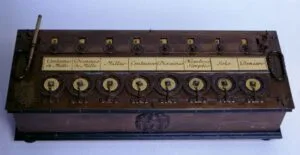
The machine could add and subtract. It could also perform division by repeated subtraction and multiplication by repeated addition.
Leibniz’s calculating machine
Gottfried Wilhelm Leibniz invented a calculating machine that was built in 1694. It could add and, after some changes, it could multiply. Leibniz invented a special stepped gear mechanism for introducing the added digits, and this is still being used.
Jacquard’s loom
Jacquard’s loom was one of the first machines run by a program. Joseph Jacquard changed the weaving industry by creating a loom that controlled the raising of the thread through punched cards. The loom used lines of holes on a card to represent the weaving pattern.
Punched card

During the years 1920 to 1930, the punched card system developed steadily. A standard card was divided into 80 columns and 12 rows. Only one character could be represented in each column, giving a maximum of 80 characters per card. Punching one, two or three holes in a column represented a character. Holes were punched into a blank card by a punch machine whose keyboard resembled that of a typewriter.
Number systems (revision)
To use the computer effectively, it is necessary to know how data is represented and communicated. Data can be represented in the following number systems:
- Decimal system
- Binary system
- Octal system
- Hexadecimal system
Evaluation
- Who invented the Pascaline, and in what year?
- What was Napier’s bones used for?
- Describe the parts of an abacus.
- How many columns and rows did a standard punched card have?
- Name the four number systems used to represent data.
Assignment
- How do the abacus and Jacquard’s loom work?
- What types of operation can the Pascaline perform?
- Explain the four number systems.
- List any four early counting devices.
This term's Data Processing topics
SS1 First Term · 5 topics
First Term Data Processing Lesson Notes for Other Topics

Database Management System II - How to Create Database
Read the full lesson note.
Database Management System I
Read the full lesson note.

Data Model
Read the full lesson note.
Data Modeling
Read the full lesson note.
Data Modeling II - Standard Data Model & Examples
Read the full lesson note.

Normalization
Read the full lesson note.

Data Model II - Types of Data Modelling
Read the full lesson note.

Entity-Relationship Models
Read the full lesson note.

Classification Of Computers
Read the full lesson note.

History Of Computer
Read the full lesson note.
Data And Information
Read the full lesson note.
Digitalization Of Data
Read the full lesson note.

Introduction to Computer Networking
Read the full lesson note.

Internet I - Electronic Mail/ E-Mail Accounts
Read the full lesson note.

Internet II - Internet & Search Engines
Read the full lesson note.
Lesson Notes for Other Classes

Basic 1 Lesson Note
The complete lesson note to guide your studies.

Basic 2 Lesson Note
The complete lesson note to guide your studies.

Basic 3 Lesson Note
The complete lesson note to guide your studies.

Basic 4 Lesson Note
The complete lesson note to guide your studies.

Basic 5 Lesson Note
The complete lesson note to guide your studies.

Basic 6 Lesson Note
The complete lesson note to guide your studies.


