
Normalization SS2 Data Processing Lesson Note
Download Lesson NoteTopic: Normalization
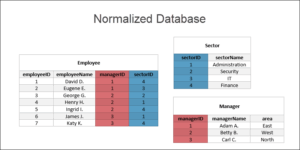
A database management system is a collection of computer software that enables users to define, create and maintain a database. Defining a database involves specifying constraints for the data stored in the database, and normalization is a logical design method which minimizes duplicate, or redundant, data and design flaws.
Normalization is the process of effectively organizing data in a database. The primary purpose of normalization is to allow the update, insert and delete operations to be performed on a single database table and propagated throughout the database using the defined relationship.
There are two goals of the normalization process:
- Eliminating redundant data (for example storing the same data in more than one table)
- Ensuring data dependencies make sense (only storing related data in a table)
The normal form (NF) of relational database theory is critical for determining a table’s degree of vulnerability to logical inconsistencies and anomalies. The higher the normal form applicable to a table, the less vulnerable it is. Each table has a “Highest Normal Form” (HNF): by definition, a table always meets the requirements of its HNF and all normal forms lower than its HNF; also by definition, a table fails to meet the requirement of any normal form higher than its HNF.
Normal form theory deals with how to reduce the amount of redundancy of data within a given table. Each normal form represents a level. To satisfy each of the requirements for a certain level, the requirements for the previous level must be met. To reach the optimal normal form for the tables within a database, the creator starts with a large list of all the data that is to be held in the database and then works through the normal forms until he can no longer break the data down into the smaller table.
TYPES OF NORMAL FORM
- First Normal Form (1NF):
First Normal Form (1NF) says that all column values must be atomic. 1NF dictates that for every row-by-column position in a given table, there exists only one value, not an array or list of values i.e in 1NF, the following rules are observed;
- Eliminating repeating information
- Create separate tables for related data.
- Second Normal Form (2NF):
The second normal form (2NF) further addresses the concept of removing duplicate data. The rule for the second normal form is;
- Remove subsets of data that apply to multiple rows of a table and place them in a separate table.
- Create relationships between these new tables and their predecessors through the use of foreign keys.
NOTE: The 2NF attempts to reduce the amount of redundant data in a table by extracting it, placing it in a new table(s) and creating relationships between those tables.
- Third Normal Form (3NF):
There are two basic requirements for a database to be in Third Normal Form:
- The requirements of both 1NF and 2NF must have been met.
- Remove columns that are not fully dependent upon the primary key.
- The Fourth Normal Form (4NF) and Fifth Normal Form (5NF):
The fourth and the fifth normal forms are beyond the scope of this syllabus.
NOTE: Both the fourth and the fifth normal forms still follow the goal of the normalization process, which are:
- eliminating redundant data.
- ensuring data dependencies make sense.
ASSIGNMENT
- State the goal of the normalization process.
First Term Data Processing Lesson Notes for Other Topics

Database Management System II - How to Create Database
Explore lesson notes covering all topics.
Database Management System I
Explore lesson notes covering all topics.
Data Model
Explore lesson notes covering all topics.
Data Modeling
Explore lesson notes covering all topics.
Data Modeling II - Standard Data Model & Examples
Explore lesson notes covering all topics.
Data Model II - Types of Data Modelling
Explore lesson notes covering all topics.

Entity-Relationship Models
Explore lesson notes covering all topics.
Classification Of Computers
Explore lesson notes covering all topics.
History Of Computer
Explore lesson notes covering all topics.
Data And Information
Explore lesson notes covering all topics.
Digitalization Of Data
Explore lesson notes covering all topics.

History Of Computing
Explore lesson notes covering all topics.

Introduction to Computer Networking
Explore lesson notes covering all topics.

Internet I - Electronic Mail/ E-Mail Accounts
Explore lesson notes covering all topics.
Internet II - Internet & Search Engines
Explore lesson notes covering all topics.


Lesson Notes for Other Classes

Basic 1 Lesson Note
The complete lesson note to guide your studies.

Basic 2 Lesson Note
The complete lesson note to guide your studies.

Basic 3 Lesson Note
The complete lesson note to guide your studies.

Basic 4 Lesson Note
The complete lesson note to guide your studies.

Basic 5 Lesson Note
The complete lesson note to guide your studies.

Basic 6 Lesson Note
The complete lesson note to guide your studies.