
Vocabulary Development: Synonym – SS1 English Lesson Note (Third Term)
Download this term · ₦1,000Lesson note at a glance
- Subject
- English Studies
- Class
- SS1
- Term
- Third Term
- Topic
- Vocabulary Development: Synonym
- Order
- Topic 2 of 6 this term
- Reading time
- 4 min
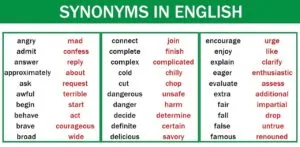
A synonym is a word that has nearly the same meaning as another word and can replace it in a sentence without changing the meaning of the sentence.
Behavioural objectives
By the end of the lesson, students should be able to:
- define a synonym;
- state why synonyms are used in writing;
- give synonyms for common words such as confess, dangerous, expensive and famous;
- replace a word in a sentence with a synonym without changing the meaning;
- tell a synonym from an antonym.
What is a synonym?
A synonym is a word whose meaning is the same as, or very close to, the meaning of another word.
- Same part of speech: a synonym of a noun is a noun, and a synonym of a verb is a verb.
- Near meaning: most synonyms are close in meaning but not always identical.
- Examples: big and large, begin and start, quick and fast, house and home.
- Many synonyms: one word can have more than one synonym, for example costly and dear for expensive.
Why are synonyms used in writing?
Synonyms are used so that a writer does not repeat the same word and the writing stays interesting.
- Avoid monotony: the same word is not used again and again.
- Express ideas clearly: a more exact word shows the meaning better.
- Improve style: varied words make essays, letters and speeches better to read.
- Build vocabulary: learning synonyms increases the number of words a student can use.
- Help in examinations: WAEC and NECO test synonyms in the lexis and structure section.
Do synonyms always mean exactly the same thing?
No, synonyms are close in meaning but may differ slightly in strength, tone or use.
- Strength: “calamity” is a much bigger disaster than “misfortune”.
- Tone: “renowned” is more formal than “well known”.
- Context: “dear” can mean expensive, but it is also used to show affection, so the sentence decides the meaning.
- Collocation: some words go together naturally, for example “costly mistake” sounds better than “dear mistake”.
What are some typical synonyms?
The table below gives common words and two synonyms for each.
| SN | Word | Synonyms |
|---|---|---|
| 1 | Confess | Admit, Own up |
| 2 | Abandon | Give up, Relinquish |
| 3 | Dangerous | Risky, Perilous |
| 4 | Surrender | Yield, Give in |
| 5 | Expensive | Dear, Costly |
| 6 | Disaster | Misfortune, Calamity |
| 7 | Aloof | Distant, Withdrawn |
| 8 | Generous | Liberal, Open-handed |
| 9 | Famous | Renowned, Eminent |
| 10 | Dishonest | Deceitful, Deceptive |
| 11 | Compensate | Requite, Atone |
| 12 | Dull | Gloomy, Cheerless |
| 13 | Reject | Refuse, Decline |
| 14 | Protagonist | Hero, Star |
| 15 | Obliterate | Efface, Destroy |
How do you replace a word with a synonym?
Replace a word by choosing a synonym that fits both the meaning and the grammar of the sentence.
- Read the sentence and find the meaning of the word in that sentence.
- Think of words with the same meaning.
- Choose one of the same part of speech.
- Put it in place of the original word.
- Read the new sentence aloud to check that the meaning and grammar are unchanged.
Examples in sentences
| Original sentence | With a synonym |
|---|---|
| The thief confessed to the crime. | The thief admitted the crime. |
| The old bridge is dangerous. | The old bridge is perilous. |
| Her car is expensive. | Her car is costly. |
| The flood was a disaster. | The flood was a calamity. |
| The chief is a generous man. | The chief is an open-handed man. |
What mistakes should students avoid when using synonyms?
- Wrong meaning: do not use a word that only looks close in meaning.
- Wrong part of speech: do not replace a verb with a noun.
- Wrong tone: do not use very formal words in a casual note to a friend.
- Wrong grammar: a synonym may need a different form, for example “an open-handed man” uses “an”.
- Using a word you do not know: check a dictionary or thesaurus first.
What is the difference between a synonym and an antonym?
A synonym is a word with a similar meaning to another word.
An antonym is a word with the opposite meaning to another word.
| Point | Synonym | Antonym |
|---|---|---|
| Meaning | Same or similar | Opposite |
| Example pair | Expensive and costly | Expensive and cheap |
| Example pair | Generous and liberal | Generous and mean |
| Use | Avoids repetition | Shows contrast |
Evaluation
- What is a synonym?
- Why do writers use synonyms?
- Give two synonyms each for: dangerous, expensive and famous.
- Give one synonym each for: confess, abandon and generous.
- Rewrite “The man was famous” using a synonym of famous.
Assignment
Find the synonyms of the following words: request, rule, acute, entire and enemy. Use one synonym of each word in a sentence.
This term's English Studies topics
SS1 Third Term · 6 topics
Get English Studies as PDF and Word
Every week of SS1 English Studies, Third Term, formatted and ready to print. Ad-free, and the copy lock comes off.
Get this term Card, bank transfer, USSD or OPay
SS1 English Studies Lesson Notes for Other Topics

Vocabulary Development - Antonyms & Adjuncts
Read the full lesson note.
Speech Writing: Features & Common Mistakes
Read the full lesson note.
Phrasal Verbs
Read the full lesson note.
Articles : Difference Between An Article & A Letter
Read the full lesson note.
Persuasive Speech: Meaning, Features & How to Write it
Read the full lesson note.

Structure, Vocabulary Development - Plural Forms of Nouns
Read the full lesson note.
Grammar, Vocabulary Development - Nouns & Gender
Read the full lesson note.
Spoken English, Vocabulary Development - Consonant Sounds: /Z/,/3/,/j/
Read the full lesson note.
Listening Comprehension , Grammar - Nouns & Types of Nouns
Read the full lesson note.
Spoken Words,Vocabulary Development: Consonant Sounds /w/
Read the full lesson note.
Structure, Writing - Noun Phrase
Read the full lesson note.

Descriptive Essays & Nominalization of Adjectives
Read the full lesson note.
Continuous Writing, Grammar - Normalization of Verbs
Read the full lesson note.
Structure,Vocabulary Development - Irregular Verbs
Read the full lesson note.
Vocabulary Development: Word Associated With Traditional Religion
Read the full lesson note.
Lesson Notes for Other Classes

SS2 Lesson Note
The complete lesson note to guide your studies.

SS3 Lesson Note
The complete lesson note to guide your studies.
