
Sole Proprietorship – SS1 Commerce Lesson Note (Third Term)
Download this term · ₦1,000Lesson note at a glance
- Subject
- Commerce
- Class
- SS1
- Term
- Third Term
- Topic
- Sole Proprietorship
- Order
- Topic 2 of 5 this term
- Reading time
- 5 min
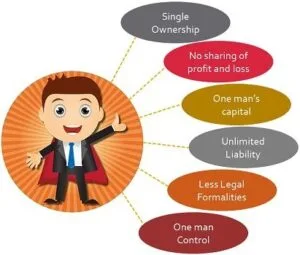
A sole proprietorship is a business set up, owned and controlled by one person who provides the capital, bears the risks and takes full responsibility for the firm. It is the oldest and simplest form of business organisation.
Behavioural objectives
- Define a sole proprietorship.
- State the features of a sole proprietorship.
- List the advantages and disadvantages of a sole proprietorship.
- Identify the sources of capital for a sole proprietorship.
- Give examples of businesses run as sole proprietorships.
What key terms should you know?
- Sole proprietor: the one person who owns, finances and runs the business. He or she is also called the one-man business owner.
- Capital: the money and assets used to start and run a business.
- Liability: the duty to pay the debts of a business.
- Unlimited liability: a duty to pay all business debts, even from the owner’s private property.
- Legal entity: a business the law treats as a person separate from its owners.
- Continuity: the ability of a business to carry on after the owner dies or retires.
- Retained profit: profit left in the business instead of being shared or spent. It is also called ploughed back profit.
What are examples of sole proprietorship businesses?
Examples of sole proprietorships are small businesses that one person owns and runs, such as shops, workshops and small farms.
| Type of activity | Examples |
|---|---|
| Small retail trading | Provision store, kiosk, roadside trader, market stall |
| Artisan work | Tailor, welder, carpenter, mechanic, barber |
| Personal services | Hairdresser, caterer, cybercafé operator |
| Small-scale farming | Poultry keeper, fish farmer, vegetable grower |
| Licensed businesses | Pharmacy, bar |
What are the features of a sole proprietorship?
The main features of a sole proprietorship are one-person ownership, unlimited liability and small size.
- One-person control: ownership, management and control are in the hands of one person.
- Unlimited liability: the owner’s liability has no limit. It extends even to private property such as a car or a house.
- Not a legal entity: in law, the business is not separate from the owner.
- No perpetual existence: the business lacks continuity. The death or retirement of the owner may end it.
- Owner’s capital: the owner provides the capital, usually a small amount.
- Sole risk-bearing: the owner bears all the risks and losses alone.
- Few formal procedures: formation is usually simple, except for businesses such as pharmacies and bars, which need a licence.
- Sole profit: the owner takes all the profit.
- Small size: it is common in small retail businesses and artisanship.
- Profit motive: the business is formed to make a profit.
How is a sole proprietorship started?
A sole proprietorship is started by following these steps in order.
- Choose the type of business and study the market.
- Raise the capital from savings, loans or other sources.
- Find a suitable place, such as a shop, stall or workshop.
- Obtain any licence or permit the business needs, as for a pharmacy or bar.
- Register the business name where the owner trades under a name other than his or her own.
- Buy stock, tools or equipment, and employ helpers if needed.
- Open for business and keep simple records of sales and expenses.
What are the advantages of a sole proprietorship?
The advantages of a sole proprietorship are mainly ease of setting up, quick decisions and full profit for the owner.
- Easy to set up: few rules and little paperwork are needed.
- Small capital: a person can start with little money.
- Easy to manage: one person runs the business, so the work is simple.
- Quick decisions: the owner does not need to consult anyone before acting.
- Flexibility: the owner can change the product, price or working hours at will.
- All profits to the owner: no one else shares the gains.
- Privacy: the owner does not have to share business secrets or publish accounts.
- Pride of ownership: the owner enjoys a feeling of independence.
- Close relationships: the owner knows workers and customers personally, which builds trust.
What are the disadvantages of a sole proprietorship?
The disadvantages of a sole proprietorship are mainly limited capital, unlimited liability and lack of continuity.
- Limited capital: the owner cannot easily raise enough money.
- Unlimited liability: the owner’s private property can be used to pay business debts.
- Not a separate legal entity: the business cannot sue or be sued in its own name.
- All risks and losses borne alone: no partner shares the loss.
- Limited expansion: small capital and one manager restrict growth.
- Lack of continuity: the death of the owner may force the business to close.
- Limited decision making: one person’s knowledge and skill limit the choices made.
- Weak against competition: a small firm finds it hard to face large rivals.
- No rest: the owner may lack holidays or leave, and may retire late.
What are the sources of capital for a sole proprietorship?
The sources of capital for a sole proprietorship are personal savings, loans, grants, trade credit, retained profits and other credit facilities.
| Source | Explanation |
|---|---|
| Personal savings | Money the owner has saved. It is the main starting source. |
| Loans from friends and relatives | Money borrowed, often with little or no interest. |
| Grants from friends and relations | Gifts of money that need not be repaid. |
| Bank loans and overdrafts | Money borrowed from banks, repaid with interest. |
| Trade credit | Goods bought now and paid for later. |
| Retained profits | Profits kept in the business, also called ploughed back profits. |
| Government grants or loans | Help from government or its agencies, e.g. NAPEP and NDE. |
| Other credit facilities | Arrangements such as hire purchase, for buying equipment. |
Which sources come from inside and which from outside?
Internal sources come from the owner or the business, while external sources come from other people or bodies.
- Internal sources: personal savings and retained profits.
- External sources: loans, grants, overdrafts, trade credit and hire purchase.
Why does a sole proprietorship lack continuity?
A sole proprietorship lacks continuity because the business and the owner are one person in law.
- No separate existence: the business and the owner are one in law.
- Owner’s death: when the owner dies, the business has no legal person to carry it on.
- Retirement or illness: if the owner cannot work, the business may stop.
- Effect: heirs may continue it only as a new business, and many such businesses close.
Evaluation
- Define a sole proprietorship.
- State five features of a sole proprietorship.
- List four advantages of a sole proprietorship.
- Explain why unlimited liability is a disadvantage to the owner of a sole proprietorship.
- Mention four sources of capital for a sole proprietorship.
Assignment
State four disadvantages of a sole proprietorship and explain why it lacks continuity.
This term's Commerce topics
SS1 Third Term · 5 topics
- Commodity Exchange
- Sole Proprietorship
- Partnership
- Partnership II
- Money
Get Commerce as PDF and Word
Every week of SS1 Commerce, Third Term, formatted and ready to print. Ad-free, and the copy lock comes off.
Get this term Card, bank transfer, USSD or OPay
SS1 Commerce Lesson Notes for Other Topics
Commodity Exchange
Read the full lesson note.

Partnership
Read the full lesson note.
Partnership II
Read the full lesson note.

Money
Read the full lesson note.
Introduction To Commerce
Read the full lesson note.
Occupation
Read the full lesson note.
Production
Read the full lesson note.

Trade - Retailers & Retail Trade
Read the full lesson note.
Foreign Trade
Read the full lesson note.
Home Trade - Small Retailers
Read the full lesson note.
Home Trade: Large Scale Retailers
Read the full lesson note.

Home Trade: Modern Trends In Retailing
Read the full lesson note.

Home Trade: Wholesale Trade
Read the full lesson note.

Foreign Trade
Read the full lesson note.
Foreign Trade II: Concepts of International Trade
Read the full lesson note.
Lesson Notes for Other Classes

SS2 Lesson Note
The complete lesson note to guide your studies.

SS3 Lesson Note
The complete lesson note to guide your studies.
