
Money – SS1 Commerce Lesson Note (Third Term)
Download this term · ₦1,000Lesson note at a glance
- Subject
- Commerce
- Class
- SS1
- Term
- Third Term
- Topic
- Money
- Order
- Topic 5 of 5 this term
- Reading time
- 5 min
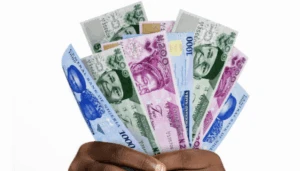
Money is anything generally acceptable as a medium of exchange for making payments and settling debts in a given economy.
Behavioural objectives
- Define money and state its characteristics.
- Explain the functions of money.
- Distinguish between legal tender and near money.
- Explain countertrade and state its advantages.
- Describe trade by barter and state its problems.
What are the characteristics of money?
Good money has ten characteristics: acceptability, portability, durability, scarcity, homogeneity, divisibility, recognisability, stability in value, security and economy.
- Acceptability: members of the community must accept it as a medium of exchange.
- Portability: it must be easy to carry about.
- Durability: it must last a fairly long time and withstand wear and tear.
- Scarcity: it must be relatively scarce, not too common.
- Homogeneity: units of the same denomination must be uniform, so one ₦50 note is identical to another ₦50 note.
- Divisibility: it must divide easily into smaller denominations, e.g. ₦500, ₦200, ₦100, ₦50, ₦20, ₦10 and ₦5.
- Recognisability: it must be easy to recognise.
- Stability in value: its value must stay fairly steady and not rise and fall sharply.
- Security: it must carry security marks so that it is difficult to imitate.
- Economy: the cost of producing and maintaining it must not be too high.
What are the functions of money?
Money has five functions: medium of exchange, measure of value, store of value, unit of account and standard for deferred payments.
- Medium of exchange: people use money to buy and sell goods and services. This solves the main problem of barter, the double coincidence of wants.
- Measure of value: money lets us measure and compare the worth of goods and services.
- Store of value: money lets people keep surplus wealth over time. Its value falls during inflation.
- Unit of account: money makes it easy to calculate and record the values of goods and services bought and sold.
- Standard for deferred payments: money allows payment to be postponed to a later date. This matters in modern business, where most transactions are on credit.
What were the early forms of money in Nigeria?
Before modern notes and coins, people used commodity money, which is a useful or valued item accepted as payment.
- Cowrie shells: small shells widely used as currency in West Africa.
- Manilas: metal bracelet-shaped pieces used in parts of southern Nigeria.
- Other items: salt, beads, cloth and livestock were also used in different places.
What are the forms of money?
Money in an economy exists mainly as legal tender and as near money.
- Legal tender: any form of money backed by law in a country, which a trader must accept in settlement of debt, e.g. naira notes and coins in Nigeria.
- Near money (quasi money): documents that can easily be converted to cash, e.g. cheques, postal orders and money orders.
What is the difference between legal tender and near money?
| Point | Legal tender | Near money |
|---|---|---|
| Backing | Backed by law | Not backed by law as final payment |
| Acceptance | A trader must accept it for debt | A trader may refuse it |
| Use | Pays debts directly | Must first be converted to cash |
| Examples | Naira notes and coins | Cheques, postal orders, money orders |
What is countertrade?
Countertrade is barter at the international level, where countries exchange goods and services without using money.
- How it works: a country gives its goods in return for goods from the other country.
- Payment: no money changes hands.
What are the advantages of countertrade?
- Technology transfer: it helps countries exchange technology.
- Closer ties: it encourages economic and political cooperation between countries.
- Debt reduction: it can reduce a country’s stock of external debts.
- Foreign exchange: it conserves the foreign exchange reserves of the countries involved.
- Production quotas: it helps where goods are under quotas set by a cartel, e.g. OPEC.
- Infrastructure: it helps a developing economy build infrastructure when the foreign contractor accepts goods as payment.
- Sanctions: a sanctioned country, e.g. one facing a loan freeze or frozen assets, can keep importing goods by barter.
What is trade by barter?
Trade by barter is the direct exchange of goods for other goods without using money as a medium of exchange.
- Period: it was the way of trading before money came into use.
- Example: a farmer exchanges yams for a fisherman’s fish.
What problems of trade by barter led to the use of money?
- Double coincidence of wants: each person must want exactly what the other has to offer.
- No common standard of value: there is no fixed rate of exchange, so goods are hard to value.
- Storage of goods: perishable goods cannot be kept, so saving is difficult.
- Indivisibility of goods: some goods cannot be divided, which makes exchange of small amounts hard.
- No standard for deferred payment: it is hard to repay a loan with items of equal size, quantity or quality.
- Waste of time and effort: people spend time and energy searching for a partner to trade with.
- Limited specialisation: barter encourages self-sufficiency, so labour cannot specialise.
- Haggling and cheating: bargaining is long and dishonest dealing is common.
- No instalment payment: buying in parts over time is not encouraged.
How does trade by barter differ from trade with money?
| Point | Trade by barter | Trade with money |
|---|---|---|
| Medium | Goods for goods | Money for goods |
| Wants | Needs double coincidence of wants | Not needed |
| Value | No common measure | Prices show value |
| Saving | Hard to save | Easy to save |
| Credit | Hard to repay fairly | Deferred payment is possible |
Evaluation
- Define money.
- List any five characteristics of money.
- State the five functions of money.
- What is countertrade? Give two of its advantages.
- State four problems of trade by barter.
Assignment
Explain the difference between legal tender and near money with two examples of near money, then explain four problems of trade by barter that led to the use of money.
This term's Commerce topics
SS1 Third Term · 5 topics
Get Commerce as PDF and Word
Every week of SS1 Commerce, Third Term, formatted and ready to print. Ad-free, and the copy lock comes off.
Get this term Card, bank transfer, USSD or OPay
SS1 Commerce Lesson Notes for Other Topics
Commodity Exchange
Read the full lesson note.
Sole Proprietorship
Read the full lesson note.
Partnership
Read the full lesson note.
Partnership II
Read the full lesson note.
Introduction To Commerce
Read the full lesson note.
Occupation
Read the full lesson note.
Production
Read the full lesson note.

Trade - Retailers & Retail Trade
Read the full lesson note.
Foreign Trade
Read the full lesson note.
Home Trade - Small Retailers
Read the full lesson note.
Home Trade: Large Scale Retailers
Read the full lesson note.

Home Trade: Modern Trends In Retailing
Read the full lesson note.

Home Trade: Wholesale Trade
Read the full lesson note.

Foreign Trade
Read the full lesson note.
Foreign Trade II: Concepts of International Trade
Read the full lesson note.
Lesson Notes for Other Classes

SS2 Lesson Note
The complete lesson note to guide your studies.

SS3 Lesson Note
The complete lesson note to guide your studies.
