
Introduction to Commerce – SS1 Commerce Lesson Note (First Term)
Download this term · ₦1,000Lesson note at a glance
- Subject
- Commerce
- Class
- SS1
- Term
- First Term
- Topic
- Introduction to Commerce
- Order
- Topic 1 of 5 this term
- Reading time
- 6 min
Commerce is the study of the production, distribution and exchange of goods and services to satisfy human wants and earn a living. It has two divisions: trade and aids to trade.
Behavioural objectives
By the end of the lesson, students should be able to:
- Define commerce.
- State the importance (functions) of commerce.
- Outline the stages in the history and development of commerce.
- List the factors that delayed and the factors that helped the growth of commerce in Nigeria and West Africa.
- Name the divisions of commerce and the subdivisions of aids to trade.
What is commerce?
Commerce is all the activities that move goods and services from producers to consumers.

What are the key terms in commerce?
- Commerce: all the activities that move goods and services from producers to consumers.
- Goods: physical items we can touch, such as rice, shoes and books.
- Services: work done for others that we cannot touch, such as teaching, banking and transport.
- Human wants: the things people desire, such as food, clothing, shelter, education and entertainment.
- Production: the making of goods and services, for example farming and manufacturing.
- Distribution: the movement of goods from the producer to the consumer, through wholesalers and retailers.
- Exchange: the giving of goods or services in return for money or other goods.
- Basic wants: the most necessary wants of man, namely food, clothing and shelter.
What is the difference between goods and services?
Goods are items we can touch and own. Services are acts done for us that we cannot touch.
| Point | Goods | Services |
|---|---|---|
| Nature | Physical and can be touched | Not physical, cannot be touched |
| Storage | Can be stored for later sale | Cannot be stored |
| Examples | Rice, shoes, books | Teaching, banking, transport |
What are the importance (functions) of commerce?
Commerce has six main functions: it creates jobs, makes exchange possible and raises living standards, among others.
- Employment: it provides jobs for traders, drivers, bankers, insurers and many others.
- Production and exchange: it makes the production and exchange of goods and services possible.
- Standard of living: it improves living standards by making modern goods available.
- Cooperation: it aids national and international cooperation by making nations depend on one another.
- Specialisation: it supports division of labour and specialisation, since people can sell what they make and buy the rest.
- Development: it brings technological innovation and aids infrastructural development.
What are the stages in the history and development of commerce?
Commerce developed in five stages: subsistence production, barter, commodity money, coins and notes, and improved aids to trade.
- Subsistence production: in the earliest time, each family produced only what it needed, such as a farmer growing yam for his own household.
- Barter: people exchanged goods and services directly for other goods and services, for example yam for fish.
- Commodity money: items such as cowries, salt and beads were accepted as payment for goods.
- Coins and notes: metal coins and paper notes became the medium of exchange. The naira and kobo are Nigeria’s money.
- Improvement in aids to trade: banks, insurance, better transport, advertising and communication made trade faster and safer.
What are the problems of barter?
Barter is the direct exchange of goods and services for other goods and services without money. It has four main problems.
- Double coincidence of wants: you must find someone who has what you want and wants what you have.
- No common measure of value: it is hard to say how many fish equal one goat.
- Indivisibility: some goods lose value if divided, such as a live cow.
- Poor storage of wealth: goods such as fish and vegetables spoil.
What factors delayed the development of commerce in Nigeria and West Africa?
Nine factors delayed the growth of commerce in Nigeria and West Africa, mainly weak capital, technology and infrastructure.
- Political instability: unrest and wars discouraged trade and investment.
- Low savings: little money was available to invest in business.
- Absence of developed markets: buyers and sellers had few places to meet.
- Poor communication system: news and orders moved slowly.
- Illiteracy: few people had the skills for modern business.
- Inadequate capital: traders lacked funds to expand.
- Low level of technology: production was slow and output was small.
- Poor infrastructure: bad roads, power and water supply raised costs.
- Low national income: people had little money to buy goods.
What factors have contributed to the growth of commerce in Nigeria and West Africa?
Seven factors have helped commerce to grow in Nigeria and West Africa, from modern production to better education.
- Modern techniques of production: machines increased output and lowered costs.
- Political stability: peace encouraged trade and investment.
- Financial institutions: banks provide loans, savings and payment services.
- Transport and communication: goods and information move faster and cheaper.
- Warehousing facilities: goods can be stored safely until they are needed.
- Improved aids to trade: for example, insurance reduces risk and advertising informs buyers.
- Education and literacy: more skilled people run and use business services.
What are the divisions of commerce?
Commerce has two divisions: trade and aids to trade.
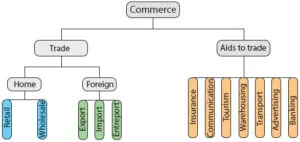
| Division | Meaning |
|---|---|
| Trade | The buying and selling of goods and services, either at home or abroad. |
| Aids to trade | Services that help trade to take place smoothly. |
What are the types of trade?
There are two types of trade: home trade and foreign trade.
- Home trade: buying and selling within one country, for example a Lagos trader selling to a buyer in Kano.
- Wholesale trade: a part of home trade in which goods are bought in bulk from producers and sold to retailers.
- Retail trade: a part of home trade in which goods are sold in small quantities to consumers.
- Foreign trade: buying and selling between one country and other countries.
- Import: buying goods from another country.
- Export: selling goods to another country.
- Entrepot trade: importing goods in order to export them again.
What are the subdivisions of aids to trade?
There are seven aids to trade: transport, insurance, banking and finance, advertising, warehousing, communication and tourism.
| Aid to trade | How it helps trade |
|---|---|
| Transport | Moves goods from producers to buyers. |
| Insurance | Protects traders against loss from risks such as fire and theft. |
| Banking and finance | Keeps money safe and provides loans and payment services. |
| Advertising | Informs buyers about goods and services. |
| Warehousing | Stores goods until they are needed. |
| Communication | Passes information quickly between buyers and sellers, for example by telephone and post. |
| Tourism | Brings visitors who spend money on local goods and services. |
Evaluation
- Define commerce.
- State four functions of commerce.
- List the stages in the history and development of commerce.
- State three factors that delayed the development of commerce in Nigeria and West Africa.
- Name the two divisions of commerce and list the subdivisions of aids to trade.
Assignment
Answer these five objective questions in your notebook.
- The main divisions of commerce are (a) Home trade and foreign trade (b) Transportation and warehousing (c) Trade and aids to trade (d) Wholesale and retail trade
- Which of the following is not a benefit of commerce? It (a) Facilitates the movement of goods and services (b) Provides employment to people (c) Increases the cost of living (d) Makes funds available for business activities
- All are aids to trade except (a) Advertising (b) Transportation (c) Retailing (d) Banking
- Which of the following can be defined as trade and aid to trade? (a) Advertising (b) Commerce (c) Warehousing (d) Retailing
- Which of the following is not a basic want of man? (a) Transport (b) Food (c) Water (d) Clothing
This term's Commerce topics
SS1 First Term · 5 topics
- Introduction to Commerce
- Occupation
- Production
- Trade: Retailers & Retail Trade
- Foreign Trade
Get Commerce as PDF and Word
Every week of SS1 Commerce, First Term, formatted and ready to print. Ad-free, and the copy lock comes off.
Get this term Card, bank transfer, USSD or OPay
SS1 Commerce Lesson Notes for Other Topics
Occupation
Read the full lesson note.
Production
Read the full lesson note.

Trade - Retailers & Retail Trade
Read the full lesson note.
Foreign Trade
Read the full lesson note.
Home Trade - Small Retailers
Read the full lesson note.
Home Trade: Large Scale Retailers
Read the full lesson note.

Home Trade: Modern Trends In Retailing
Read the full lesson note.

Home Trade: Wholesale Trade
Read the full lesson note.

Foreign Trade
Read the full lesson note.
Foreign Trade II: Concepts of International Trade
Read the full lesson note.

Foreign Trade III: Documents Used in Foreign Trade
Read the full lesson note.
Foreign Trade - Custom And Excise Authority
Read the full lesson note.
Foreign Trade V - Nigeria Ports (NPA) & Nigeria Airport Authority (NAA)
Read the full lesson note.
Commodity Exchange
Read the full lesson note.

Sole Proprietorship
Read the full lesson note.
Lesson Notes for Other Classes

SS2 Lesson Note
The complete lesson note to guide your studies.

SS3 Lesson Note
The complete lesson note to guide your studies.
