
Area of Plane Figures II – JSS3 Mathematics Lesson Note (Second Term)
Download this term · ₦1,000Lesson note at a glance
- Subject
- Mathematics
- Class
- JSS3
- Term
- Second Term
- Topic
- Area of Plane Figures II
- Order
- Topic 6 of 6 this term
- Reading time
- 4 min
The area of a plane figure is the amount of flat surface it covers, measured in square units.
Behavioural objectives
- State the formulas for the area of a rectangle, a square, a triangle, a circle and a sector.
- Calculate the area of a rectangle, a triangle and a circle from given measurements.
- Calculate the area of a sector using the radius and the angle.
- Split a compound shape into simpler figures.
- Find the total area of a compound shape and use it to solve a money problem.
What are the formulas for the area of plane figures?
Each plane figure has its own area formula, and the answer is always in square units.
| Figure | Formula | Meaning of letters |
|---|---|---|
| Rectangle | Area = w × h | w = width, h = height |
| Square | Area = a2 | a = length of one side |
| Triangle | Area = ½ × b × h | b = base, h = perpendicular height |
| Circle | Area = π × r2 | r = radius |
| Sector | Area = ½ × r2 × θ | r = radius, θ = angle in radians |
- Square units: area is written as cm2, m2 or km2, depending on the unit of length used.
- Compound shape: a shape made from two or more simpler figures joined together.
- Value of π: use 3.14159… or the value your teacher gives (for example 3.14 or 22/7).
What is the area of a sector?
A sector is the part of a circle enclosed by two radii and the arc between them.
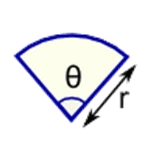
Area = ½ × r2 × θ
- r: the radius of the circle.
- θ: the angle at the centre, in radians.
Sector with the angle in degrees
- Formula: Area = (θ ÷ 360) × π × r2, with θ in degrees.
- Link between units: 180° = π radians.
Worked example: angle in radians
Find the area of a sector with radius 4 cm and angle 1.5 radians.
- Write the formula: Area = ½ × r2 × θ.
- Substitute: Area = ½ × 42 × 1.5.
- Work out: ½ × 16 × 1.5 = 12 cm2.
Worked example: angle in degrees
Find the area of a sector with radius 6 cm and angle 60°.
- Write the formula: Area = (θ ÷ 360) × π × r2.
- Substitute: Area = (60 ÷ 360) × π × 62 = ⅙ × π × 36.
- Work out: 6π = 18.85 cm2 (to 2 decimal places).
How do you find the area of a rectangle?
The area of a rectangle is its width multiplied by its height.
Example: What is the area of this rectangle?
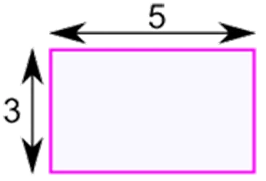
- Formula: Area = w × h.
- w: width.
- h: height.
- Read the measurements: w = 5 and h = 3.
- Substitute: Area = 5 × 3.
- Work out: Area = 15 square units.
How do you find the area of a circle?
The area of a circle is π multiplied by the square of its radius.
Example: What is the area of this circle?
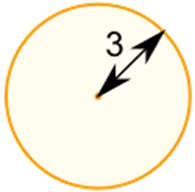
- Radius: r = 3.
- Diameter: if only the diameter is given, halve it to get the radius first.
| Area | = π × r2 |
| = π × 32 | |
| = π × (3 × 3) | |
| = 3.14159… × 9 | |
| = 28.27 (to 2 decimal places) |
How do you find the area of a triangle?
The area of a triangle is half of its base multiplied by its perpendicular height.
Example: What is the area of this triangle?

- Height: h = 12.
- Base: b = 20.
- Note: the height is measured at right angles to the base, not along a slanting side.
- Write the formula: Area = ½ × b × h.
- Substitute: Area = ½ × 20 × 12.
- Work out: Area = 120 square units.
How do you find the area of a compound shape?
To find the area of a compound shape, split it into simple figures, find each area and add them.
Example: Sam cuts grass at $0.10 per square metre. How much does Sam earn cutting this area?

Steps
- Break the shape into two parts, as shown below.
- Find the area of each part.
- Add the areas to get the total.
- Multiply the total area by the price per square metre.

Part A: the square
- Formula: Area of A = a2.
- Working: 20 m × 20 m = 400 m2.
Part B: the triangle
- Measurements: viewed sideways, it has a base of 20 m and a height of 14 m.
- Working: Area of B = ½ × b × h = ½ × 20 m × 14 m = 140 m2.
Total area and money earned
- Total area: Area of A + Area of B = 400 m2 + 140 m2 = 540 m2.
- Earnings: $0.10 × 540 = $54.
What mistakes should you avoid when finding area?
Most errors come from wrong units, wrong radius or a missing half.
- Forgetting the half: a triangle needs ½ × b × h, not b × h.
- Squaring wrongly: r2 means r × r, not r × 2.
- Using the diameter: the circle formula needs the radius.
- Mixing units: change all lengths to the same unit before multiplying.
- Wrong angle unit: use radians in ½ × r2 × θ, and degrees in (θ ÷ 360) × π × r2.
Evaluation
- Write the formulas for the area of a circle and the area of a sector.
- Find the area of a rectangle with width 6 and height 4.
- Find the area of a triangle with base 10 and height 8.
- Find the area of a circle of radius 2. Give your answer to 2 decimal places.
- Explain how you would find the area of a shape made up of a square and a triangle.
Assignment
- A triangle has base 12 cm and height 8 cm. Find its area. A rectangle with height 6 cm has the same area as the triangle. Find the width of the rectangle.
This term's Mathematics topics
JSS3 Second Term · 6 topics
Get Mathematics as PDF and Word
Every week of JSS3 Mathematics, Second Term, formatted and ready to print. Ad-free, and the copy lock comes off.
Get this term Card, bank transfer, USSD or OPay
JSS3 Mathematics Lesson Notes for Other Topics

Simultaneous Linear Equations (I) – In One Or Two Variables
Read the full lesson note.
Simultaneous Linear Equations II - Elimination Method
Read the full lesson note.

Geometry I - Similar Shapes
Read the full lesson note.
Area Of Plane Figures
Read the full lesson note.

Trigonometry
Read the full lesson note.

Construction
Read the full lesson note.
Measures Of Central Tendency
Read the full lesson note.
Application Of Measures Of Central Tendency To Analyse Given Information
Read the full lesson note.

Data Presentation - Pie Charts
Read the full lesson note.
Binary Numbers - Number Base Conversions
Read the full lesson note.
Solving Equation Expressions
Read the full lesson note.
Binary Numbers (Base 2)
Read the full lesson note.

Rational And Non-Rational Numbers And Compound Interest
Read the full lesson note.

Factorisation
Read the full lesson note.

Word Problems - Solving Equation Expression
Read the full lesson note.
Lesson Notes for Other Classes

JSS1 Lesson Note
The complete lesson note to guide your studies.

JSS2 Lesson Note
The complete lesson note to guide your studies.
