
Area of Plane Figures – JSS3 Mathematics Lesson Note (Second Term)
Download this term · ₦1,000Lesson note at a glance
- Subject
- Mathematics
- Class
- JSS3
- Term
- Second Term
- Topic
- Area of Plane Figures
- Order
- Topic 4 of 6 this term
- Reading time
- 4 min
Area is the amount of surface a plane figure covers, measured in square units such as cm² and m².
Behavioural objectives
By the end of the lesson, students should be able to:
- State what area is and give its units.
- Write the area formula for a triangle, rectangle, trapezium, ellipse, square, parallelogram and circle.
- Say what each letter in these formulas stands for.
- Write the formula for the circumference of a circle.
- Use the formulas to find the area of simple plane figures.
What is area?
Area is the size of a flat surface, found by measuring the space inside its boundary.
- Plane figure: a flat shape with length and width only, such as a square or a circle.
- Measurements used: base, vertical height, width, side length or radius, depending on the shape.
- Units of area: square units, written with a small 2, for example cm² and m².
- Everyday example: the floor of a classroom, measured in m², to know how much tile is needed.
| Length unit used | Area unit |
|---|---|
| millimetre (mm) | mm² |
| centimetre (cm) | cm² |
| metre (m) | m² |
| kilometre (km) | km² |
What are the area formulas for plane figures?
Each plane figure has its own area formula, and the table below lists all seven.
| Figure | Area formula |
|---|---|
| Triangle | ½ × b × h |
| Rectangle | w × h |
| Trapezium | ½(a + b) × h |
| Ellipse | πab |
| Square | a2 |
| Parallelogram | b × h |
| Circle | π × r2 |
Triangle
The area of a triangle is half the base multiplied by the vertical height.

Area = ½ × b × h
- b: base.
- h: vertical height.
Rectangle
The area of a rectangle is its width multiplied by its height.
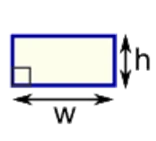
Area = w × h
- w: width.
- h: height.
Trapezium
A trapezium is a four-sided figure with one pair of parallel sides, called a trapezoid in the US.
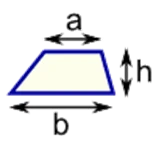
Area = ½(a + b) × h
- a and b: the lengths of the two parallel sides.
- h: vertical height.
Ellipse
An ellipse is an oval shape, and its area is π multiplied by a and b.

Area = πab
- a and b: the semi-major and semi-minor axes (half the longest and shortest widths).
Square
The area of a square is the length of one side multiplied by itself.

Area = a2
- a: length of side.
Parallelogram
The area of a parallelogram is its base multiplied by its vertical height.
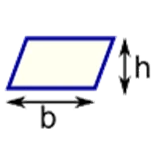
Area = b × h
- b: base.
- h: vertical height.
Circle
The area of a circle is π multiplied by the radius squared.

Area = π × r2
Circumference = 2 × π × r
- r: radius, the distance from the centre to the edge.
- Circumference: the distance round the circle.
- Diameter: twice the radius, so r = diameter ÷ 2.
How are the base and height measured?
The height is measured as the vertical height, at right angles to the base.
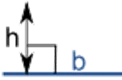
Note: h is at right angles to b.
- Vertical height: the straight distance from the base to the top, not along a sloping side.
- Sloping side: never use it as h in the triangle, trapezium or parallelogram formulas.
How do we use the formulas? (worked examples)
To find an area, write the formula, substitute the values, calculate and add the unit.
Steps
- Write down the formula for the figure.
- Replace each letter with its given value.
- Work out the answer.
- Write the answer with the correct square unit.
Example 1: Triangle
Find the area of a triangle with base 8 cm and vertical height 5 cm.
- Area = ½ × b × h
- Area = ½ × 8 × 5
- Area = 20 cm²
Example 2: Trapezium
Find the area of a trapezium with parallel sides 6 cm and 10 cm and vertical height 4 cm.
- Area = ½(a + b) × h
- Area = ½(6 + 10) × 4 = ½ × 16 × 4
- Area = 32 cm²
Example 3: Circle
A circle has radius 5 cm. Leave π in your answers.
- Area = π × r² = π × 5 × 5 = 25π cm²
- Circumference = 2 × π × r = 2 × π × 5 = 10π cm
What mistakes should students avoid?
Most errors come from using the wrong measurement or forgetting a step.
- Forgetting the half: the triangle and trapezium formulas both contain ½.
- Using the slanting side: always use the vertical height, at right angles to the base.
- Mixing up area and circumference: area uses r², circumference uses 2 × π × r.
- Using the diameter as the radius: halve the diameter first.
- Wrong units: area is in square units, circumference is in ordinary length units.
Evaluation
- Write the formula for the area of a triangle.
- Find the area of a triangle with base 10 cm and vertical height 6 cm.
- Find the area of a square whose side is 7 cm.
- Find the area of a trapezium with parallel sides 5 cm and 9 cm and vertical height 4 cm.
- A circle has a radius of 7 cm. Leave π in your answers and find (a) the area and (b) the circumference.
Assignment
- Answer all three parts: (a) find the area of a parallelogram with base 8 cm and vertical height 5 cm; (b) find the area of a rectangle with width 6 cm and height 9 cm; (c) a circle has a radius of 3 cm, so leave π in your answers and find its area and its circumference.
This term's Mathematics topics
JSS3 Second Term · 6 topics
Get Mathematics as PDF and Word
Every week of JSS3 Mathematics, Second Term, formatted and ready to print. Ad-free, and the copy lock comes off.
Get this term Card, bank transfer, USSD or OPay
JSS3 Mathematics Lesson Notes for Other Topics

Simultaneous Linear Equations (I) – In One Or Two Variables
Read the full lesson note.
Simultaneous Linear Equations II - Elimination Method
Read the full lesson note.

Geometry I - Similar Shapes
Read the full lesson note.

Trigonometry
Read the full lesson note.

Area Of Plane Figures II
Read the full lesson note.

Construction
Read the full lesson note.
Measures Of Central Tendency
Read the full lesson note.
Application Of Measures Of Central Tendency To Analyse Given Information
Read the full lesson note.

Data Presentation - Pie Charts
Read the full lesson note.

Binary Numbers - Number Base Conversions
Read the full lesson note.
Solving Equation Expressions
Read the full lesson note.
Binary Numbers (Base 2)
Read the full lesson note.

Rational And Non-Rational Numbers And Compound Interest
Read the full lesson note.

Factorisation
Read the full lesson note.

Word Problems - Solving Equation Expression
Read the full lesson note.
Lesson Notes for Other Classes

JSS1 Lesson Note
The complete lesson note to guide your studies.

JSS2 Lesson Note
The complete lesson note to guide your studies.
