
Space Science – JSS3 Intermediate Science Lesson Note (Second Term)
Download this term · ₦1,000Lesson note at a glance
- Subject
- Intermediate Science
- Class
- JSS3
- Term
- Second Term
- Topic
- Space Science
- Order
- Topic 8 of 8 this term
- Reading time
- 5 min
Space science is the study of the Sun, planets, moons, stars and everything else beyond the Earth’s atmosphere.
Behavioural objectives
- Define the Solar System and list its members.
- Name the eight planets in order from the Sun and group them as inner or outer planets.
- Define a star and a satellite, and give examples of each.
- Explain why the Moon seems to change shape.
- State at least four ways space science helps people on Earth.
What is the Solar System?
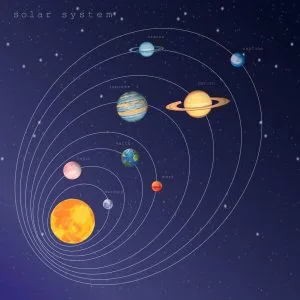
The Solar System is the Sun and all the objects that travel around it.
- The Sun: the star at the centre. Its strong gravity holds the other members in place.
- Eight planets: large bodies that travel around the Sun.
- Moons (satellites): bodies that orbit the planets.
- Asteroids: small rocky bodies, many found in a belt between Mars and Jupiter.
- Comets: bodies of ice and dust that travel around the Sun.
- Space dust: tiny particles found between the larger bodies.
What is an orbit?
An orbit is the curved path one body follows as it travels around another.
- Revolution: the movement of a planet around the Sun. Earth takes about 365 days, which is one year.
- Rotation: the spinning of a planet on its own axis. Earth takes about 24 hours, which gives day and night.
- Gravity: the pull of the Sun that keeps the planets in their orbits.
What are the planets of the Solar System?
There are eight planets: Mercury, Venus, Earth, Mars, Jupiter, Saturn, Uranus and Neptune, in that order from the Sun.
What are the inner planets?
The inner planets are the four small, rocky planets closest to the Sun.
- Mercury: closest to the Sun. Very hot by day and freezing at night.
- Venus: the hottest planet, because its thick clouds trap heat like a greenhouse.
- Earth: our home. The only planet known to have liquid water and life.
- Mars: the “Red Planet”. It has giant volcanoes and red dust.
What are the outer planets?
The outer planets are the four very large planets beyond the asteroid belt.
- Jupiter: the largest planet. It is bigger than all the other planets put together.
- Saturn: famous for its bright rings made of ice and rock.
- Uranus: a cold, blue planet that spins on its side.
- Neptune: the farthest planet. It is dark, cold and very windy.
What is the difference between inner and outer planets?
Inner planets are small and rocky. Outer planets are large and made mostly of gas and ice.
| Feature | Inner planets | Outer planets |
|---|---|---|
| Position | Close to the Sun | Far from the Sun |
| Size | Small | Very large |
| Make-up | Rock | Mostly gas and ice |
| Examples | Mercury, Venus, Earth, Mars | Jupiter, Saturn, Uranus, Neptune |
How can I remember the order of the planets?
Use the sentence whose first letters match the planet names.
- My: Mercury
- Very: Venus
- Educated: Earth
- Mother: Mars
- Just: Jupiter
- Served: Saturn
- Us: Uranus
- Noodles: Neptune
What is a star?
A star is a massive ball of burning gas that gives off its own heat and light.
- The Sun: a medium-sized star. It looks big because it is the closest star to us.
- Other stars: they look like tiny dots because they are extremely far away.
- Constellations: groups of stars that form patterns, such as a hunter or a lion.
What is the difference between a star and a planet?
A star makes its own light. A planet is a body that orbits a star and only reflects its light.
| Feature | Star | Planet |
|---|---|---|
| Light | Makes its own light | Reflects light from a star |
| Heat | Gives off heat | Does not make heat |
| Movement | Is the centre of its system | Orbits a star |
| Example | The Sun | Earth |
What is a satellite?
A satellite is any body that orbits a planet. There are two types: natural and artificial.
- Natural satellites: made by nature. The Moon is Earth’s only natural satellite.
- Artificial satellites: machines built by humans and launched into space by rockets.
What do artificial satellites do?
- Television: carry signals for satellite TV, such as DSTV.
- Navigation: support GPS on phones.
- Weather forecasting: show clouds and storms from above.
- Communication: help carry international calls and internet signals.
Why does the Moon seem to change shape?
The Moon seems to change shape because we see different amounts of its sunlit half as it orbits the Earth.
- Own light: the Moon makes no light. It reflects sunlight.
- Half lit: the Sun always lights one half of the Moon.
- Cycle: the Moon takes about one month to go round the Earth.
What are the main phases of the Moon?
- New Moon: the lit half faces away from us, so we cannot see the Moon.
- Crescent: a thin curved slice is lit.
- First quarter: half of the face we see is lit.
- Full Moon: the whole face we see is lit.
- Last quarter: half of the face is lit again, on the opposite side.
Why is space science important?
Space science gives us useful technology and knowledge that improve life on Earth.
- Communication: satellites make satellite TV, international calls and the internet possible.
- Weather forecasting: satellites warn of storms and drought, which helps farmers prepare.
- Navigation (GPS): helps ships, aeroplanes and drivers find their way.
- Scientific knowledge: studying other planets helps us care for Earth. Venus shows how trapped heat warms a planet.
- New technology: space research has led to improved everyday products, such as some scratch-resistant lenses.
Evaluation
- Define the Solar System and list four of its members.
- Name the eight planets in order, starting from the Sun.
- State two differences between a star and a planet.
- Explain why the Moon seems to change shape.
- Give three ways artificial satellites help you in daily life.
Assignment
Draw the Sun and the eight planets in order. Label each planet and mark the inner and outer planets.
This term's Intermediate Science topics
JSS3 Second Term · 8 topics
Get Intermediate Science as PDF and Word
Every week of JSS3 Intermediate Science, Second Term, formatted and ready to print. Ad-free, and the copy lock comes off.
Get this term Card, bank transfer, USSD or OPay
JSS3 Intermediate Science Lesson Notes for Other Topics
The Nervous System
Read the full lesson note.
Sense Organ
Read the full lesson note.

Coordination and Control
Read the full lesson note.
Health and Hygiene
Read the full lesson note.

Diseases
Read the full lesson note.
Drug Use and Misuse
Read the full lesson note.

Biotechnology
Read the full lesson note.
Revision of JSS2 Lesson
Read the full lesson note.
Classification of Living Things
Read the full lesson note.

Microorganisms
Read the full lesson note.

Ecology
Read the full lesson note.
Soil Science
Read the full lesson note.
Environmental Pollution
Read the full lesson note.
Conservation of Natural Resources
Read the full lesson note.
Renewable and Non-renewable Resources
Read the full lesson note.
Lesson Notes for Other Classes

JSS1 Lesson Note
The complete lesson note to guide your studies.

JSS2 Lesson Note
The complete lesson note to guide your studies.
