
Microorganisms – JSS3 Intermediate Science Lesson Note (First Term)
Download this term · ₦1,000Lesson note at a glance
- Subject
- Intermediate Science
- Class
- JSS3
- Term
- First Term
- Topic
- Microorganisms
- Order
- Topic 3 of 8 this term
- Reading time
- 4 min
Microorganisms (microbes) are tiny living things that can only be seen clearly with a microscope.
- Where they live: in air, soil, water, food and inside the human body.
- Everyday signs of microbes: milk going sour and a small cut becoming swollen and painful.
Behavioural objectives
By the end of the lesson, students should be able to:
- Define microorganisms and name the four main groups.
- Describe the features and give examples of bacteria, fungi, protozoa and viruses.
- State the useful and harmful roles of microorganisms.
- Name diseases caused by each group of microorganisms.
- List ways of protecting ourselves from harmful microorganisms.
What are the types of microorganisms?
There are four main types of microorganisms: bacteria, fungi, protozoa and viruses.
1. Bacteria
Bacteria are single-celled microorganisms with no true nucleus.
- Cocci: bacteria shaped like tiny balls.
- Bacilli: bacteria shaped like rods.
- Spirals: bacteria shaped like coils or corkscrews.
- Examples: the bacteria that cause tetanus, cholera and tuberculosis (TB).
2. Fungi
Fungi are organisms that feed on dead or living matter. Some are large, but many are microscopic.
- Yeasts: single-celled fungi used to make bread rise.
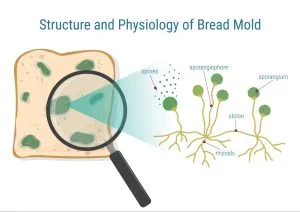
- Moulds: fungi that grow as furry threads on old bread or spoiled oranges.
- Mushrooms: large fungi that can be seen without a microscope.
3. Protozoa
Protozoa are single-celled, animal-like microorganisms that are more complex than bacteria.
- Habitat: they usually live in wet places such as ponds, streams and muddy ground.
- Amoeba: a protozoan that moves and feeds by changing its shape.
- Plasmodium: the protozoan that causes malaria.
4. Viruses
Viruses are the smallest microorganisms and can multiply only inside the living cells of a host.
- Not fully alive: outside a host cell they cannot grow or multiply.
- Size: they are much smaller than bacteria.
- Hosts: people, animals and plants.
- Examples: the viruses that cause the common cold, flu and COVID-19.
How do the four groups compare?
| Group | Main feature | Example | Disease caused |
|---|---|---|---|
| Bacteria | Single-celled, no true nucleus | Cocci, bacilli | Tetanus, cholera, TB |
| Fungi | Yeasts (single-celled) and moulds (threads) | Yeast, bread mould | Ringworm, athlete’s foot |
| Protozoa | Single-celled, animal-like | Amoeba, Plasmodium | Malaria, amoebic dysentery |
| Viruses | Multiply only inside host cells | Cold and flu viruses | Polio, measles, common cold |
What is the difference between a virus and a bacterium?
A bacterium is a single-celled organism that can live and multiply on its own.
A virus is a much smaller particle that can multiply only inside a living host cell.
| Feature | Bacterium | Virus |
|---|---|---|
| Size | Bigger | Much smaller |
| Multiplies | On its own, in suitable conditions | Only inside a host cell |
| Considered alive? | Yes | Not fully |
| Example disease | Cholera | Measles |
What are the useful roles of microorganisms?
Many microorganisms are helpful to people and to the environment.
- In the kitchen: yeast makes bread soft and fluffy, and certain bacteria turn milk into yoghurt and cheese.
- In the soil: microbes break down dead plants and animals into nutrients for crops. This is called decomposition.
- Nitrogen-fixing bacteria: some bacteria in the soil and in the roots of beans make the soil more fertile.
- In medicine: some antibiotics, such as penicillin, are made from fungi.
- In the body: “good bacteria” in the gut help us digest food.
What are the harmful roles of microorganisms?
Harmful microorganisms that cause disease are called pathogens, or germs.
Causing diseases
- Bacteria: tetanus, cholera and tuberculosis (TB).
- Viruses: polio, measles and the common cold.
- Protozoa: malaria and amoebic dysentery.
- Fungi: skin problems such as ringworm and athlete’s foot.
Other harmful effects
- Food spoilage: microbes make food rot, smell bad or taste sour. Eating spoiled food can cause food poisoning.
- Damage to materials: microbes can rot wood, leather shoes and clothes that stay damp for a long time.
How can we protect ourselves from harmful microorganisms?
We protect ourselves by stopping microbes from entering the body and by controlling where they breed.
- Wash your hands: soap and clean water lift microbes off the skin and wash them away.
- Cook food properly: high heat kills most harmful bacteria and worms.
- Keep surroundings clean: do not leave stagnant water where mosquitoes, which carry the malaria protozoan, can breed.
- Get vaccinated: a vaccine trains the body to fight dangerous viruses before they cause illness.
- Cover and store food: this slows down spoilage and keeps flies away.
- Note: antibiotics treat bacterial infections but do not work against viruses.
Evaluation
- Define microorganisms and name the four main groups.
- Name the three shapes of bacteria.
- Give one way bacteria help us and one way they harm us.
- State two differences between a virus and a bacterium.
- List three ways of preventing the spread of disease-causing microbes.
Assignment
Draw a table with four columns: group of microorganism, one example, one disease it causes and one way to prevent that disease.
This term's Intermediate Science topics
JSS3 First Term · 8 topics
Get Intermediate Science as PDF and Word
Every week of JSS3 Intermediate Science, First Term, formatted and ready to print. Ad-free, and the copy lock comes off.
Get this term Card, bank transfer, USSD or OPay
JSS3 Intermediate Science Lesson Notes for Other Topics
Revision of JSS2 Lesson
Read the full lesson note.
Classification of Living Things
Read the full lesson note.

Ecology
Read the full lesson note.
Soil Science
Read the full lesson note.
Environmental Pollution
Read the full lesson note.
Conservation of Natural Resources
Read the full lesson note.
Renewable and Non-renewable Resources
Read the full lesson note.
The Nervous System
Read the full lesson note.
Sense Organ
Read the full lesson note.

Coordination and Control
Read the full lesson note.
Health and Hygiene
Read the full lesson note.

Diseases
Read the full lesson note.
Drug Use and Misuse
Read the full lesson note.

Biotechnology
Read the full lesson note.
Space Science
Read the full lesson note.
Lesson Notes for Other Classes

JSS1 Lesson Note
The complete lesson note to guide your studies.

JSS2 Lesson Note
The complete lesson note to guide your studies.
