
Sense Organ – JSS3 Intermediate Science Lesson Note (Second Term)
Download this term · ₦1,000Lesson note at a glance
- Subject
- Intermediate Science
- Class
- JSS3
- Term
- Second Term
- Topic
- Sense Organ
- Order
- Topic 2 of 8 this term
- Reading time
- 5 min
Sense organs are body parts that detect changes around us and send messages to the brain through nerves.
Behavioural objectives
- State the five sense organs and the sense each one controls.
- Name the main parts of the eye and the ear and state the function of each.
- Explain how the nose and the tongue detect smells and tastes.
- Describe the two layers of the skin and the things the skin can sense.
- State simple ways of caring for each sense organ.
What are sense organs?
Sense organs are organs that contain receptors which pick up information from the surroundings and pass it to the brain.
- Stimulus: a change in the surroundings that the body can detect, such as light, sound, heat or a smell.
- Receptor: a special cell that detects a stimulus and starts a nerve signal.
- Nerves: carry the signal from the sense organ to the brain.
- Brain: reads the signal and tells us what is happening.
What are the five sense organs and their senses?
The five sense organs are the eye, ear, nose, tongue and skin.
| Sense organ | Sense | What it detects |
|---|---|---|
| Eye | Sight | Light, colour and shape |
| Ear | Hearing and balance | Sound and body position |
| Nose | Smell | Chemicals in the air |
| Tongue | Taste | Chemicals in food and drink |
| Skin | Touch | Pressure, temperature and pain |
What is the eye and what are its parts?
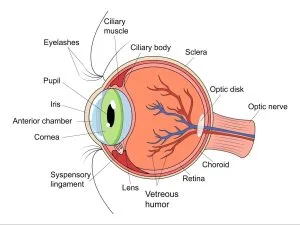
The eye is the sense organ of sight, and it catches light and turns it into signals for the brain.
Main parts and functions
- Cornea: the clear “front window” that lets light in.
- Iris: the coloured part of the eye. It controls how much light enters by making the pupil big or small.
- Pupil: the black opening in the centre of the iris through which light passes.
- Lens: focuses light onto the back of the eye, like a camera lens.
- Retina: the “screen” at the back of the eye where the image lands.
- Optic nerve: the cable that carries the image signals to the brain.
How do we care for the eye?
- Do not rub your eyes with dirty hands.
- Avoid reading in very dim light.
What is the ear and what are its parts?
The ear is the sense organ of hearing and balance.
Main parts and functions
- Outer ear (pinna): the part you see. It acts like a funnel to catch sound waves.
- Ear drum: a thin skin that vibrates when sound hits it.
- Ossicles: three tiny bones that make the sound vibrations stronger.
- Cochlea: a snail-shaped part filled with liquid that turns vibrations into nerve signals.
- Semicircular canals: fluid-filled loops in the inner ear that help us keep our balance.
- Auditory nerve: sends the sound signals to the brain.
How does sound travel through the ear?
- The pinna catches sound waves and passes them into the ear canal.
- The sound waves make the ear drum vibrate.
- The ossicles make the vibrations stronger.
- The cochlea changes the vibrations into nerve signals.
- The auditory nerve carries the signals to the brain.
How do we care for the ear?
- Never put sharp objects like matches or sticks into your ear, because you could tear your ear drum.
How does the nose detect smell?
The nose is the sense organ of smell, and it detects chemicals in the air.
- Inside the roof of the nose are tiny hairs called olfactory receptors.
- When you sniff, air carries tiny “smell particles” to these hairs.
- The hairs send a message to the brain through the olfactory nerve.
- Use of smell: it helps us enjoy the smell of delicious food and stay away from a stinking gutter.
- Smell and taste: they work together, so food tastes “flat” when you have a blocked nose from a cold.
How does the tongue detect taste?
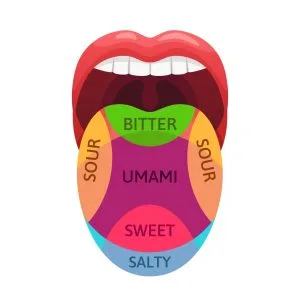
The tongue is the sense organ of taste, a strong muscle covered in tiny bumps called taste buds.
- Food mixes with saliva in the mouth.
- The taste buds pick up the chemicals in the food.
- The taste buds send a signal to the brain.
What are the tastes the tongue can detect?
- Sweet: as in sugar and ripe mango.
- Sour: as in lime and lemon.
- Salty: as in salt and salted fish.
- Bitter: as in bitter leaf and bitter kola.
- Umami (savoury): a fifth taste that some scientists include.
What is the skin and how does it sense?
The skin is the largest organ in the human body and the sense organ of touch.
What does the skin sense?
Nerve endings in the skin tell the brain about the following.
- Touch or pressure: such as someone tapping your shoulder.
- Temperature: whether something is hot or cold.
- Pain: a warning that your body is being hurt.
What are the layers of the skin?
- Epidermis: the outer layer we see.
- Dermis: the inner layer where the nerves, sweat glands and hair roots are found.
Evaluation
- Name the five sense organs and the sense of each.
- Which organ helps with both hearing and balance?
- What are the four main tastes our tongue can detect?
- State the function of the iris and of the retina.
- Why is the skin considered a sense organ?
Assignment
Draw and label the human eye. Write one line on the function of each part you label, and give two ways of caring for the eye.
This term's Intermediate Science topics
JSS3 Second Term · 8 topics
Get Intermediate Science as PDF and Word
Every week of JSS3 Intermediate Science, Second Term, formatted and ready to print. Ad-free, and the copy lock comes off.
Get this term Card, bank transfer, USSD or OPay
JSS3 Intermediate Science Lesson Notes for Other Topics
The Nervous System
Read the full lesson note.

Coordination and Control
Read the full lesson note.
Health and Hygiene
Read the full lesson note.

Diseases
Read the full lesson note.
Drug Use and Misuse
Read the full lesson note.

Biotechnology
Read the full lesson note.
Space Science
Read the full lesson note.
Revision of JSS2 Lesson
Read the full lesson note.
Classification of Living Things
Read the full lesson note.

Microorganisms
Read the full lesson note.

Ecology
Read the full lesson note.
Soil Science
Read the full lesson note.
Environmental Pollution
Read the full lesson note.
Conservation of Natural Resources
Read the full lesson note.
Renewable and Non-renewable Resources
Read the full lesson note.
Lesson Notes for Other Classes

JSS1 Lesson Note
The complete lesson note to guide your studies.

JSS2 Lesson Note
The complete lesson note to guide your studies.
