
Human Reproduction (II) – JSS1 Basic Science Lesson Note (Third Term)
Download Lesson NoteLesson note at a glance
- Subject
- Basic Science
- Class
- JSS1
- Term
- Third Term
- Topic
- Human Reproduction (II)
- Order
- Topic 2 of 9 this term
- Reading time
- 4 min
Pregnancy is the period between fertilisation and the birth of the young one. In humans it lasts about nine months. During this time the fertilised egg grows into an embryo and then a fetus, the woman shows signs such as a missed period and tiredness, and she needs proper care.
Behavioural objectives
By the end of the lesson, students should be able to:
- define pregnancy;
- state signs and symptoms of pregnancy;
- list the care a woman needs during pregnancy;
- tell the difference between myths and facts about pregnancy;
- describe the growth of the fetus month by month.
What is pregnancy?
Conception, also known as pregnancy, is the period between fertilisation and the birth of the young one.
In humans, the period of pregnancy lasts for about nine (9) months.
What are the signs and symptoms of pregnancy?
- Food aversions: A newly pregnant woman may feel repelled by the smell of certain foods or find that foods she once enjoyed now seem unpleasant.
- Mood swings: Due to hormonal changes, it is common for pregnant women to experience changes in mood.
- Abnormal bloating: Hormonal changes may cause bloating similar to premenstrual symptoms.
- Frequent urination: Hormonal changes increase blood flow through the kidneys, filling the bladder more quickly and leading to frequent urination.
- Fatigue: Pregnant women often feel tired and sleepy due to changes in metabolism and hormones.
- Sore breasts: The breasts become swollen and sensitive due to rising hormone levels.
- Missed period: Missing a menstrual period is a common sign of pregnancy, though some women may still experience light bleeding.
- High basal body temperature: If body temperature remains raised for 18 consecutive days, it could indicate pregnancy.
What care is needed during pregnancy?
- Get a pregnancy test as soon as you miss your period.
- Talk with your partner and someone you trust.
- Begin antenatal care check-ups with a medical doctor.
- Follow proper antenatal instructions and avoid unprescribed drugs.
- Eat nourishing foods rich in protein, calcium, folic acid, iodine and iron.
- Drink plenty of water and fruit juices.
- Get adequate rest.
- Avoid smoking and alcohol.
What are the myths and facts about pregnancy?
A myth is a false belief that many people hold, while a fact is a truth that can be proven. In many African societies, there are several myths about pregnancy that are not scientifically true.
Myths about pregnancy
- Only pregnancy can make a woman miss her period.
- All pregnant women vomit.
- Pregnancy makes a woman unclean before God.
- All pregnant women have morning sickness.
- Pregnant women should not dye their hair.
- Pregnant women should not eat fish.
- A woman cannot get pregnant during her period.
- A woman cannot get pregnant the first time she has sex.
- Washing the vagina after sex prevents pregnancy.
- Pregnant women should not take baths.
Facts about pregnancy
- Pregnant women should not carry heavy objects.
- Some women may experience light bleeding and still be pregnant.
- Pregnant women should not change cat litter.
- Pregnant women should not drink alcohol.
- Some pregnancies can last longer than nine months.
What are the stages of growth of the fetus?
Each month, a group of eggs (oocytes) develops in the ovary. Usually, one egg matures and is released during ovulation.
After fertilisation, the fertilised egg (zygote) begins to divide and travel down the fallopian tube toward the uterus for implantation. Once implanted, it develops into an embryo, and after the 8th week, it becomes a fetus.
Pregnancy is divided into three trimesters, each showing distinct developmental stages.
Month-by-month fetal development
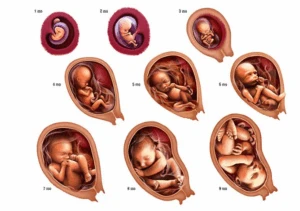
Month 1
- The amniotic sac forms around the embryo.
- The placenta develops to supply nutrients.
- The heart begins to beat (about 65 times per minute).
- Length: about ¼ inch (smaller than a grain of rice).
Month 2
- Facial features and limbs start forming.
- The neural tube (brain and spinal cord) develops.
- The baby is about 1 inch long.
- Heartbeat can usually be detected.
- The embryo becomes a fetus by the end of the month.
Month 3
- Arms, hands, fingers, feet and toes fully form.
- Teeth and nails begin to develop.
- Organs become functional.
- Length: about 4 inches; weight: about 1 ounce.
Month 4
- Heartbeat is audible with a Doppler device.
- Hair, eyelashes, eyebrows and nails form.
- The nervous system begins to function.
- Gender can be identified on ultrasound.
- Length: about 6 inches; weight: about 4 ounces.
Month 5
- The baby starts moving (quickening).
- Hair begins to grow; the skin is covered with vernix caseosa.
- Length: about 10 inches; weight: ½ to 1 pound.
Month 6
- The skin is reddish and wrinkled; veins are visible.
- The eyelids open and the baby responds to sounds.
- The baby may survive with intensive care if born prematurely.
- Length: about 12 inches; weight: about 2 pounds.
Month 7
- The baby gains body fat; hearing is fully developed.
- The baby moves frequently and responds to stimuli.
- Length: about 14 inches; weight: 2 to 4 pounds.
Month 8
- Brain development continues rapidly.
- The baby can see and hear; the lungs are still maturing.
- Length: about 18 inches; weight: about 5 pounds.
Month 9
- The lungs are nearly fully developed.
- The baby’s reflexes are well coordinated.
- The baby assumes the birth position (head down).
- Length: 18 to 20 inches; weight: about 7 pounds.
Evaluation
- What is pregnancy?
- Give four (4) facts about pregnancy.
Assignment
- List five signs and symptoms of pregnancy.
- State four ways a pregnant woman can take care of her health.
- Describe how the baby develops in Month 5 of pregnancy.
This term's Basic Science topics
JSS1 Third Term · 9 topics
Third Term Basic Science Lesson Notes for Other Topics
Simple Machines
Read the full lesson note.
Simple Machines - The Safe Use of Simple Machines
Read the full lesson note.
Concept of Technology
Read the full lesson note.
Technology in Home - Electric Gadgets
Read the full lesson note.
Technology in Transportation - Land and Air
Read the full lesson note.
What Is Water Transportation?
Read the full lesson note.
Exploring Your Environment I
Read the full lesson note.
Exploring Your Environment II
Read the full lesson note.

Exploring Your Environment III
Read the full lesson note.
Animals - As Living Things (Characteristics)
Read the full lesson note.

Uses of Animals
Read the full lesson note.
Meaning and Characteristics of Plants
Read the full lesson note.

Meaning and Characteristics of Animals
Read the full lesson note.
Plants - As Living Things II
Read the full lesson note.
Uses of Plants
Read the full lesson note.
Lesson Notes for Other Classes

Basic 1 Lesson Note
The complete lesson note to guide your studies.

Basic 2 Lesson Note
The complete lesson note to guide your studies.

Basic 3 Lesson Note
The complete lesson note to guide your studies.

Basic 4 Lesson Note
The complete lesson note to guide your studies.

Basic 5 Lesson Note
The complete lesson note to guide your studies.

Basic 6 Lesson Note
The complete lesson note to guide your studies.

