
Production of Beads – JSS1 Cultural & Creative Arts Lesson Note (Second Term)
Download Lesson NoteLesson note at a glance
- Subject
- Cultural & Creative Arts
- Class
- JSS1
- Term
- Second Term
- Topic
- Production of Beads
- Order
- Topic 4 of 7 this term
- Reading time
- 8 min
Bead production is the making of small decorative objects, usually pierced for threading or stringing, from materials such as glass, clay, seeds, shells, stones, plastic and metal. Beads are used for personal adornment and artistic expression. In Nigeria, beads also communicate status, wealth, age and cultural identity.

Behavioural objectives
By the end of the lesson, students should be able to:
- define bead production and name the materials used for beads;
- list natural and manufactured beads;
- describe the traditional beadwork of the Yoruba, Igbo, Hausa-Fulani and Benin peoples;
- state the steps for making clay beads and paper beads;
- explain the cultural meaning of beads and their colours in Nigeria;
- list the safety measures to follow when making beads.
What is the history of bead-making?
Bead-making is an ancient craft. It has developed from simple natural materials to advanced manufacturing techniques, while keeping its cultural importance across civilisations.
The history of bead-making dates back to prehistoric times, when early humans used naturally perforated shells, seeds and stones as decorative elements. Archaeological evidence shows that beads were among the earliest forms of human ornamentation, with examples found in ancient burial sites worldwide.
In Africa, beads have played important roles in social, economic and spiritual life for thousands of years. Nigerian cultures have rich beadworking traditions, and different ethnic groups developed distinctive styles and techniques that communicate status, wealth, age and cultural identity.
What are the types of beads?
Natural material beads
- Seed beads (from plants like Job’s tears)
- Shell beads (cowrie, conch, mother-of-pearl)
- Stone beads (agate, turquoise, coral)
- Bone and ivory beads
- Wood beads (ebony, bamboo, palm)
- Clay and ceramic beads
Manufactured beads
- Glass beads (pressed, blown, lampwork)
- Plastic and acrylic beads
- Metal beads (brass, copper, silver)
- Crystal beads
- Resin beads
- Paper beads
What is traditional Nigerian beadwork?
Nigerian beadwork traditions vary among ethnic groups, each with its own styles and cultural meanings.
Yoruba beadwork
The Yoruba people are renowned for their elaborate beaded crowns (ade), which signify royal authority and divine kingship. These crowns often feature detailed patterns and symbolic motifs, including birds, faces and geometric designs. Yoruba beadwork also includes divination bags (apo ifa), ceremonial garments and personal ornaments that indicate social status and religious affiliation.
Igbo beadwork
The Igbo people traditionally use beads in their prestigious coral jewellery, particularly the heavy coral necklaces worn by titled men and women. These coral beads, often imported through historical trade routes, represent wealth, achievement and social standing. The quantity and quality of coral beads worn directly relate to one’s position in society. Modern Igbo beadwork has expanded to include colourful glass beads in various ceremonial and decorative items.
Hausa-Fulani beadwork
Hausa-Fulani beadwork emphasises geometric patterns and often includes Islamic design elements. It appears in leather goods, horse decorations and personal ornaments. The northern regions also produce distinctive prayer beads (tasbih) used in Islamic religious practices.
Benin Kingdom beadwork
Benin Kingdom beadwork historically adorned royal regalia and ceremonial objects. Red coral beads were particularly significant in royal costume and decoration.
What materials and tools are needed for bead production?
Basic materials
- Glass rods or powder for glass beads
- Polymer clay for clay beads
- Natural seeds and pods
- Shells and stones
- Metal wire and sheets
- Thread, string or wire for stringing
- Paper for paper beads
- Plastic pellets for plastic beads
Tools required
- Kiln or torch for glass beads
- Pliers (round-nose, flat-nose)
- Wire cutters
- Needles for threading
- Scissors
- Mandrels for shaping
- Grinding tools for smoothing
- Polishing compounds
- Measuring tools
- Safety equipment (goggles, gloves)
How are glass beads made?
Glass bead-making is one of the most advanced bead production techniques. The process begins with heating glass rods or powder to a molten state using a torch or kiln. The hot glass is wound around a steel mandrel coated with bead release, which gives the basic bead shape.
Artists can add colours, patterns and decorative elements while the glass is still molten. Once shaped, beads must be annealed (slowly cooled) to prevent cracking. After cooling, the mandrel is removed, leaving a hole for stringing.
Lampwork technique
- Heat glass rod in flame
- Wind molten glass around mandrel
- Shape bead while rotating
- Add decorative elements
- Flame polish for smooth finish
- Anneal in kiln
- Remove from mandrel
- Clean and polish
How are clay beads made?
Clay beads are easy to make and can take many shapes. The process involves preparing clay (natural or polymer), shaping beads by hand or with moulds, and creating holes for stringing. Natural clay is left to dry, while polymer clay is cured according to the manufacturer’s instructions. The beads are then finished with paint, glaze or varnish.
Clay bead process
- Prepare clay to proper consistency
- Roll into uniform balls or shapes
- Pierce with wire or needle
- Smooth surface with water
- Allow to dry completely
- Fire in kiln (for ceramic clay)
- Apply glazes or paints
- Fire again if using glazes
How are paper beads made?
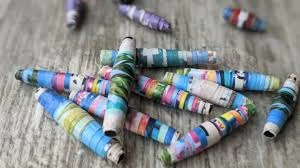
Paper beads are an eco-friendly and cheap option for bead production. The technique involves cutting paper into triangular or rectangular strips, applying glue to one side, and rolling the paper tightly around a thin rod or wire. The bead is then sealed with varnish or Mod Podge for durability. Paper beads can be made from magazines, newspapers, decorative papers or hand-painted papers.
Paper bead steps
- Cut paper into triangular strips
- Apply glue to back of paper
- Start rolling from wide end
- Roll tightly around toothpick
- Glue down pointed end
- Remove from toothpick
- Apply several coats of varnish
- Allow to dry between coats
How are seed and natural beads made?
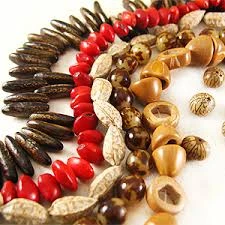
Many Nigerian communities traditionally use seeds, pods and other natural materials for bead-making. These materials require collection, cleaning, drying and sometimes treatment to prevent decay. Holes are carefully drilled or burned through the materials, and the beads may be polished with natural oils or left in their natural state.
Natural bead preparation
- Collect seeds when fully mature
- Clean thoroughly
- Dry completely to prevent mould
- Sort by size and quality
- Drill holes carefully
- Polish with natural oils
- String or store properly
How are beads strung and designed?
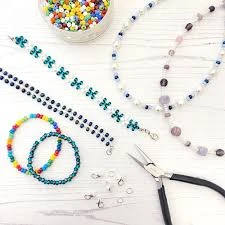
Creating finished beadwork requires an understanding of stringing techniques and design principles. Basic stringing uses thread, wire or cord passed through the bead holes. More complex techniques include weaving, where beads are built into fabric-like structures, and wire-wrapping, where beads are secured with decorative wire work.
Stringing techniques
- Single strand (basic threading)
- Multi-strand (parallel or twisted)
- Bead weaving (loom or off-loom)
- Wire wrapping
- Knotting between beads
- Elastic stringing
- Chain incorporation
What is the cultural significance of beads?
Beads serve many functions in Nigerian culture beyond decoration:
- Social status: certain beads are reserved for royalty, chiefs or specific age groups.
- Religion: beads feature in traditional worship, divination practices and Islamic prayer beads.
- Rites of passage: specific beads mark transitions such as birth, initiation, marriage and death.
- Traditional medicine: beads are sometimes used for their believed protective or healing properties.
Symbolic meanings of bead colours
| Colour | Meaning |
|---|---|
| Red | Vitality, life force, protection |
| White | Purity, spirituality, peace |
| Blue | Depth, stability, trust |
| Green | Nature, growth, fertility |
| Black | Mystery, elegance, power |
| Yellow | Wisdom, clarity, energy |
What is contemporary bead production?
Modern bead-making in Nigeria combines traditional techniques with contemporary methods and materials. Artisans now use electric kilns, modern tools and imported materials while keeping cultural design elements. The global market for African beads has created economic opportunities while raising questions about cultural authenticity and appropriation.
Modern applications
- Fashion jewellery
- Tourist souvenirs
- Export products
- Art installations
- Therapeutic crafts
- Educational projects
What are the economic aspects of bead production?
Bead production provides significant economic opportunities in Nigeria. Small-scale producers make beads for local markets, while larger operations export internationally. The industry supports other businesses, including material suppliers, tool makers and shipping services. Training programmes teach bead-making skills as a way to earn income, particularly for women and youth.
Market considerations
- Local demand for traditional designs
- International market for “ethnic” jewellery
- Tourism industry requirements
- Online sales platforms
- Craft fair opportunities
- Wholesale versus retail pricing
How is the quality of beads controlled?
Producing quality beads requires attention to uniform size and shape, durable materials and construction, consistent colour, smooth finishing and secure holes for stringing. Professional bead-makers develop quality standards that distinguish their work in competitive markets.
Quality indicators
- Consistent sizing
- Smooth surfaces
- Durable construction
- Even colouring
- Proper hole placement
- Appropriate weight
- Professional finishing
What safety rules apply to bead production?
Bead production involves various safety concerns, depending on the materials and techniques used. Glass bead-making requires eye protection, heat-resistant surfaces and proper ventilation. Chemical processes need gloves and masks, while sharp tools demand careful handling. A well-organised workspace prevents accidents and improves efficiency.
Safety equipment
- Safety goggles
- Heat-resistant gloves
- Ventilation systems
- Fire extinguishers
- First aid supplies
- Protective clothing
- Proper lighting
How should beads be preserved and stored?
Proper storage extends bead life and maintains quality. Different materials need specific storage conditions. Glass beads need cushioning to prevent chipping, natural materials must be kept dry to prevent decay, and metal beads should be kept from moisture to prevent tarnishing. Organised storage also helps manage stock and makes design work easier.
Evaluation
- Define bead production and name four materials used to make beads.
- Name three natural beads and three manufactured beads.
- State what the Yoruba crown (ade) and the Igbo coral necklace show about the people who wear them.
- List the steps for making paper beads.
- State three safety measures to follow when making glass beads.
Assignment
- Make a set of paper beads at home, using the paper bead steps in this lesson. Bring them to class.
- Write a short paragraph on the cultural significance of beads in Nigeria. Include at least two uses of beads and two colour meanings.
This term's Cultural & Creative Arts topics
JSS1 Second Term · 7 topics
Second Term Cultural & Creative Arts (CCA) Lesson Notes for Other Topics

Introduction to Modelling: Making Objects with Paper Mache
Read the full lesson note.

Traditional Fabrics and Dresses
Read the full lesson note.

Singing Tonic Solfa of Twinkle Twinkle Little Star and Matching Songs
Read the full lesson note.

Musical Notes and Their Values
Read the full lesson note.

Methods of Modelling Objects with Clay Plastering
Read the full lesson note.

Importance of Traditional Dresses
Read the full lesson note.

Musical Notes: Rhythmic Clapping
Read the full lesson note.

Fashion Accessories
Read the full lesson note.

Musical Notes - Introduction to Notation
Read the full lesson note.

Costume and Make-up in Drama
Read the full lesson note.

Mosaic
Read the full lesson note.

Forms of Dance
Read the full lesson note.

Choral Singing
Read the full lesson note.

Care of Tools and Equipment used in Performing Arts and Entertainment
Read the full lesson note.

Play
Read the full lesson note.
Lesson Notes for Other Classes

Basic 1 Lesson Note
The complete lesson note to guide your studies.

Basic 2 Lesson Note
The complete lesson note to guide your studies.

Basic 3 Lesson Note
The complete lesson note to guide your studies.

Basic 4 Lesson Note
The complete lesson note to guide your studies.

Basic 5 Lesson Note
The complete lesson note to guide your studies.

Basic 6 Lesson Note
The complete lesson note to guide your studies.

