
Children’s Poems – Basic 5 English Lesson Note (Second Term)
Download this term · ₦1,000Lesson note at a glance
- Subject
- English Studies
- Class
- Basic 5
- Term
- Second Term
- Topic
- Children’s Poems
- Order
- Topic 17 of 51 this term
- Reading time
- 4 min
Learning Objectives
By the end of the lesson, pupils should be able to:
- Read the selected children’s poems rhythmically
- Identify the key words or lines that introduce the main ideas in the poems
iii. Construct sentences with the selected words in another context with the words in the poems iv. Answer questions on the poems
Learning Activities
- Pupils in groups read the poems rhythmically
- Pupils in pairs write out the main ideas or words in the poems iii. The check up the meaning of the new words in sentences iv. Pupils in smaller groups analyse the passage to derive the hidden meaning in the passage
Embedded Core Skills
- Communication and Collaboration ii. Critical thinking and problem solving iii. Leadership skills and Personal Development iv. Creativity and Imagination
Learning Materials
- Wall charts
- Audio player
- Video clip
- Wall charts
- Laptop
Content
Selected children’s poems can be a great way to develop both comprehensive and vocabulary skills. Poems often use descriptive language and imagery, which can help children learn new words and expand their understanding of the world around them. Additionally, the rhyme and rhythm of poems can make them more engaging and memorable for children, helping to build their comprehension skills.
Some examples of children’s poems that are known for their vocabulary and comprehension-building content include:
“The Owl and the Pussycat” by Edward Lear,
“The Jabberwocky” by Lewis Carroll, and
“The Road Not Taken” by Robert Frost
Who sat and watched my infant head, when sleeping on my cradle bed, And tears, sweet drops, did stand in eyes, Like pearls upon her feathers dress?
Who passed her gentle hand above, My lowly form, and kissed my brow And, whispering, “Weep not, my sister ‘Tis but a flower scarce hushed, or know?
My mother. Where her tender hand Smoothed the pillow of my head, And where her love and watch did stand, The night and every night she slept
And, in my soul, the thought doth dwell, That, one sweet day I’ll know full well, All love and truth my mother taught, And the hej joy and crown in heaven”
- What is the main subject of the poem? a) An infant b) A mother c) A bird d) A pillow
- Who is the speaker in the poem? a) The infant b) The mother c) A narrator d) A bird
- What is the tone of the poem? a) Romantic b) Nostalgic c) Melancholic d) Joyful
- What is the main metaphor used in the poem? a) Pearls on feathers b) A cradle c) A pillow d) A crown
- Who is the person who sat and watched the infant’s head? a) The father b) The bird c) The mother d) A stranger
- How are the person’s eyes described in the poem? a) Teary b) Happy c) Angry
- Who whispered “weep not, my sweet”? a) The mother b) The bird c) The father d) The nurse
- What is the main emotion conveyed by the poem? a) Love b) Sorrow c) Anger d) Hope
- What is the main theme of the poem? a) The love of a mother b) The love of a child c) The beauty of nature d) The passing of time
- What is the imagery used to describe the mother’s love in the poem? a) Tender hand b) Smoothed pillow c) Watching eyes d) All of the above
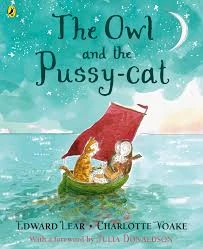
poem: “The Owl and the Pussycat” by Edward Lear
 .
.
The Owl and the Pussycat went to sea in a beautiful pea green boat, They took some honey, and plenty of money, Wrapped up in a five pound note.
The Owl looked up to the stars above, And sang to a small guitar, “O lovely Pussy! O Pussy, my love, What a beautiful Pussy you are, You are, You are! What a beautiful Pussy you are!”
The Pussycat smiled as she sailed away, with a “meow, meow” and a “purr, purr” “I love you, Owl, but please save our grinning, until we were a five pound note.”
So they lived happily ever after, The Owl and the Pussycat in the boat, And if they haven’t drowned, they’re still alive and well, Sailing on the deep sea in their beautiful pea green boat.
This term's English Studies topics
Basic 5 Second Term · 51 topics
- Making and Responding Requests (Sentence Building)
- Children’s Novel
- Letter Writing, Informal Letter
- Dictation for the Week
- Discussion on Roles of Individual Members of the Family
- Children’s Poems
- Acknowledging Receipt of Letters of Congratulations and Sympathy
- Dictations for the Week
- Speech Work Consonant Contrast /S/ and /Z/
- Types of Clause:-Independent and Dependent Clause
- Emphasis on New Words, and Meaning/Purpose
Get English Studies as PDF and Word
Every week of Basic 5 English Studies, Second Term, formatted and ready to print. Ad-free, and the copy lock comes off.
Get this term Card, bank transfer, USSD or OPay
Second Term English Studies Lesson Notes for Other Topics

Activities on Future Tense
Read the full lesson note.

Future Tense: Simple Future
Read the full lesson note.
Argumentative: Day School is Better than Boarding School
Read the full lesson note.
Contrasting Vowels /e/ and /ᴣ:/
Read the full lesson note.

Literature: Comparing Myths and Legends
Read the full lesson note.
Making Sentences with Simple Present Tense and Simple Past Tense
Read the full lesson note.
Introduction to Vowel Contrast /ᴂ/, /a:/ and /ᴅ/, /ᴐ:/
Read the full lesson note.
Vocabulary Development: Child Labour and Development
Read the full lesson note.

Comprehension: Currency
Read the full lesson note.
Activities on Tenses
Read the full lesson note.
Comprehension: Moi-Moi
Read the full lesson note.
Speech Work: Long Sound /ᴣ:/
Read the full lesson note.
Vocabulary Development: Words Related to Marriage
Read the full lesson note.

Comprehension: The Yoruba Family
Read the full lesson note.
Speech Work: /ᴧ/ Sound
Read the full lesson note.
Lesson Notes for Other Classes
Basic 1 Lesson Note
The complete lesson note to guide your studies.

Basic 2 Lesson Note
The complete lesson note to guide your studies.

Basic 3 Lesson Note
The complete lesson note to guide your studies.

Basic 4 Lesson Note
The complete lesson note to guide your studies.
Basic 6 Lesson Note
The complete lesson note to guide your studies.
JSS1 Lesson Note
The complete lesson note to guide your studies.
