
Values That Promotes Peace – Basic 5 Civic Education Lesson Note (Third Term)
Download this term · ₦1,000Lesson note at a glance
- Subject
- Civic Education
- Class
- Basic 5
- Term
- Third Term
- Topic
- Values That Promotes Peace
- Order
- Topic 3 of 6 this term
- Reading time
- 6 min
Learning Objectives
By the end of this lesson, students will be able to:
- Understand the concept of peace and its significance in society
- Identify various settings and practices that promote peaceful coexistence
- Recognize the important role these peace-promoting elements play in fostering harmony
Essential Vocabulary
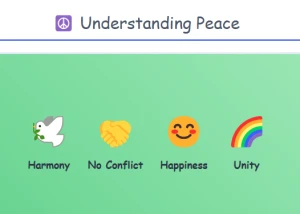
Core Terms:
- Peace: A state of harmony and absence of conflict
- Tolerance: Accepting and respecting differences in others
- Coexistence: Living together harmoniously despite differences
- Harmony: A state of agreement and peaceful cooperation
- Unity: The condition of being joined together as one
- Tranquility: A state of peace and calm
- Serenity: Peaceful calmness and composure
Related Concepts:
- Concord: Agreement and harmony between people
- Amity: Friendship and peaceful relationships
- Respect: Showing consideration and regard for others
- Understanding: The ability to comprehend and empathize
- Rights: Basic freedoms and entitlements
- Justice: Fair treatment and equality for all
- Law: Rules that govern behavior in society
- Order: A state of organization and peace
- Reconciliation: The process of restoring friendly relations
- Mediation: Helping to resolve conflicts peacefully
- Compromise: Finding middle ground in disagreements
Required Resources
- Lagos State Civic Education Curriculum Guidelines
- Ministry of Education approved textbooks
- Interactive presentation materials
- Chart paper and writing materials
- Student notebooks and worksheets
Building on Previous Knowledge
This lesson connects to earlier learning by:
- Reviewing the fundamental concept of peace and its importance in personal and community life
- Building on previous discussions about conflict resolution and behavior modification
- Connecting individual values to community peace-building efforts
Key Skills Development
Students will develop:
- Critical thinking: Analyzing peace-promoting strategies
- Communication: Discussing peace concepts effectively
- Collaboration: Working together to understand peaceful coexistence
Core Content
Understanding Peace
Peace represents a state of calmness, harmony, and freedom from conflict, violence, or war. It encompasses both the absence of hostility and the presence of positive conditions that allow individuals and communities to thrive together. Peace is not merely the absence of conflict but the active presence of justice, respect, and mutual understanding.
Key Elements That Promote Peace
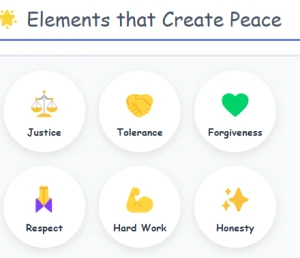
1. Justice
Justice involves treating everyone fairly and equally, ensuring that laws apply uniformly to all people regardless of their background. When everyone receives fair treatment and equal opportunities, social tensions decrease and peaceful coexistence becomes possible.
2. Tolerance
Tolerance means accepting and respecting differences in others, including differences in religion, culture, abilities, and perspectives. This involves showing kindness and understanding toward people who may be different from ourselves, including those with disabilities or from different cultural backgrounds.
3. Forgiveness
Forgiveness involves releasing grudges and moving forward from conflicts or hurt feelings. It means being willing to let go of past wrongs so that peace can be restored to relationships and communities. Forgiveness does not mean forgetting, but rather choosing not to let past conflicts continue to cause harm.
4. Respect for Human Rights
Respecting human rights means acknowledging and protecting everyone’s basic freedoms, including the right to free speech, freedom of religion, and freedom of movement. When people’s fundamental rights are protected and respected, they feel secure and are less likely to engage in conflict.
5. Hard Work and Dedication
Working diligently toward personal and community goals promotes peace by keeping people constructively engaged. When individuals focus their energy on productive activities like education, career development, or community service, they are less likely to engage in destructive behaviors that lead to conflict.
6. Honesty and Truthfulness
Being honest and truthful creates an environment of trust where people can rely on one another. When communication is based on truth and transparency, misunderstandings are reduced, and conflicts are less likely to arise from deception or misinformation.
Additional Peace-Promoting Values
Understanding and Empathy
The ability to comprehend and relate to others’ experiences, feelings, and perspectives without bias or prejudice helps bridge differences between people and groups.
Respect and Consideration
Showing consideration for others and treating them with dignity honors their worth as human beings and creates an atmosphere of mutual respect.
Law and Order
Having clear, fair rules that govern behavior and are applied consistently helps maintain social stability and prevents chaos that could lead to conflict.
Reconciliation and Mediation
These processes help restore relationships between people or groups who have been in conflict by facilitating dialogue, understanding, and agreement.
Assessment Questions
Multiple Choice Questions
- Peace can best be described as a situation of:
- a) Freedom from disturbance and conflict
- b) Complete silence
- c) Isolation from others
- d) Avoiding all challenges
- Tolerance primarily means:
- a) Accepting and respecting differences in others
- b) Agreeing with everyone
- c) Avoiding different people
- d) Changing others to be like you
- Forgiveness involves:
- a) Letting go of grudges and moving forward
- b) Forgetting everything that happened
- c) Avoiding the person who hurt you
- d) Getting revenge
- Respect for human rights means:
- a) Treating everyone with dignity and ensuring access to basic rights
- b) Only protecting the rights of certain people
- c) Ignoring people’s needs
- d) Making decisions for others
- Hard work promotes peace by:
- a) Keeping people constructively engaged in positive activities
- b) Making people too tired to interact
- c) Creating competition between people
- d) Forcing people to work alone
Discussion Questions
- How does honesty contribute to maintaining peaceful relationships in a community?
- Why is justice essential for creating and maintaining peace in society?
- In what ways can education help promote tolerance and understanding between different groups?
- How can mediation and reconciliation help resolve conflicts peacefully?
- What role does respect play in preventing conflicts and promoting harmony?
Lesson Implementation Plan
Review and Introduction
- Review previous lessons on values and their importance
- Introduce the concept of peace as both absence of conflict and presence of positive conditions
- Discuss the connection between personal values and community peace
Core Peace-Promoting Values
- Explore justice, tolerance, forgiveness, and respect for human rights
- Use real-world examples and scenarios to illustrate each concept
- Engage students in discussions about how these values apply in their daily lives
Additional Peace Elements
- Discuss hard work, honesty, understanding, and other peace-promoting factors
- Examine the role of law, order, mediation, and reconciliation
- Connect these concepts to Nigerian society and local communities
Assessment and Application
- Conduct comprehensive review of all peace-promoting elements
- Assess student understanding through various evaluation methods
- Discuss practical applications of peace-building in students’ lives and communities
Learning Outcomes
Upon completion of this lesson, students will:
- Demonstrate understanding of peace as a multifaceted concept
- Identify and explain various values and practices that promote peaceful coexistence
- Apply peace-promoting principles in their personal relationships and community interactions
- Appreciate the importance of individual contributions to community peace and harmony
Assessment Methods
- Oral questioning and class participation
- Written evaluation exercises
- Group discussions and collaborative activities
- Practical demonstrations of peace-promoting behaviors
- Reflection on personal experiences with conflict resolution
This term's Civic Education topics
Basic 5 Third Term · 6 topics
Get Civic Education as PDF and Word
Every week of Basic 5 Civic Education, Third Term, formatted and ready to print. Ad-free, and the copy lock comes off.
Get this term Card, bank transfer, USSD or OPay
Basic 5 Civic Education Lesson Notes for Other Topics
Advantages and Disadvantages of Pressure Group
Read the full lesson note.
Meaning and Definition of Values
Read the full lesson note.
Concept Of Social Injustice
Read the full lesson note.
Types Of Social Injustice
Read the full lesson note.
How To Communicate Social Injustice
Read the full lesson note.

Meaning Of Loyalty And Evidence Of Loyalty
Read the full lesson note.
Loyalty In Relationships And Its examples
Read the full lesson note.
Importance Of Loyalty Consequences Of Disloyalty
Read the full lesson note.
National Service That Shows Loyalty
Read the full lesson note.
Meaning Of Leadership Types Of Leadership
Read the full lesson note.
Qualities Of A Good Leader
Read the full lesson note.
Leadership Functions
Read the full lesson note.
Leadership Styles
Read the full lesson note.
Characteristics Of A Bad Leader
Read the full lesson note.
Definition And Meaning Of Government
Read the full lesson note.
Lesson Notes for Other Classes

Basic 1 Lesson Note
The complete lesson note to guide your studies.

Basic 2 Lesson Note
The complete lesson note to guide your studies.

Basic 3 Lesson Note
The complete lesson note to guide your studies.

Basic 4 Lesson Note
The complete lesson note to guide your studies.

Basic 6 Lesson Note
The complete lesson note to guide your studies.
