
Süratul Fīl (Quran 105) – Basic 4 Islamic Studies Lesson Note (First Term)
Download this term · ₦1,000Lesson note at a glance
- Subject
- Islamic Studies
- Class
- Basic 4
- Term
- First Term
- Topic
- Süratul Fīl (Quran 105)
- Order
- Topic 1 of 9 this term
- Reading time
- 6 min
Recitation and Translation
Arabic Text and Pronunciation
Verse 1: أَلَمْ تَرَ كَيْفَ فَعَلَ رَبُّكَ بِأَصْحَابِ الْفِيلِ Alam tara kayfa fa’ala rabbuka bi-as-hābi’l-fīl
Verse 2: أَلَمْ يَجْعَلْ كَيْدَهُمْ فِي تَضْلِيلٍ Alam yaj’al kaydahum fī tadlīl
Verse 3: وَأَرْسَلَ عَلَيْهِمْ طَيْرًا أَبَابِيلَ Wa arsala ‘alayhim tayran abābīl
Verse 4: تَرْمِيهِم بِحِجَارَةٍ مِّن سِجِّيلٍ Tarmīhim bi-hijāratin min sijjīl
Verse 5: فَجَعَلَهُمْ كَعَصْفٍ مَّأْكُولٍ Fa-ja’alahum ka-‘asfin ma’kūl
English Translation
Verse 1: “Have you not seen how your Lord dealt with the companions of the elephant?”
Verse 2: “Did He not make their plan go astray?”
Verse 3: “And He sent against them birds in flocks,”
Verse 4: “Striking them with stones of clay,”
Verse 5: “And He made them like eaten straw.”
Simple Translation for Children
- Verse 1: Haven’t you heard what Allah did to the people with the elephant?
- Verse 2: Allah made their evil plan fail.
- Verse 3: Allah sent many birds against them.
- Verse 4: The birds threw small stones at them.
- Verse 5: Allah destroyed them completely, like crushed leaves.
Key Arabic Words and Meanings
- Fīl (فِيل) = Elephant
- As-hāb (أَصْحَاب) = Companions/People
- Rabbuka (رَبُّك) = Your Lord
- Tayran (طَيْر) = Birds
- Hijāra (حِجَارَة) = Stones
- Abābīl (أَبَابِيل) = Flocks/Groups
Reasons for Revelation (Asbāb al-Nuzūl)
Historical Background
The Year of the Elephant:
- This event happened in the year Prophet Muhammad (peace be upon him) was born
- It was called “Ām al-Fīl” (The Year of the Elephant)
- This was around 570 CE (Christian Era)
- It was a miraculous event that protected the Ka’bah
Who Were the People of the Elephant?
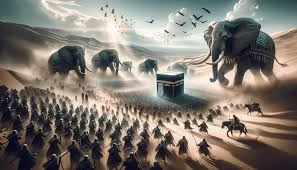
Abraha al-Ashram:
- He was the ruler of Yemen
- He was appointed by the king of Abyssinia (Ethiopia)
- He was a Christian who wanted to destroy Islam’s holy places
- He built a big church in Yemen and wanted people to visit it instead of Makkah
His Army:
- Abraha brought a large army to attack Makkah
- The army included soldiers, horses, and elephants
- The main elephant was very big and strong
- The elephant was trained for war and destruction
The Story of What Happened
Abraha’s Plan:
- Abraha wanted to destroy the Ka’bah in Makkah
- He thought this would make people come to his church instead
- He gathered a powerful army with elephants
- He marched toward Makkah to attack the holy city
The Journey to Makkah:
- Abraha’s army traveled from Yemen toward Makkah
- They captured camels and property along the way
- Among the captured camels were 200 camels belonging to Abdul-Muttalib (Prophet Muhammad’s grandfather)
- The people of Makkah were afraid and didn’t know how to fight such a strong army
Abdul-Muttalib’s Response:
- Abdul-Muttalib was the leader of Makkah at that time
- Abraha met with him and offered to return his camels
- Abdul-Muttalib said: “I am the owner of the camels, but the Ka’bah has its own Lord who will protect it”
- He showed complete trust in Allah’s protection
The Miracle of Allah:
- When the army reached the outskirts of Makkah, something amazing happened
- The main elephant refused to move toward the Ka’bah
- No matter how much they tried, the elephant would not go forward
- But when they turned it in any other direction, it would move easily
Allah’s Punishment:
- Suddenly, flocks of birds appeared in the sky
- These were special birds sent by Allah
- Each bird carried small stones in its beak and claws
- The birds threw these stones at Abraha’s army
The Destruction:
- The stones were not ordinary stones
- They were like small pebbles but very deadly
- Anyone hit by these stones was destroyed
- The army was completely defeated and destroyed
The Outcome:
- Abraha and his army were destroyed
- The Ka’bah was protected by Allah’s miracle
- This event showed Allah’s power to protect His house
- It prepared the way for Prophet Muhammad’s birth in the same year
Lessons from the Story
- Allah protects what is sacred to Him
- No one can destroy what Allah wants to preserve
- Pride and arrogance lead to destruction
- Allah’s power is greater than any human army
- Even animals obey Allah’s commands
Uses of the Chapter
Spiritual Uses
Remembering Allah’s Power:
- This surah reminds us that Allah is all-powerful
- It shows that Allah protects what is sacred
- It teaches us to trust in Allah’s protection
- It demonstrates that Allah controls everything in creation
Strengthening Faith:
- Reading this surah increases our belief in Allah
- It shows us real examples of Allah’s miracles
- It helps us trust Allah when we face difficulties
- It reminds us that Allah always wins against evil
Protection from Enemies:
- Many Muslims recite this surah when they feel threatened
- It reminds us that Allah can defeat any enemy
- It gives comfort to those who are afraid
- It shows that Allah protects His faithful servants
Educational Uses
Teaching History:
- This surah teaches us about important Islamic history
- It tells us about the time before Prophet Muhammad was born
- It shows how Allah prepared the world for Islam
- It connects us to the holy city of Makkah
Learning Arabic:
- Children can learn new Arabic vocabulary
- It helps with Arabic pronunciation practice
- Students learn about Arabic grammar structures
- It improves Arabic reading skills
Understanding Allah’s Names:
- The surah shows Allah as “Rabb” (Lord and Master)
- It demonstrates Allah’s attribute of protection
- It reveals Allah’s power over all creation
- It shows Allah’s wisdom in planning events
Practical Daily Uses
In Daily Prayers:
- Some Muslims recite this surah in their daily prayers
- It can be recited in Sunnah (voluntary) prayers
- It’s good for teaching children short surahs
- It’s easy to memorize for new Muslims
For Protection:
- Parents recite it to protect their children
- Travelers recite it for safe journeys
- Students recite it before exams for Allah’s help
- It’s recited when facing any kind of danger
Teaching Children:
- This surah is perfect for children to memorize
- The story is exciting and easy to understand
- It teaches important moral lessons
- Children learn about Allah’s power through the story
Special Occasions
During Hajj and Umrah:
- Pilgrims recite this surah when they see the Ka’bah
- It reminds them of Allah’s protection of the holy house
- It increases their appreciation for the sacred places
- It connects them to the history of Makkah
When Facing Difficulties:
- This surah gives hope during hard times
- It reminds us that Allah can solve any problem
- It shows that no enemy can succeed against Allah’s will
- It brings comfort and peace to worried hearts
In Islamic Education:
- Teachers use this surah to teach Islamic history
- It’s used to explain Allah’s attributes and power
- Students learn about pre-Islamic Arabian history
- It connects Quranic stories to real historical events
Benefits of Regular Recitation
Spiritual Benefits:
- Increases faith and trust in Allah
- Brings peace and tranquility to the heart
- Strengthens connection with Islamic history
- Develops love for the Holy Quran
Educational Benefits:
- Improves Arabic language skills
- Enhances memory through regular recitation
- Teaches historical and moral lessons
- Develops understanding of Quranic stories
Personal Benefits:
- Provides comfort during difficult times
- Increases sense of Allah’s protection
- Builds confidence in Allah’s power
- Creates awareness of Allah’s constant care
Exercises
Exercise 1: Fill in the Blanks
- Süratul Fīl means “The Chapter of the _______.”
- The elephant army was led by _______.
- Allah sent _______ to destroy the army.
- This event happened in the year Prophet _______ was born.
Exercise 2: True or False
- Abraha wanted to destroy the Ka’bah. _____
- The elephant moved easily toward the Ka’bah. _____
- The birds threw ordinary stones at the army. _____
- This surah has 5 verses. _____
This term's Islamic Studies topics
Basic 4 First Term · 9 topics
Get Islamic Studies as PDF and Word
Every week of Basic 4 Islamic Studies, First Term, formatted and ready to print. Ad-free, and the copy lock comes off.
Get this term Card, bank transfer, USSD or OPay
Basic 4 Islamic Studies Lesson Notes for Other Topics
Shirk
Read the full lesson note.
Suratul-Qadr Q95 v (1-8)
Read the full lesson note.

Belief in the Revealed Books
Read the full lesson note.
Suratul-Tin Q95 v 1-8
Read the full lesson note.
Prophet Muhammad (SAW)
Read the full lesson note.
Suratul-Inshirah (Quran 94)
Read the full lesson note.

Moral Lessons from Prophet Muhammad (SAW) - His Qualities
Read the full lesson note.

Belief in the Angels
Read the full lesson note.
Suratul-Fatihah
Read the full lesson note.
Asmaul-Lahi-Husna: Names 21-35
Read the full lesson note.
Suratul-Humazah (Quran 104)
Read the full lesson note.
Fara'id wa Sunnatul Wudu and Correcting Mistakes
Read the full lesson note.
Suratul-Tawbah (Quran 9 v 128-129)
Read the full lesson note.
Mustahabah of Wudu and Correcting Omissions
Read the full lesson note.
Suratul-Duha (Quran 93 v1-6)
Read the full lesson note.
Lesson Notes for Other Classes

Basic 1 Lesson Note
The complete lesson note to guide your studies.

Basic 2 Lesson Note
The complete lesson note to guide your studies.

Basic 3 Lesson Note
The complete lesson note to guide your studies.

Basic 5 Lesson Note
The complete lesson note to guide your studies.
Basic 6 Lesson Note
The complete lesson note to guide your studies.
