
Cost Concept – SS2 Economics Lesson Note (Second Term)
Download this term · ₦1,000Lesson note at a glance
- Subject
- Economics
- Class
- SS2
- Term
- Second Term
- Topic
- Cost Concept
- Order
- Topic 2 of 9 this term
- Reading time
- 3 min
Cost of production is the sum of all payments made to the factors of production used to produce goods and services. These factors are land, capital, labour and entrepreneur. Economists view cost as opportunity cost, while accountants view it as the money spent to acquire a product. The main types are total, fixed, variable, average and marginal cost.
Behavioural objectives
By the end of the lesson, students should be able to:
- define cost of production;
- explain the economist’s view and the accountant’s view of cost;
- define total, fixed, variable, average and marginal cost;
- state the formula for each type of cost.
What is cost of production?
Cost of production can be defined as the sum of all the payments to the factors of production used in the production of goods and services.
For goods and services to be produced, all four factors of production, which are land, capital, labour and entrepreneur, must work together.
How do economists and accountants view cost?
Economist’s view of cost
Economists view cost as opportunity cost. They look at the value of the alternative given up, whatever the amount of money spent on the item. For example, if an individual buys a shoe instead of a handset, the opportunity cost is the handset forgone.
Accountant’s view of cost
To an accountant, cost is the total amount of money spent to acquire a product.
What are the types of cost?
1. Total cost (TC)
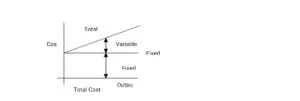
Total cost is the total sum of fixed and variable costs incurred by an enterprise in the production of a particular commodity.
Total cost = Fixed cost + Variable cost, or Average cost x Quantity.
2. Fixed cost (FC)
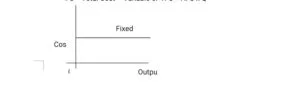
Fixed cost, also called overhead cost or unavoidable cost, is the cost that remains constant in the short run no matter the level of output. For example, money spent on rent.
FC = TC – VC, or TFC = AFC x Q
3. Variable cost (VC)
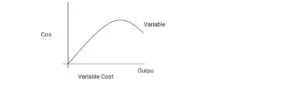
Variable cost, also called direct cost, is the cost of production that changes directly with the level of output. For example, the cost of raw materials and labour.
VC = TC – FC
4. Average cost (AC) or average total cost (ATC)
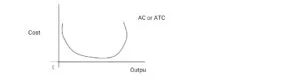
Average cost is the cost per unit of output. It is the total cost of producing a given output divided by the number of units of output.
AC = Total cost ÷ Total output, or ATC = AFC + AVC
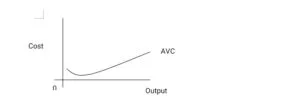
5. Average variable cost (AVC)
Average variable cost is the variable cost per unit of output.
AVC = TVC ÷ TQ, or ATC – AFC
6. Average fixed cost (AFC)
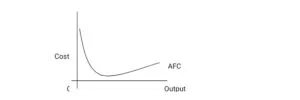
Average fixed cost is the fixed cost per unit of output.
AFC = Total fixed cost ÷ Quantity
7. Marginal cost (MC)
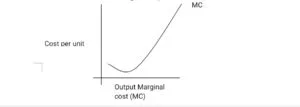
Marginal cost, also called incremental cost, is the addition to total cost needed to produce one more unit of output. It depends only on variable cost, because fixed cost does not vary with the level of output.
Marginal cost = Change in TC ÷ Change in output
Evaluation
- Define cost of production.
- Explain the difference between the economist’s view and the accountant’s view of cost.
- State two examples each of fixed cost and variable cost.
- Write the formula for average total cost and for average variable cost.
- Why does marginal cost not depend on fixed cost?
Assignment
- Define total cost and state its formula.
- Define marginal cost and write its formula.
- Explain opportunity cost, using an example.
This term's Economics topics
SS2 Second Term · 9 topics
Get Economics as PDF and Word
Every week of SS2 Economics, Second Term, formatted and ready to print. Ad-free, and the copy lock comes off.
Get this term Card, bank transfer, USSD or OPay
Second Term Economics Lesson Notes for Other Topics
Economic Growth and Development
Read the full lesson note.

Balance of Payments (B.O.P) 2
Read the full lesson note.
Balance of Payments (B.O.P) 1
Read the full lesson note.

Economic Reform Programmes
Read the full lesson note.
Economic Development Challenges
Read the full lesson note.

Current Economic Plans MDGs NEEDS Vision 2030
Read the full lesson note.
International Economic Organization
Read the full lesson note.

Economic Development Planning
Read the full lesson note.
Imperfect Market
Read the full lesson note.

Industries In Nigeria
Read the full lesson note.

Market Structure
Read the full lesson note.
Supply And Demand Of Labour
Read the full lesson note.
Labour Market
Read the full lesson note.
Economics System
Read the full lesson note.
Production Possibility Curve
Read the full lesson note.
Lesson Notes for Other Classes

Basic 1 Lesson Note
The complete lesson note to guide your studies.

Basic 2 Lesson Note
The complete lesson note to guide your studies.

Basic 3 Lesson Note
The complete lesson note to guide your studies.

Basic 4 Lesson Note
The complete lesson note to guide your studies.

Basic 5 Lesson Note
The complete lesson note to guide your studies.

Basic 6 Lesson Note
The complete lesson note to guide your studies.
