
Supply and Demand of Labour – SS2 Economics Lesson Note (Second Term)
Lesson note at a glance
- Class
- SS2
- Subject
- Economics
- Term
- Second Term
- Reading time
- 7 min
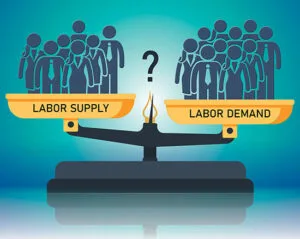
Supply and demand of labour are the two market forces that decide how many people work and what wage they are paid.
- Supply of labour: the total number of people of working age offered for employment at a particular time and a given wage rate.
- Demand for labour: the total number of workers an employer is willing and ready to hire at the same time and wage rate.
Behavioural objectives
By the end of the lesson, students should be able to:
- Define supply of labour and demand for labour.
- State the factors that affect the supply of and demand for labour.
- Distinguish between nominal wages and real wages.
- Explain how wages are determined and why they vary between occupations.
- Describe the types, causes, consequences and solutions of unemployment.
- State the objectives and weapons of a trade union.
What is supply of labour?
Supply of labour is the total number of people of working age offered for employment at a particular time and a given wage rate.
- It relates to the quantity of labour available in the economy.
What are the factors affecting supply of labour?
- Population size and growth: a larger population usually gives a larger labour supply.
- Age structure: the share of people who are of working age.
- School leaving age: a higher leaving age delays entry into the labour force.
- Age of entry and retirement: the official ages at which people start and stop work.
- Full-time education: people who study beyond the normal leaving age are not available for work.
- Married women in paid employment: more women taking paid jobs increases supply.
- Disability or incapacity: some people of working age cannot work.
- Unwillingness to work: some able-bodied people choose not to work.
- Working hours per week: longer hours increase the labour supplied.
- Wage rate: higher pay usually attracts more people to offer their labour.
What is demand for labour?
Demand for labour is the total number of workers an employer is willing and ready to hire at a particular time and a given wage rate.
- It is the quantity of human effort that entrepreneurs need for production.
- Derived demand: labour is wanted because of the goods and services it helps to produce, not for itself.
What are the factors influencing demand for labour?
- Number of industries: more industries in a country means more demand for workers.
- Nature of industries: labour-intensive industries need more workers than capital-intensive ones.
- Other factors of production: the amount of land, capital and entrepreneurs available.
- Wage rate: the price of labour affects how many workers employers hire.
- State of employment: the level of employment already in the economy.
- Demand for output and price level: higher demand for the goods workers make raises demand for those workers.
What are wages?
Wages are the payment made to labour for work done, usually on a daily or weekly basis.
- Salary: the payment made to labour every month.
What are the types of wages?
There are two types of wages: nominal wages and real wages.
- Nominal wages: the actual money paid for labour in a particular period.
- Real wages: the purchasing power of the wage, that is, the goods and services it can buy.
| Point | Nominal wages | Real wages |
|---|---|---|
| Meaning | Money received | Goods and services the money can buy |
| Measured in | Naira | Purchasing power |
| Effect of rising prices | Stays the same | Falls |
How are wages determined?
Wages are determined by market forces of demand and supply, and by government activities and policies.
How do demand and supply determine wages in a market economy?
In a competitive labour market, the wage rate settles where demand for labour meets supply of labour.
| Situation | Effect on wage rate |
|---|---|
| Supply of labour is greater than demand | Wage rate falls |
| Demand for labour is greater than supply | Wage rate rises |
| Demand equals supply | Wage rate is stable and acceptable to employer and worker |
How does the government influence wages?
Government institutions and wage commissions help to fix wages, especially in the public service.
- Cost of living: the higher the cost of living, the higher wages are likely to be.
- Level of productivity: the greater the output in the country, the higher the wage rate.
- Type of occupation: the wage structure differs from one occupation to another.
What causes variation in wages?
Wages vary between occupations because jobs differ in training, skill, risk and bargaining strength.
- Cost of training: costly training, as for doctors, leads to higher pay.
- Period of training: longer training usually earns higher pay.
- Skill needed: scarce skills attract higher wages.
- Bargaining power of trade unions: strong unions can win higher pay.
- Degree of risk: dangerous jobs pay more.
- Prestige: some jobs carry social honour, which can affect the pay offered.
What is unemployment?

Unemployment is a situation in which persons of working age, able and willing to work, cannot find paid employment.
- The affected people are qualified by age, law, custom and other factors to work.
- They still cannot find jobs.
What are the types of unemployment?
There are nine types of unemployment: structural, seasonal, voluntary, technological, frictional, casual, residual, cyclical and disguised.
- Structural unemployment: arises from changes in the pattern of demand for certain goods, so industries cut their workforce.
- Seasonal unemployment: occurs in industries whose production varies with the seasons, such as farming.
- Voluntary unemployment: arises when fit people refuse to work although jobs exist.
- Technological unemployment: results when industries adopt capital-intensive methods of production.
- Frictional unemployment: occurs while workers move from one job to another and search for a new one.
- Casual unemployment: occurs in jobs of an unsettled nature that are not permanent.
- Residual unemployment: affects people who cannot work because of physical or mental disability.
- Cyclical unemployment: occurs during the depression or recession stage of the business cycle.
- Disguised unemployment: occurs when workers are not used efficiently or are underemployed.
What are the causes of unemployment?
- Economic recession: firms produce less and employ fewer workers.
- Changes in the pattern of demand: some industries shrink.
- Seasonal changes: farming and other production slow down at certain times.
- Economic reform policies: some policies lead to job losses.
- Poor education planning: inadequate curricula leave graduates without needed skills.
- Capital-intensive methods: machines replace workers.
- Rapid population growth: the labour force grows faster than the economy.
- Physical and mental disability: some people cannot be employed.
What are the consequences of unemployment?
- Increase in crime rate: idle people may turn to crime.
- Threat to peace and stability: unrest can follow widespread joblessness.
- Waste of human resources: skills and effort are not used.
- High dependency: the unemployed rely on family and others.
- Migration: people move to other places or countries to find work.
What are the solutions to unemployment?
- Industrialisation: new industries create jobs.
- Population control: slows the growth of the labour force.
- Redesigning the educational system: gives students skills that employers need.
- Proper development plans: guide the economy towards job creation.
- Provision of social amenities: roads, power and water support businesses and create jobs.
What is a trade union?
A trade union is an association of workers formed to take collective action against employers on matters of welfare and working conditions.
- Academic Staff Union of Universities (ASUU): a union of university teachers.
- National Union of Petroleum and Natural Gas Workers (NUPENG): a union of workers in the oil and gas sector.
What are the objectives of a trade union?
- Good wages: to secure fair pay for members.
- Protection of members: to safeguard members’ interests.
- Policy formulation: to help in making labour policy.
- Entry qualifications: to regulate entry into the various professions.
- Job security: to protect members from unfair dismissal.
- Working conditions: to secure better conditions at work.
What are the weapons of a trade union?
There are five weapons of a trade union, listed here from the mildest to the strongest.
- Collective bargaining: the union and management try to settle their differences through joint negotiation.
- Threat to strike: the union gives an ultimatum that a strike will follow if demands are not met in a given time.
- Work to rule: workers deliberately slow down operations to press for better conditions of service.
- Picket lines: workers refuse to work, parade and sometimes block the entrance to the plant or factory.
- Strike: workers stay away completely from work until their demands are met.
Evaluation
- Define supply of labour and demand for labour.
- State four factors that affect the supply of labour.
- Distinguish between nominal wages and real wages.
- List four types of unemployment and explain any two of them.
- State three weapons of a trade union.
Assignment
State four reasons for differences in earnings among workers and explain any two of them.
This term's Economics topics
SS2 Second Term · 9 topics
SS2 Economics Lesson Notes for Other Topics

Production Possibility Curve
Read the full lesson note.
Cost Concept
Read the full lesson note.

Revenue Concept
Read the full lesson note.
Economics System
Read the full lesson note.
Labour Market
Read the full lesson note.

Market Structure
Read the full lesson note.

Imperfect Market
Read the full lesson note.

Industries In Nigeria
Read the full lesson note.
Basic Tools For Economic Analysis
Read the full lesson note.
Measures Of Dispersion
Read the full lesson note.

Theory Of Consumer Behaviour
Read the full lesson note.

Demand And Supply
Read the full lesson note.
Elasticity Of Demand
Read the full lesson note.
Income Elasticity Of Demand
Read the full lesson note.

Cross Elasticity Of Demand
Read the full lesson note.
Lesson Notes for Other Classes

SS1 Lesson Note
The complete lesson note to guide your studies.

SS3 Lesson Note
The complete lesson note to guide your studies.
