
Market Structure – SS2 Economics Lesson Note (Second Term)
Lesson note at a glance
- Class
- SS2
- Subject
- Economics
- Term
- Second Term
- Reading time
- 6 min
A market is any arrangement or system that brings buyers and sellers of goods and services into contact to do business.

Behavioural objectives
By the end of the lesson, students should be able to:
- define a market in the physical and the economic sense;
- list the types of market based on commodity, channel of distribution and price;
- state the conditions necessary for a perfect market;
- explain the short-run and long-run equilibrium of a perfect competitor;
- explain when a competitive firm makes a loss.
What is a market?
A market is any arrangement, system or organisation that brings buyers and sellers together to buy and sell goods and services.
- Physical sense: a fixed place where people meet to buy and sell goods, that is, a marketplace.
- Economic sense: any arrangement whereby buyers and sellers are in contact to transact business, with or without a fixed place.
What are the types of market?
Markets are grouped in three ways: by commodity, by channel of distribution and by price.
What are the markets based on type of commodity?
- Consumer goods market: made up of buyers and sellers of consumer goods.
- Labour market: made up of workers and employers, and deals with the recruitment of unskilled, semi-skilled, skilled and professional workers.
- Capital market: a financial market which deals in long-term loans.
- Money market: a financial market which deals in short-term loans.
- Stock exchange market: made up of buyers and sellers of second-hand securities.
- Foreign exchange market: deals with the buying and selling of foreign currencies.
What are the markets based on channel of distribution?
- Wholesale market: traders buy goods in large quantities from producers and sell in smaller lots to retailers.
- Retail market: traders sell goods in small quantities directly to final consumers.
What are the markets according to price?
- Perfect market: prices are fixed by the forces of demand and supply, and no buyer or seller can influence them.
- Imperfect market: one or more sellers or buyers can influence the price.
What are the types of imperfect market?
There are three common types of imperfect market: monopoly, oligopoly and monopolistic competition.
- Monopoly: one seller controls the whole supply of a product that has no close substitute.
- Oligopoly: a few large sellers dominate the market, as with mobile telephone networks.
- Monopolistic competition: many sellers offer similar but not identical products, such as brands of soap or toothpaste.
What is a perfect market?
A perfect market is a market structure in which prices are determined by the forces of demand and supply.
What are the conditions necessary for a perfect market?
A perfect market needs the following conditions:
- Homogeneous commodity and existence of close substitutes: goods bought and sold are identical in size, shape, colour and so on.
- Large number of buyers and sellers: each buyer or seller has no control over the prevailing price.
- Free entry and exit: there is no barrier or restriction to entering or leaving the industry.
- No preferential treatment: all buyers are treated equally.
- Perfect knowledge: buyers and sellers have full information about the price of the goods or services.
- Uniformity of prices: each perfect competitor is a price taker, and there are no transport costs.
- Portable goods: the goods are easy to carry from place to place.
- Easy transfer of factors of production: land, labour and capital move freely from one use to another.
- A firm is in equilibrium at the output where marginal cost (MC) equals marginal revenue (MR).
How are price and quantity determined under perfect competition?
Price and quantity are determined by the interaction of the forces of supply and demand in the whole market.
- Price takers: every firm accepts the market price and cannot change it.
- Output choice: each firm chooses only the quantity that gives it the best profit at that price.
What are the short-run and long-run positions of a perfect competitor?
A perfect competitor may earn abnormal profit in the short run, but earns only normal profit in the long run.
- Normal profit: the minimum reward that keeps a firm in business, when revenue just covers all costs.
- Abnormal profit: profit above normal profit, earned when price is above average cost.
What is equilibrium in the short run?
The short run is the period in which a firm can vary its output by changing the variable factors of production.
- The market sets the price, so the firm chooses the quantity that maximises its profit.
- In the short run, a firm can make an abnormal profit.
Equilibrium occurs when two conditions are satisfied:
- Marginal cost is equal to marginal revenue (MC = MR).
- Marginal cost cuts the marginal revenue from below at the point of equality.
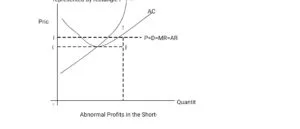
- At point b: price is greater than marginal cost, so it is better to increase output.
- At point S: the firm is at equilibrium, where MC = MR = P = AR.
- Abnormal profit: the firm earns abnormal profit, shown by rectangle PORS.
What is equilibrium in the long run?
The long run is a period in which all costs vary with the level of output, so firms can adjust their scale of operation.
- Abnormal profit attracts new firms into the market.
- Supply increases as the new firms enter.
- Price may fall if demand remains constant.
- New and old firms adjust their output to the new price.
- Abnormal profit disappears and each firm earns normal profit.
- Long-run condition: MC = MR = AC = AR = P.
- Normal profit: firms just cover average cost, so the AC curve touches (is tangential to) the AR curve.
- Output and price: the firm produces Oqi and sells at OP.
What is the difference between short-run and long-run equilibrium?
| Point | Short run | Long run |
|---|---|---|
| Meaning of period | Output changes by varying variable factors. | All costs vary and scale can change. |
| Profit | Abnormal profit is possible. | Only normal profit. |
| Entry of new firms | Not yet complete. | New firms enter until abnormal profit ends. |
| Condition | MC = MR = P = AR | MC = MR = AC = AR = P |
When does a competitive firm make a loss?
A competitive firm makes a loss when the price is below its average cost.

- Cause: at price P, the price is below the average cost.
- Size of loss: the loss is represented by area apbc in the figure.
- Result: if the firm cannot cover its average cost, it may close down.
- Exit: closing down may be the point of exit from the market.
Evaluation
- Define a market in economics.
- List four conditions necessary for a perfect market.
- State the two conditions that must be satisfied for a firm to be in equilibrium in the short run.
- Why do firms in a perfect market make only normal profits in the long run?
- When does a competitive firm make a loss?
Assignment
- Explain the difference between the short-run and long-run equilibrium of a perfect competitor.
This term's Economics topics
SS2 Second Term · 9 topics
SS2 Economics Lesson Notes for Other Topics

Production Possibility Curve
Read the full lesson note.

Cost Concept
Read the full lesson note.

Revenue Concept
Read the full lesson note.

Economics System
Read the full lesson note.

Labour Market
Read the full lesson note.

Supply And Demand Of Labour
Read the full lesson note.

Imperfect Market
Read the full lesson note.

Industries In Nigeria
Read the full lesson note.

Basic Tools For Economic Analysis
Read the full lesson note.

Measures Of Dispersion
Read the full lesson note.

Theory Of Consumer Behaviour
Read the full lesson note.

Demand And Supply
Read the full lesson note.

Elasticity Of Demand
Read the full lesson note.

Income Elasticity Of Demand
Read the full lesson note.

Cross Elasticity Of Demand
Read the full lesson note.
Lesson Notes for Other Classes

SS1 Lesson Note
The complete lesson note to guide your studies.

SS3 Lesson Note
The complete lesson note to guide your studies.
