
Functions and Mapping – SS3 Mathematics Lesson Note (Second Term)
Lesson note at a glance
- Class
- SS3
- Subject
- Mathematics
- Term
- Second Term
- Reading time
- 5 min
A function, also called a mapping, is a rule that assigns each element x in set A to exactly one element y in set B.
Behavioural objectives
By the end of the lesson, students should be able to:
- define a function (mapping), domain, co-domain, image and range;
- state the images and the range of a mapping from a diagram;
- find the value of a function for a given value of x;
- find the domain of a mapping when the range is given;
- identify one-one, many-one, onto and identity mappings.
What is a function?
A function is a rule that assigns each element x in set A to one unique element y in set B.
- Domain: set A, the set of elements that the rule acts on.
- Co-domain: set B, the set in which the images are found.
- Image: the element y in B that the rule gives for an element x in A.
- Range: the set of all the images of the elements of the domain.
- Condition: every element of the domain must have exactly one image.

What are the image and the range of a function?
The image is the unique element in set B produced by an element in set A, and the range is the set of all such images.
- Image: the unique element in set B produced by an element in set A.
- Range: the collection of all the images of the elements of the domain.
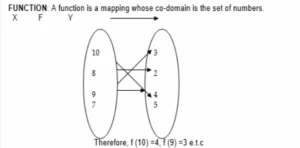
Using the diagram above:
- f(w) = g, f(x) = b, f(y) = f, f(z) = a
- g, b, f and a are the images of w, x, y and z respectively.
- Range = {a, b, f, g}
- Note: the range is part of the co-domain. It may be smaller than the co-domain.
How is a function written?
A function is written as f: A → B, which is read as “f maps A to B”.
- f: A → B: the rule f takes elements from set A to set B.
- f: x → 3x² + 2: the rule f maps x onto 3x² + 2.
- f(x) = 3x² + 2: the same rule, written to give the image of x.
- f(4): the image of 4, found by replacing x with 4 in the rule.
How do you find the value of a function?
To find the value of a function, replace x in the rule with the given number and simplify.
- Write the rule f(x).
- Replace every x with the given number, using brackets.
- Work out the powers first, then multiply, then add or subtract.
Example 1: finding the value of a function
Given f(x) = 3x² + 2, find (a) f(4) (b) f(-3) (c) f(-1/2).
Solution
f(x) = 3x² + 2
(a) f(4) = 3(4²) + 2
= 3(16) + 2
= 48 + 2
= 50
(b) f(-3) = 3(-3)² + 2
= 3(9) + 2
= 27 + 2
= 29
(c) f(-1/2) = 3(-1/2)² + 2
= 3(1/4) + 2
= 3/4 + 8/4
= 11/4
How do you find the domain when the range is given?
To find the domain from a given range, set the rule equal to each member of the range and solve for x.
- Write the rule and the range.
- Put the rule equal to the first member of the range.
- Solve for x. A squared term gives a positive and a negative value.
- Repeat for every member of the range.
- Collect all the values of x as the domain.
Example 2: finding the domain from the range
Determine the domain D of the mapping g: x → 2x² – 1, if R = {1, 7, 17} is the range and g is defined on D.
Solution
g(x) = 2x² – 1, R = {1, 7, 17}
When g(x) = 1:
1 = 2x² – 1
2 = 2x²
x² = 1
x = 1 or x = -1
When g(x) = 7:
7 = 2x² – 1
8 = 2x²
x² = 4
x = 2 or x = -2
When g(x) = 17:
17 = 2x² – 1
18 = 2x²
x² = 9
x = 3 or x = -3
Domain D = {-3, -2, -1, 1, 2, 3}
- If positive numbers only: when the question says x is positive, D = {1, 2, 3}.
What are the types of mapping?
There are four types of mapping in this topic: one-one, many-one, onto and identity.
One-one mapping
A mapping is one-one if different elements in the domain have different images in the co-domain.
- Rule: if x₁ ≠ x₂, then f(x₁) ≠ f(x₂).
- Example: f: x → 2x on {1, 2, 3} gives 2, 4, 6, all different.
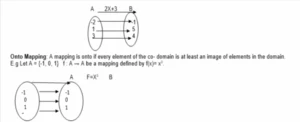
The mapping above is one-one.
Many-one mapping
A mapping is many-one if two or more elements of the domain share the same image.
- Example: f: x → x² on {-2, 2} gives 4 for both elements.
Onto mapping
A mapping is onto if its range is the same as its co-domain.
- Meaning: every element of the co-domain is the image of at least one element of the domain.
Identity mapping
An identity mapping takes every element onto itself.
- Rule: f: x → x, so f(x) = x for all x ∈ X.
- Example: {1, 2, 3} → {1, 2, 3} with 1 → 1, 2 → 2, 3 → 3.

Comparison of the types
| Type | Key feature | Example |
|---|---|---|
| One-one | Different elements have different images | x → 2x |
| Many-one | Some elements share an image | x → x² on {-2, 2} |
| Onto | Range equals co-domain | {1, 2} → {3, 4} with 1 → 3, 2 → 4 |
| Identity | Each element maps to itself | x → x |
- Not a function: a rule that gives one element of A two different images in B.
Evaluation
- Define domain, co-domain, image and range.
- Given f(x) = x² + 4x + 3, find the values of (a) f(2) (b) f(1/2) (c) f(-3).
- Given that f(x) = ax + b, f(2) = 7 and f(3) = 12, find a and b.
- Find the domain of h: x → x² + 1 if the range is {2, 5, 10}.
- State whether f: x → 2x on {1, 2, 3} is one-one, and give a reason.
Assignment
Answer all parts of this task.
- State what makes a mapping one-one, and what makes a mapping an identity mapping.
- Given f(x) = 3x² + 2, find f(2) and f(-1).
- Use your answer to part 2 to name one image of f and say what the range of f contains.
This term's Mathematics topics
SS3 Second Term · 7 topics
SS3 Mathematics Lesson Notes for Other Topics

Bond And Debentures, Shares, Income Tax Value Added Tax
Read the full lesson note.
Coordinate Geometry of a Straight Line
Read the full lesson note.

Construction
Read the full lesson note.

Differentiation of Algebraic Function
Read the full lesson note.
Differentiation of Algebraic Function II
Read the full lesson note.

Integration and Evaluation of Simple Algebraic Functions
Read the full lesson note.
Logic
Read the full lesson note.
Application of Surds to Trigonometry Ratio and Trigonometry Graph
Read the full lesson note.

Matrices and Determinant
Read the full lesson note.

Calculating Distances Using Longitude, Latitude & Great Circles
Read the full lesson note.
Surface Area and Volume of Sphere and Hemispherical Sphere Volume
Read the full lesson note.

Longitude and Latitude
Read the full lesson note.
Binary Operations Properties
Read the full lesson note.

Arithmetic of Finance
Read the full lesson note.
Simple Equations And Variations
Read the full lesson note.
Lesson Notes for Other Classes

SS1 Lesson Note
The complete lesson note to guide your studies.

SS2 Lesson Note
The complete lesson note to guide your studies.
