
Construction – SS3 Mathematics Lesson Note (Second Term)
Lesson note at a glance
- Class
- SS3
- Subject
- Mathematics
- Term
- Second Term
- Reading time
- 5 min
A locus is the path traced by a point that moves under one or more given conditions. The plural is loci.
Behavioural objectives
By the end of the lesson, students should be able to:
- define locus and loci;
- state the four types of loci covered in this lesson;
- construct each type of locus using a mathematical set;
- measure lines and angles correctly with a ruler and protractor;
- describe each locus in words after constructing it.
Instructional resource
- Mathematical set: ruler, pencil, compass, protractor and set squares.
What is a locus?
A locus is the path traced by a point that moves under a given condition or conditions.
- Plural: the plural of locus is loci.
- Condition: the rule the moving point must obey, such as “always 2 cm from point O”.
- Equidistant: the same distance from two or more things.
- Possible conditions: a fixed distance from a point, from a line, or from two points.
Teacher’s activities: Explains the meaning of locus to the whole class.
Students’ activities: Note down the points.
What tools are needed to construct a locus?
Loci are constructed with a ruler, a pair of compasses and a pencil, and sometimes a protractor.
- Ruler: draws straight lines and measures lengths in centimetres.
- Compass: draws circles and arcs of a fixed radius.
- Protractor: measures and checks angles in degrees.
- Sharp pencil: keeps lines thin so that arcs cross at clear points.
What are the types of loci and how are they constructed?
There are four types of loci in this lesson: a point equidistant from a fixed point, from two fixed points, from two intersecting lines, and at a fixed distance from a line.
The teacher leads the whole class through each construction. Students construct the same in their books.
1. What is the locus of a point equidistant from a fixed point?
It is the circumference of a circle with the fixed point as the centre.
Example: draw the locus of a point 2 cm from a fixed point O.
- Mark the fixed point O.
- Open the compass to a radius of 2 cm, using the ruler.
- Place the compass point on O.
- Draw a complete circle. Every point on it is 2 cm from O.
2. What is the locus of a point equidistant from two fixed points?
It is the perpendicular bisector of the line segment joining the two points.
Example: construct the locus of a point equidistant from two points A and B, where |AB| = 7 cm.
- Draw the line AB, 7 cm long.
- Open the compass to more than half of AB, for example 4 cm.
- Place the compass point on A and draw arcs above and below AB.
- Keep the same radius, place the compass point on B and draw arcs to cut the first arcs.
- Join the two points where the arcs cross, using a ruler.
- Label the line. It cuts AB at its midpoint, 3.5 cm from A, at right angles.
3. What is the locus of a point equidistant from two intersecting straight lines?
It is the pair of bisectors of the angles formed by the two lines.
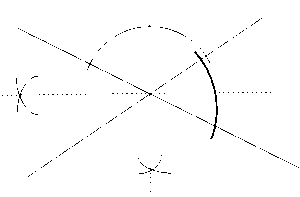
Example: construct the locus of a point equidistant from two lines that cross at O.
- Draw the two lines crossing at O.
- Place the compass point on O and draw an arc cutting both arms of one angle, at P and Q.
- With the compass point on P, draw an arc inside the angle.
- With the same radius and the compass point on Q, draw an arc to cut the first one.
- Join O to the point where the arcs cross. This is the first angle bisector.
- Repeat steps 2 to 5 for the neighbouring angle to get the second bisector.
- Check with a protractor that the two bisectors meet at 90°.
4. What is the locus of a point at a fixed distance from a given straight line?
It is two parallel lines, one on each side of the given line, each at the fixed distance from it.
Example: construct the locus of a point 3.2 cm from line AB.
- Draw the line AB.
- Mark two points on AB, well apart.
- At each point, construct a perpendicular to AB with a set square or compass.
- On each perpendicular, measure 3.2 cm above AB and 3.2 cm below AB.
- Join the two upper marks with a ruler. Join the two lower marks.
- Label the two parallel lines as the locus.
- If AB is a line segment: join the two parallel lines with a semicircle of radius 3.2 cm at each end, centred on A and on B.
How do the four loci compare?
| Condition | Locus | Key tool |
|---|---|---|
| Fixed distance from a point | Circle | Compass |
| Equidistant from two points | Perpendicular bisector | Compass and ruler |
| Equidistant from two intersecting lines | Two angle bisectors | Compass and ruler |
| Fixed distance from a line | Two parallel lines | Ruler and set square |
What mistakes should students avoid?
- Changing the compass radius: keep the same opening when drawing arcs from both ends.
- Thick pencil lines: they make the crossing points hard to find.
- Erasing arcs: keep construction arcs visible, as marks are given for them.
- Missing labels: label points, lines and lengths clearly.
Evaluation
The teacher asks the students the following questions, and the students respond.
- Define loci.
- State the locus of a point equidistant from two fixed points.
- Construct the locus of a point 3 cm from a given point.
- State the locus of a point equidistant from two intersecting lines.
Assignment
- Draw a line PQ, 6 cm long. Construct the locus of a point equidistant from P and Q. Then construct the locus of a point 2.5 cm from line PQ.
References
- New General Mathematics for SS 1 by J B Channon et al.
- New Concept Mathematics for SS 1 by H N Odogwu et al.
This term's Mathematics topics
SS3 Second Term · 7 topics
SS3 Mathematics Lesson Notes for Other Topics

Bond And Debentures, Shares, Income Tax Value Added Tax
Read the full lesson note.
Coordinate Geometry of a Straight Line
Read the full lesson note.

Differentiation of Algebraic Function
Read the full lesson note.
Differentiation of Algebraic Function II
Read the full lesson note.

Integration and Evaluation of Simple Algebraic Functions
Read the full lesson note.
Functions and Mapping
Read the full lesson note.
Logic
Read the full lesson note.
Application of Surds to Trigonometry Ratio and Trigonometry Graph
Read the full lesson note.

Matrices and Determinant
Read the full lesson note.

Calculating Distances Using Longitude, Latitude & Great Circles
Read the full lesson note.
Surface Area and Volume of Sphere and Hemispherical Sphere Volume
Read the full lesson note.

Longitude and Latitude
Read the full lesson note.
Binary Operations Properties
Read the full lesson note.
Arithmetic of Finance
Read the full lesson note.
Simple Equations And Variations
Read the full lesson note.
Lesson Notes for Other Classes

SS1 Lesson Note
The complete lesson note to guide your studies.

SS2 Lesson Note
The complete lesson note to guide your studies.
