
Statics – SS3 Further Mathematics Lesson Note (Second Term)
Lesson note at a glance
- Class
- SS3
- Subject
- Further Mathematics
- Term
- Second Term
- Reading time
- 4 min
Statics is the branch of mechanics that deals with forces acting on bodies that are at rest or in equilibrium.
Behavioural objectives
By the end of the lesson, students should be able to:
- define force and state its unit;
- explain what a polygon of forces is and how it is drawn;
- explain what is meant by resolution of forces;
- find the horizontal and vertical components of a force inclined to the horizontal;
- find the resultant of two perpendicular forces from their components.
What is a force?
Force is an action that tends to change the state of a body at rest or in uniform motion in a straight line.
- Unit: the newton (N).
- Type of quantity: a vector, so it has both magnitude and direction.
- Effects: a force can start a motion, stop a motion, change speed, change direction or change the shape of a body.
- Examples: the weight of a bag, the pull of a rope, the push of a person on a wall.
What are the features of a force?
A force is fully described by three features.
- Magnitude: the size of the force, for example 230 N.
- Direction: the line along which the force acts, for example 30° to the horizontal.
- Point of application: the point on the body where the force acts.
What is a resultant force?
A resultant is a single force that has the same effect as all the forces acting together on a body.
- It is the vector sum of the forces.
- If the resultant is zero, the body is in equilibrium.
What is a polygon of forces?
A polygon of forces is a broken line that is constructed to determine the resultant vector (geometric sum) of a given system of forces.
How to draw a polygon of forces
- Choose a suitable scale, for example 1 cm to 10 N.
- Draw the first force as a line with the correct length and direction.
- Draw the second force starting from the end (head) of the first force.
- Continue in the same way for every other force, head to tail.
- Join the start of the first force to the end of the last force.
- This closing line is the resultant. Measure its length and convert it with the scale.
- Measure the angle it makes with a reference line to get its direction.
What does a closed polygon mean?
- Closed polygon: the last force ends where the first began, so the resultant is zero.
- Meaning: the forces are in equilibrium.
- Special case: for three forces, the polygon is a triangle (triangle of forces).
What is resolution of forces?
Resolution of forces is the splitting of a given force into two parts that act at right angles to each other.
- Horizontal component: the part that acts along the x-axis.
- Vertical component: the part that acts along the y-axis.
- Effect: the two components together have the same effect as the original force.
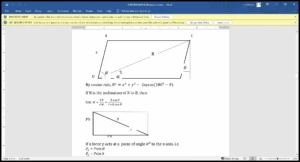
If a force P acts at a point at an angle θ to the x-axis, then:
- horizontal component = P cos θ
- vertical component = P sin θ
How do the two components compare?
| Feature | Horizontal component | Vertical component |
|---|---|---|
| Axis | x-axis | y-axis |
| Formula (θ from x-axis) | P cos θ | P sin θ |
| Value when θ = 0° | P | 0 |
| Value when θ = 90° | 0 | P |
How do you resolve a force? (steps)
- Draw the force P and mark the angle θ it makes with the horizontal.
- Draw a right-angled triangle with P as the hypotenuse.
- The side next to θ is the horizontal component: P cos θ.
- The side opposite θ is the vertical component: P sin θ.
- Write each answer with its unit (N) and direction.
- Take care: if the angle is given from the vertical, the two formulas swap.
How do you find a resultant from components?
The resultant of two perpendicular components X and Y is found with Pythagoras’ theorem.
- Magnitude: R = √(X² + Y²).
- Direction: tan α = Y ÷ X, where α is the angle R makes with the x-axis.
- Equilibrium: the sum of the horizontal components is zero and the sum of the vertical components is zero.
Worked examples
Example 1: resolution of a force
A force of 40 N is inclined at 30° to the horizontal. Find its horizontal and vertical components.
- Horizontal component = 40 cos 30° = 40 × 0.8660 = 34.64 N.
- Vertical component = 40 sin 30° = 40 × 0.5 = 20 N.
Example 2: resolution of a force
A force of 100 N acts at 60° to the horizontal. Find its components.
- Horizontal component = 100 cos 60° = 100 × 0.5 = 50 N.
- Vertical component = 100 sin 60° = 100 × 0.8660 = 86.6 N.
Example 3: resultant of two perpendicular forces
A force of 3 N acts along the x-axis and a force of 4 N acts along the y-axis. Find the resultant.
- R = √(3² + 4²) = √25 = 5 N.
- tan α = 4 ÷ 3 = 1.333, so α = 53.1° to the x-axis.
Evaluation
- Define force and state its unit.
- What is a polygon of forces used for?
- What is meant by resolution of forces?
- A force P acts at an angle θ to the x-axis. Write down its horizontal and vertical components.
- A force of 50 N acts at 30° to the horizontal. Find its horizontal and vertical components.
Assignment
Work on the following questions from New Further Mathematics Project 3:
- Page 186, exercise 12, questions 1, 2, 3, 5, 7 and 8.
- Page 258, revision exercise chapter 12, questions 13, 17, 20 and 23.
This term's Further Mathematics topics
SS3 Second Term · 5 topics
SS3 Further Mathematics Lesson Notes for Other Topics

Integration
Read the full lesson note.

Conic Sections
Read the full lesson note.

Modelling
Read the full lesson note.

Games Theory
Read the full lesson note.

Inequalities
Read the full lesson note.

Matrices and Determinant
Read the full lesson note.

Partial Fraction
Read the full lesson note.

Probability Distribution And Approximation
Read the full lesson note.

Variance
Read the full lesson note.

Correlation & Regression
Read the full lesson note.
Lesson Notes for Other Classes

SS1 Lesson Note
The complete lesson note to guide your studies.

SS2 Lesson Note
The complete lesson note to guide your studies.
