
Inequalities – SS3 Further Mathematics Lesson Note (First Term)
Download this term · ₦1,000Lesson note at a glance
- Subject
- Further Mathematics
- Class
- SS3
- Term
- First Term
- Topic
- Inequalities
- Order
- Topic 1 of 6 this term
- Reading time
- 5 min
A quadratic inequality is an inequality in which one side is a quadratic polynomial and the other side is zero.
Behavioural objectives
By the end of the lesson, students should be able to:
- Define a quadratic inequality and write its standard forms.
- Solve quadratic inequalities by the algebraic method.
- Solve quadratic inequalities by the graphical method.
- Solve linear inequalities in two dimensions by shading regions on a graph.
What is a quadratic inequality?
A quadratic inequality is an inequality in which a quadratic expression is compared with zero using <, >, ≤ or ≥.
- Constants: in ax2 + bx + c, the letters a, b and c are constants and a ≠ 0.
- Variable: x is the variable, raised to the power of 2.
- Example: 3x2 + 2x ≥ 0 is a quadratic inequality.
- Meaning: it describes the intervals where the quadratic expression is less than, greater than, or equal to zero.
- Solution set: the set of values of x that make the inequality true.
What are the standard forms of a quadratic inequality?
There are four standard forms of a quadratic inequality.
- Form 1: ax2 + bx + c > 0
- Form 2: ax2 + bx + c < 0
- Form 3: ax2 + bx + c ≥ 0
- Form 4: ax2 + bx + c ≤ 0
How do you solve a quadratic inequality?
To solve a quadratic inequality, find the roots of the expression and test each interval they create.
- Set the expression. Move all terms to one side so that the other side is zero.
- Factorise or find the roots. Factorise, or use the quadratic formula if the expression does not factorise.
- Determine the critical points. These are the roots, where the expression equals zero and its sign may change.
- Create intervals. Use the critical points to divide the number line into sections.
- Choose test values. Pick one convenient number inside each interval, not the critical points themselves.
- Evaluate the inequality. Substitute each test value into the original inequality to see whether it is true.
- Determine the solution regions. Keep the intervals where the inequality is true.
- Express the solution set. Write it as an inequality, on a number line or in set notation.
What rules must you remember?
- Strict signs (< or >): the roots are not part of the solution.
- Non-strict signs (≤ or ≥): the roots are part of the solution.
- Negative multiplier: reverse the inequality sign when you multiply or divide both sides by a negative number.
- Positive a, expression greater than 0: the solution lies outside the roots.
- Positive a, expression less than 0: the solution lies between the roots.
What methods can be used to solve quadratic inequalities?
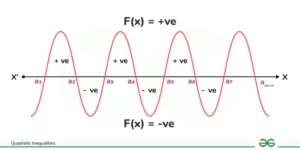
There are two methods for solving a quadratic inequality: the graphical method and the algebraic method.
What is the graphical method?
The graphical method means drawing the graph of the quadratic function and reading the solution from the graph.
Example: Solve x2 – 3x – 4 > 0
Solution
Step 1: Plot the graph of y = x2 – 3x – 4.
- For the x-intercepts, put y = 0: x2 – 3x – 4 = 0.
- Split the middle term: x2 – 4x + x – 4 = 0.
- Group the terms: x(x – 4) + 1(x – 4) = 0.
- Factorise: (x – 4)(x + 1) = 0.
- The roots are x = 4 and x = -1.

Step 2: Find where the graph lies above the x-axis (where y > 0).
- The coefficient of x2 is positive, so the curve opens upwards.
- The curve is above the x-axis outside the roots -1 and 4.
Step 3: Read the x-values for those regions.
- x < -1
- x > 4
The solution set is x < -1 or x > 4.
What is the algebraic method?
The algebraic method means finding the roots, then testing a value in each interval.
Example 1: Solve x2 – 3x – 4 > 0
- The roots are x = -1 and x = 4.
- The intervals are x < -1, -1 < x < 4 and x > 4.
- Test x = -2: 4 + 6 – 4 = 6, which is greater than 0, so it is true.
- Test x = 0: 0 – 0 – 4 = -4, which is not greater than 0, so it is false.
- Test x = 5: 25 – 15 – 4 = 6, which is greater than 0, so it is true.
- The solution is x < -1 or x > 4.
Example 2: Solve x2 – 5x + 6 ≤ 0
- Factorise: (x – 2)(x – 3) ≤ 0.
- The roots are x = 2 and x = 3.
- Test x = 1: 1 – 5 + 6 = 2, which is not ≤ 0, so it is false.
- Test x = 2.5: 6.25 – 12.5 + 6 = -0.25, which is ≤ 0, so it is true.
- Test x = 4: 16 – 20 + 6 = 2, which is not ≤ 0, so it is false.
- The sign is ≤, so the roots are included.
- The solution is 2 ≤ x ≤ 3.
How do you solve inequalities in two dimensions?
An inequality in two dimensions involves x and y, and its solution is a region of the graph plane.
- Boundary line: the line obtained by replacing the inequality sign with an equals sign.
- Solid line: used for ≤ and ≥, because points on the line belong to the solution.
- Dashed line: used for < and >, because points on the line do not belong to the solution.
- Test point: a point not on the line, usually (0, 0), used to choose the correct side.
What are the steps?
- Replace the inequality sign with = to get the boundary line.
- Find two points on the line, such as the intercepts, and draw it.
- Use a solid line for ≤ or ≥, and a dashed line for < or >.
- Substitute the test point into the original inequality.
- If the statement is true, shade the side containing the test point.
- If the statement is false, shade the other side.
Example 1: Show the region x + y ≤ 4
- The boundary line is x + y = 4.
- It passes through (4, 0) and (0, 4).
- The sign is ≤, so draw a solid line.
- Test (0, 0): 0 + 0 ≤ 4 is true.
- Shade the side of the line that contains the origin.
Example 2: Show the region y > 2x – 1
- The boundary line is y = 2x – 1.
- It passes through (0, -1) and (1, 1).
- The sign is >, so draw a dashed line.
- Test (0, 0): 0 > -1 is true.
- Shade the side of the line that contains the origin.
How do you solve several inequalities together?
For several inequalities, draw every boundary line and find the region that satisfies all of them.
- Example: x ≥ 0, y ≥ 0 and x + y ≤ 4.
- Region: a triangle with vertices (0, 0), (4, 0) and (0, 4).
- Boundaries: all three lines are solid, because every sign includes equality.
Evaluation
- What is a quadratic inequality? Write its four standard forms.
- State the steps for solving a quadratic inequality.
- Factorise x2 – 3x – 4 and state its roots.
- From the graph of y = x2 – 3x – 4, state the values of x for which y > 0.
- For the inequality x + y ≤ 4, state the type of boundary line and the side to shade.
Assignment
- Write down the four standard forms of a quadratic inequality, with one example of your own for each.
- Using the roots found in the worked example, use the graph of y = x2 – 3x – 4 to solve x2 – 3x – 4 < 0.
This term's Further Mathematics topics
SS3 First Term · 6 topics
Get Further Mathematics as PDF and Word
Every week of SS3 Further Mathematics, First Term, formatted and ready to print. Ad-free, and the copy lock comes off.
Get this term Card, bank transfer, USSD or OPay
SS3 Further Mathematics Lesson Notes for Other Topics
Matrices and Determinant
Read the full lesson note.
Partial Fraction
Read the full lesson note.

Probability Distribution And Approximation
Read the full lesson note.

Variance
Read the full lesson note.
Correlation & Regression
Read the full lesson note.

Integration
Read the full lesson note.

Conic Sections
Read the full lesson note.
Statics
Read the full lesson note.

Modelling
Read the full lesson note.

Games Theory
Read the full lesson note.
Lesson Notes for Other Classes

SS1 Lesson Note
The complete lesson note to guide your studies.

SS2 Lesson Note
The complete lesson note to guide your studies.
