
Conic Sections – SS3 Further Mathematics Lesson Note (Second Term)
Lesson note at a glance
- Class
- SS3
- Subject
- Further Mathematics
- Term
- Second Term
- Reading time
- 6 min
Conic sections are the curves formed when a plane cuts a cone: the circle, the parabola, the ellipse and the hyperbola.
Behavioural objectives
- State the definitions of a parabola, an ellipse and a hyperbola.
- Recognise the standard two-dimensional equations of a parabola, an ellipse and a hyperbola.
- Find the vertex, focus and directrix of a parabola from its equation.
- Write a parabola in canonical form by completing the square.
- Find the foci, vertices and asymptotes of a simple ellipse or hyperbola.
Instructional resources
- Solid shapes: models of parabolic, elliptic and hyperbolic types, and similar items.
How is the lesson presented?
The teacher presents the lesson step by step, starting with questions on previous lessons.
Step 1: Identification of prior knowledge
- Mode: entire class.
- Activity: the teacher arouses the students’ interest with questions relevant to the lesson.
- Example question: “What is a circle?”
- Expected answer: a circle is the locus of points at a fixed distance from a fixed point, the centre.
What are the types of conic section?
There are four conic sections: the circle, the parabola, the ellipse and the hyperbola.
- Circle: the plane cuts the cone at right angles to its axis.
- Ellipse: the plane is tilted and cuts across one nappe to form a closed oval.
- Parabola: the plane is parallel to the side of the cone and gives one open curve.
- Hyperbola: the plane cuts both parts of the cone and gives two open branches.
What is a parabola?
A parabola is the locus of points equidistant from a given point, called the focus, and from a given line, called the directrix.
- Standard equation: a parabola with its vertex at the origin has the equation y2 = 4ax.
- Focus: (a, 0).
- Directrix: x = -a.
What are the parts of a parabola?

From the diagram above:
- Directrix: line AB, a distance of a from the y-axis.
- Axis of symmetry: line AF.
- Vertex: point V.
- Latus rectum: the line with endpoints R and Q, drawn through the focus.
- Length of latus rectum: 4a for the parabola y2 = 4ax.
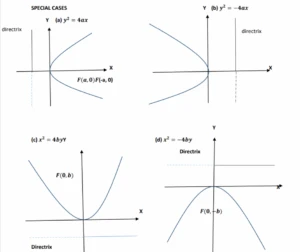
What are the four standard forms of a parabola with vertex at the origin?
| Equation | Opens | Focus | Directrix |
|---|---|---|---|
| y2 = 4ax | To the right | (a, 0) | x = -a |
| y2 = -4ax | To the left | (-a, 0) | x = a |
| x2 = 4ay | Upwards | (0, a) | y = -a |
| x2 = -4ay | Downwards | (0, -a) | y = a |
Here a is taken as a positive number.
What is the equation of a parabola whose vertex is not at the origin?
If the vertex of y2 = 4ax is translated to the point (x1, y1), the equation becomes:
(y – y1)2 = 4a(x – x1)
- Canonical form: this equation is said to be in the standard or canonical form.
- Vertex: (x1, y1).
- Focus: (x1 + a, y1).
- Directrix: x = x1 – a.
How do you write a parabola in canonical form?
- Keep the squared variable and its linear term on the left.
- Move the other terms to the right.
- Complete the square on the left by adding the same number to both sides.
- Factorise the right side to match 4a(x – x1) or 4a(y – y1).
- Read off the vertex, a, the focus and the directrix.
Worked examples on the parabola
Example 1
Find the focus and directrix of the parabola y2 = 16x.
Solution
Compare y2 = 16x with y2 = 4ax.
4a = 16, so a = 4.
Hence, the focus is (4, 0) and the directrix is x = -4.
Example 2
Write the equation y2 – 4y – 12x + 40 = 0 in canonical form and hence determine the vertex, focus and directrix.
Solution
- y2 – 4y – 12x + 40 = 0
- y2 – 4y + 4 – 12x + 36 = 0
- y2 – 4y + 4 = 12x – 36
- (y – 2)2 = 12(x – 3)
Hence, the vertex is (3, 2).
Since 4a = 12, a = 3.
The focus is (3 + 3, 2) = (6, 2).
The directrix is x = 3 – 3 = 0.
Example 3
Find the equation of the parabola whose vertex is the origin and whose focus is the point F(5, 0).
Solution
Let the equation of the parabola be y2 = 4ax.
The focus F(a, 0) = (5, 0), so a = 5.
Hence, the equation of the parabola is y2 = 20x.
What is an ellipse?
An ellipse is the locus of points whose distances from two fixed points, called the foci, add up to a constant.
- Standard equation: x2/a2 + y2/b2 = 1, with a > b > 0 and centre at the origin.
- Vertices: (a, 0) and (-a, 0).
- Major axis: the longer axis, along the x-axis, of length 2a.
- Minor axis: the shorter axis, along the y-axis, of length 2b.
- Foci: (c, 0) and (-c, 0), where c2 = a2 – b2.
- Eccentricity: e = c/a, which is less than 1.
- Centre (h, k): the equation becomes (x – h)2/a2 + (y – k)2/b2 = 1.
Example 4
Find the vertices, foci and eccentricity of the ellipse x2/25 + y2/9 = 1.
Solution
- Compare with x2/a2 + y2/b2 = 1: a2 = 25 and b2 = 9.
- So a = 5 and b = 3.
- c2 = 25 – 9 = 16, so c = 4.
- Vertices: (5, 0) and (-5, 0).
- Foci: (4, 0) and (-4, 0).
- Eccentricity: e = 4/5.
What is a hyperbola?
A hyperbola is the locus of points whose distances from two fixed points, called the foci, differ by a constant.
- Standard equation: x2/a2 – y2/b2 = 1, with centre at the origin.
- Vertices: (a, 0) and (-a, 0).
- Transverse axis: the line joining the vertices, of length 2a.
- Foci: (c, 0) and (-c, 0), where c2 = a2 + b2.
- Asymptotes: the lines y = (b/a)x and y = -(b/a)x, which the branches approach.
- Eccentricity: e = c/a, which is greater than 1.
Example 5
Find the vertices, foci and asymptotes of the hyperbola x2/16 – y2/9 = 1.
Solution
- Compare with x2/a2 – y2/b2 = 1: a2 = 16 and b2 = 9.
- So a = 4 and b = 3.
- c2 = 16 + 9 = 25, so c = 5.
- Vertices: (4, 0) and (-4, 0).
- Foci: (5, 0) and (-5, 0).
- Asymptotes: y = (3/4)x and y = -(3/4)x.
How do the conic sections compare?
The table sets the parabola, ellipse and hyperbola side by side, with centre or vertex at the origin.
| Feature | Parabola | Ellipse | Hyperbola |
|---|---|---|---|
| Equation | y2 = 4ax | x2/a2 + y2/b2 = 1 | x2/a2 – y2/b2 = 1 |
| Shape | One open curve | Closed oval | Two open branches |
| Number of foci | 1 | 2 | 2 |
| Eccentricity | e = 1 | e < 1 | e > 1 |
| Relation for c | Focus at (a, 0) | c2 = a2 – b2 | c2 = a2 + b2 |
Evaluation
- Find the foci and directrices of the following parabolas:
- (a) y2 = 32x. Answer: focus (8, 0), directrix x = -8.
- (b) y2 = -40x. Answer: focus (-10, 0), directrix x = 10.
- (c) x2 = 12y. Answer: focus (0, 3), directrix y = -3.
- (d) x2 = -50y. Answer: focus (0, -25/2), directrix y = 25/2.
- Write the equations of the following parabolas in canonical form and hence determine their vertices, foci and directrices:
- (a) y2 – 6y – 2x + 19 = 0. Answer: (y – 3)2 = 2(x – 5), V(5, 3), F(11/2, 3) and x = 9/2.
- (b) y2 + 4y + 4x + 16 = 0. Answer: (y + 2)2 = -4(x + 3), V(-3, -2), F(-4, -2) and x = -2.
- (c) x2 – 6x – 4y + 13 = 0. Answer: (x – 3)2 = 4(y – 1), V(3, 1), F(3, 2) and y = 0.
- (d) x2 + 4x + 4y + 16 = 0. Answer: (x + 2)2 = -4(y + 3), V(-2, -3), F(-2, -4) and y = -2.
- Find the vertices, foci and eccentricity of the ellipse x2/36 + y2/20 = 1. Answer: vertices (6, 0) and (-6, 0), foci (4, 0) and (-4, 0), e = 2/3.
- Find the foci and asymptotes of the hyperbola x2/9 – y2/16 = 1. Answer: foci (5, 0) and (-5, 0), asymptotes y = (4/3)x and y = -(4/3)x.
Assignment
Find the equations of the following parabolas, whose vertex is the origin and whose foci are the points:
- F(-4, 0)
- F(0, 5)
- F(0, -4)
This term's Further Mathematics topics
SS3 Second Term · 5 topics
- Integration
- Conic Sections
- Statics
- Modelling
- Games Theory
SS3 Further Mathematics Lesson Notes for Other Topics
Integration
Read the full lesson note.
Statics
Read the full lesson note.
Modelling
Read the full lesson note.
Games Theory
Read the full lesson note.
Inequalities
Read the full lesson note.
Matrices and Determinant
Read the full lesson note.
Partial Fraction
Read the full lesson note.
Probability Distribution And Approximation
Read the full lesson note.
Variance
Read the full lesson note.
Correlation & Regression
Read the full lesson note.
Lesson Notes for Other Classes

SS1 Lesson Note
The complete lesson note to guide your studies.

SS2 Lesson Note
The complete lesson note to guide your studies.
