
Solar Energy Storage Technologies – SS2 Solar Photovoltaic Installation & Maintenance Lesson Note (First Term)
Download this term · ₦1,000Lesson note at a glance
- Subject
- Solar Photovoltaic Installation & Maintenance
- Class
- SS2
- Term
- First Term
- Topic
- Solar Energy Storage Technologies
- Order
- Topic 2 of 7 this term
- Reading time
- 7 min
Solar energy storage is the keeping of electricity made by solar panels in batteries so it can be used when the sun is not shining.
- Lithium-ion batteries: small, efficient and suited to homes.
- Flow batteries: store energy in liquid tanks and last 20 years or more.
- Lifespan: both last longer than lead-acid batteries.
Behavioural objectives
By the end of the lesson, students should be able to:
- State why lead-acid batteries are not enough for advanced PV systems.
- Explain how lithium-ion and flow batteries work.
- List the advantages of lithium-ion and flow batteries for solar systems.
- Compare lithium-ion and flow batteries by size, best use, lifespan, maintenance and cost.
- Describe the C-rating, the BMS and temperature as design considerations.
Why do we store solar energy?
We store solar energy because panels only produce electricity in daylight, but people need power at night and on cloudy days.
- Daytime supply: panels produce most power around midday.
- Night demand: lights, fans, fridges and televisions are used after sunset.
- Battery bank: one or more batteries hold the extra energy until it is needed.
How does energy move through a solar storage system?
- The solar panels produce direct current (DC) electricity from sunlight.
- The charge controller regulates the power going into the battery.
- The battery stores the energy as chemical energy.
- The inverter changes the stored DC power to alternating current (AC) for the appliances.
What key terms describe a battery?
These four terms are used to judge any solar battery.
- Capacity: the amount of energy a battery can store, shown in ampere-hours (Ah) or kilowatt-hours (kWh).
- Depth of Discharge (DoD): the percentage of the stored energy that can safely be used.
- Cycle: one full charge and one full discharge of the battery.
- Cycle life: the number of cycles a battery gives before it performs poorly.
Why do we need advanced batteries?
We need advanced batteries because lead-acid batteries are heavy, wear out quickly and cannot be fully drained.
Lead-acid batteries are the heavy ones used in cars. They are cheap, but they have three main problems:
- Heavy: they are bulky and hard to fit in small spaces.
- Short life: they do not last many years.
- Low usable energy: draining them completely damages them.
Advanced PV systems need batteries that do the following:
- Last longer: 10+ years instead of about 2 years.
- Are smaller: they save space in our homes.
- Charge faster: they can soak up all the midday sun quickly.
An advanced battery is to a lead-acid battery what a smartphone battery is to an old flashlight battery.
| Feature | Lead-acid battery | Advanced battery (lithium-ion) |
|---|---|---|
| Weight | Very heavy | Much lighter and compact |
| Life | About 2 years | 10+ years |
| Usable energy | About 50% | Up to 90% |
| Charging | Slower | Faster |
What is a lithium-ion battery?
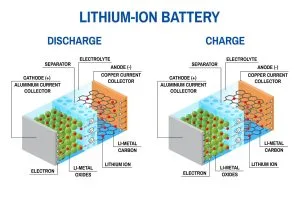
A lithium-ion (Li-ion) battery is a rechargeable battery in which lithium ions move between two electrodes to store and release energy.
- Everyday examples: laptops and smartphones already carry Li-ion batteries.
- Solar use: solar systems use much larger versions.
- Popularity: Li-ion is the most widely used advanced solar battery today.
What are the main parts of a lithium-ion battery?
- Anode: the electrode on one side, where the ions are held when the battery is charged.
- Cathode: the electrode on the other side, where the ions go when the battery discharges.
- Electrolyte: the material that lets the ions travel between the electrodes.
How do lithium-ion batteries work?
- When the battery supplies power, lithium ions move from the anode to the cathode.
- This movement creates the electric current that runs the appliances.
- When the sun shines, the solar panels “push” the ions back to the anode.
- The battery is now recharged and ready for use again.
Why is lithium-ion good for solar?
- High Depth of Discharge (DoD): you can use up to 90% of the energy in a lithium battery, but only about 50% in a lead-acid battery before it starts “dying”.
- Efficiency: almost all the energy you put in comes back out, and very little is lost as heat.
- Cycle life: they can be charged and emptied (cycled) 4,000 to 6,000 times.
- Compact size: they fit easily into a small house or shop.
What is a flow battery?
A flow battery is a rechargeable battery that stores energy in liquid chemicals held in two large tanks instead of a solid box.
What are the main parts of a flow battery?
- Electrolyte tanks: two tanks that hold the liquid chemicals, usually vanadium.
- Pumps: they move the liquids from the tanks to the central chamber.
- Cell stack (central chamber): the place where the liquids react to give or take electricity.
How do flow batteries work?
- Pumps draw the two liquids out of their tanks.
- The liquids pass through the central chamber, where they react.
- The reaction creates electricity that goes to the load.
- The liquids return to the tanks.
- To recharge, solar power drives the reaction the other way and the liquids store energy again.
Why are flow batteries “advanced”?
- Very long life: the liquid does not “wear out” like solid battery parts, so flow batteries can last 20+ years.
- Easy scaling: if you want more storage, you buy a bigger tank of liquid instead of a new battery.
- Fire safety: the liquid is mostly water-based, so the fire risk is much lower than with lithium batteries that get too hot.
What are the limits of flow batteries?
- Large size: they need a whole room for the tanks and pumps.
- High initial cost: they cost more to buy and install.
- Pump checks: the pumps need minimal but regular checking.
How do lithium-ion and flow batteries compare?
A lithium-ion battery is compact and low in maintenance, while a flow battery is large, long-lasting and costly at first.
When you design a system for a client, you must choose the right tool for the job.
| Feature | Lithium-ion | Flow batteries |
|---|---|---|
| Size | Small and compact | Very large (needs a room) |
| Best use | Homes and small offices | Large factories and mini-grids |
| Lifespan | 10 to 15 years | 20 to 25 years |
| Maintenance | None (zero) | Minimal (checking pumps) |
| Cost | Medium | High (initial cost) |
What should you consider when adding advanced batteries to a hybrid system?
You must consider the C-rating, the BMS and the temperature, because you cannot just “plug and play” these batteries.
What is the C-rating?
- Meaning: the C-rating shows how fast a battery can be discharged.
- Example: a 1C rating means the battery can give its full capacity in one hour.
- Lithium batteries: they have high C-ratings, so they can power heavy loads like air conditioners or pumping machines easily.
What is the Battery Management System (BMS)?
- Meaning: the BMS is the “brain” of the battery, a circuit board inside it.
- Job: it protects the battery from getting too hot or overcharging.
- Failure: if the BMS fails, the battery will not work.
Why does temperature matter?
- Heat damage: even “advanced” batteries are damaged by extreme heat.
- Location: install them in a cool, ventilated place.
- Avoid: never place them directly under a hot roof.
Which battery should you choose?
Choose the battery that matches the client’s space, load and budget.
- Lithium: use it for a standard house where space is tight.
- Flow batteries: use them for a large farm or a hospital that needs power to last for decades.
Evaluation
- State three problems with lead-acid batteries.
- What is Depth of Discharge (DoD)? Give the usable percentage for lithium and for lead-acid batteries.
- Explain how a flow battery stores and releases energy.
- What does the BMS do in an advanced battery?
- Give two reasons why a battery should not be installed directly under a hot roof.
Assignment
- A client has a small shop with very little space. Using the comparison table, name the battery type you would recommend and give three reasons.
- Write short notes on the advantages of flow batteries for a hospital or a large farm.
This term's Solar Photovoltaic Installation & Maintenance topics
SS2 First Term · 7 topics
Get Solar Photovoltaic Installation & Maintenance as PDF and Word
Every week of SS2 Solar Photovoltaic Installation & Maintenance, First Term, formatted and ready to print. Ad-free, and the copy lock comes off.
Get this term Card, bank transfer, USSD or OPay
SS2 Solar Photovoltaic Installation & Maintenance Lesson Notes for Other Topics
Advanced PV System Design
Read the full lesson note.
Energy Efficiency in Solar System
Read the full lesson note.

Safety in PV Installation
Read the full lesson note.

Nigerian and International Standard
Read the full lesson note.

Electrical Codes and Regulations
Read the full lesson note.
Grid-Tied Solar Set-Up
Read the full lesson note.
Solar Water Pumping System
Read the full lesson note.
Solar Street Lightening System
Read the full lesson note.

Solar Home System
Read the full lesson note.

Advanced Wiring Techniques
Read the full lesson note.

PV System Maintenance I
Read the full lesson note.
PV System Maintenance II
Read the full lesson note.

Monitoring and Performance Evaluation
Read the full lesson note.
Practical: Maintenance of Installed System
Read the full lesson note.

Introduction to Solar Entrepreneurship
Read the full lesson note.
Lesson Notes for Other Classes

SS1 Lesson Note
The complete lesson note to guide your studies.

SS3 Lesson Note
The complete lesson note to guide your studies.
